So who is Eddie Dalton?
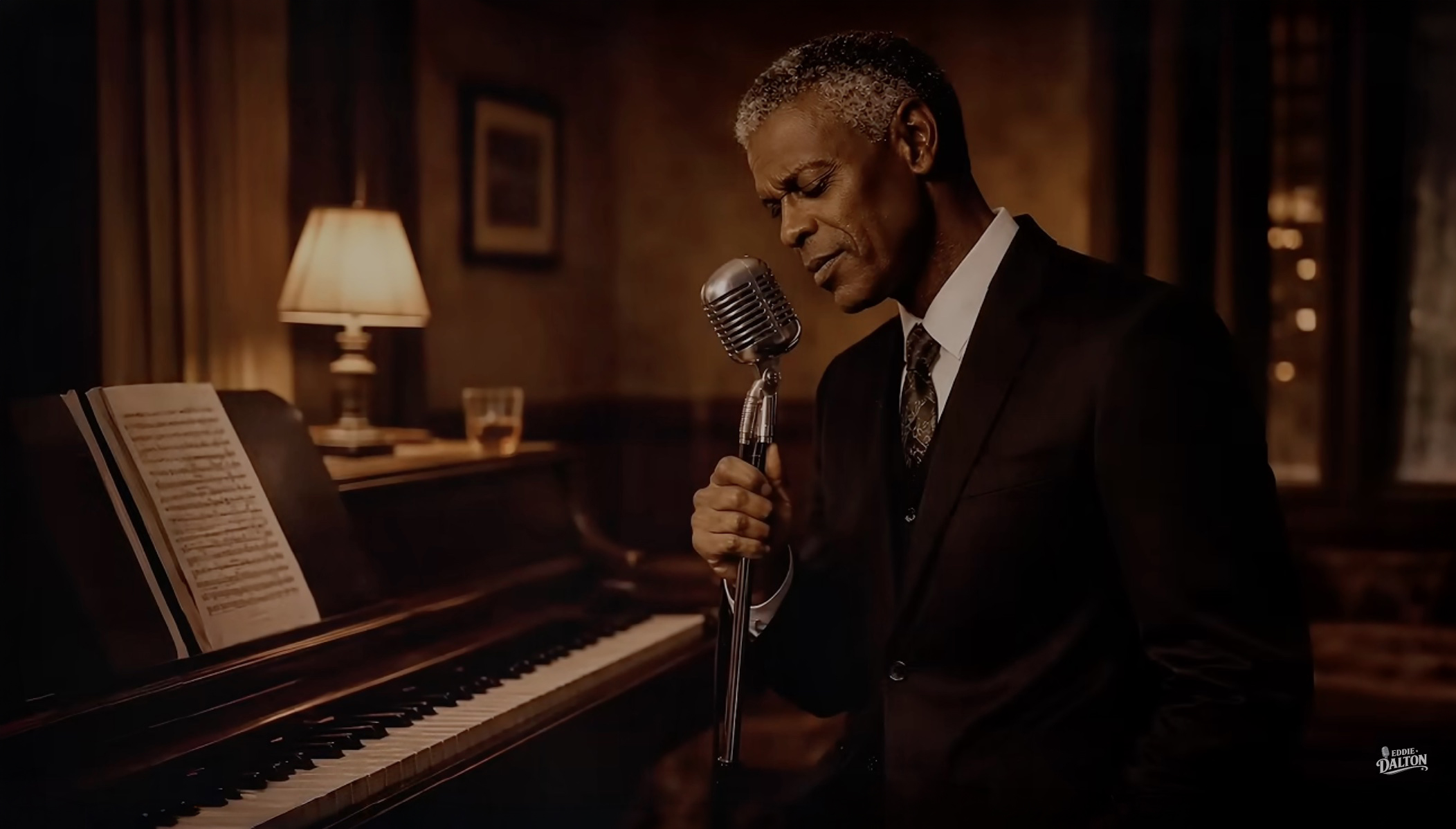 Eddie Dalton, the artist who doesn’t exist.
I. A chance discovery
It began the way everything begins these days: without my having looked for it. YouTube had suggested a video, no doubt because I’d spent a few evenings replaying Midnight Train to Georgia by Gladys Knight & the Pips, or It’ll Never Happen Again by Lady Blackbird — two tracks that share that same vein of lived-in soul, of voices carrying a whole life in a single breath. The algorithm had done its work in the most banal way possible: it had spotted a pattern in my listening and handed me something cut from the same cloth.
That something was called Somewhere Along the Way, sung by a certain Eddie Dalton. I checked nothing, looked nothing up. I just listened. A gravelly voice, a melody that rises gently, lyrics about time that has slipped away before we had the chance to watch it pass, about that day when you discover the man in the mirror has taken the place of someone else — the one you used to be yourself, not so long ago. A song, in short, about exactly what I’m living through right now: seventy-two years old, a parenthesis in Hua Hin between two lives, possibilities not yet decided, and this strange sensation that the years accelerated precisely when I would have wanted to slow them down.
The emotion was immediate and sincere. I thought of Aznavour’s Hier encore, of that almost brutal shock at the gap between yesterday’s carefree ease and today’s clear-eyed awareness. I thought too of Il n’y a plus d’après, that Guy Béart song which Juliette Gréco carried with such particular gravity — that way of inhabiting a moment while already knowing it will never come again. Eddie Dalton’s song stood somewhere between the two: the same bitter observation, but with, in the bridge, a kind of peace, an acceptance of the road travelled without regret over the choices made.
It was only afterwards, looking a little more closely — the slightly too-smooth quality of the image, the total absence of any public presence for this man outside his videos — that doubt set in. Eddie Dalton does not exist.
II. The investigation: a factory of artists who don’t exist
The facts, once you start digging, are quite dizzying. Eddie Dalton is said to be an entirely artificial creation: voice, face, biography, all supposedly generated by artificial intelligence. The name that keeps coming up in several pieces of American press investigation (Showbiz411, Newsweek, the Washington Times) is Dallas Ray Little, operating out of South Carolina via a label called Crunchy Records — a genuine factory of musical characters, since other similar “artists” (a country singer, other pseudonyms) appear to come off the same production line.
The numbers, for their part, are not artificial at all. As I write these lines, the official YouTube channel shows 165,000 subscribers and more than 5.6 million views for Somewhere Along the Way alone, published on 8 April 2026. On Spotify, the profile claims 552,669 monthly listeners — a level of reach that many career artists would envy. The track Another Day Old tops 9 million plays on its own. In spring 2026, “Eddie Dalton” even hit number one on iTunes in several countries.
What’s most unsettling, digging a bit further, are the official credits displayed on Spotify itself: Eddie Dalton is credited as “Main Artist, Electric Guitar,” and Dallas Little as “Composer, Lyricist, Executive [Producer].” The platform therefore documents, in black and white, the existence of a real human author behind a performer who, himself, is not real — with nothing, nowhere on the page, disclosing to the public the artificial nature of the singer. Unlike Deezer, which now requires labelling of AI-generated content, neither Spotify, nor Apple Music, nor YouTube demand this kind of transparency.
It’s worth staying honest, too, about the limits of what we actually know. That the character and his image are manufactured seems solidly established by several converging sources. That the voice itself is entirely synthetic, on the other hand, rests largely on an initial investigation by a single outlet, picked up in a chain by the others rather than independently verified. I don’t have absolute technical certainty — and I’m wary of claiming more than the facts allow.
What is beyond doubt, in any case, is the scale of the phenomenon and the almost total absence of safeguards. Guitar tutorials circulate teaching people to play the chords of a song signed by a man who never existed. Listeners, in the comments, say the song “touched them to the depths of their soul.” My own parents, any witness to this story could have written, became fans without ever asking the question.
III. What this says about emotion itself
What remains, the question that genuinely interests me beyond the technological curiosity, is this: can an artificial, or semi-artificial, creation produce real emotion? And does knowing its origin — human or synthetic — change anything about that emotion?
On the first point, my own experience seems to me to offer a fairly clear answer, and it’s precisely because it followed the wrong order that I find it convincing. I didn’t try to find out who was singing before letting myself be moved — I was moved first, and doubt only came afterwards, on a second reading. It’s almost an accidental blind test. If the emotion had depended on prior knowledge of the artist’s authenticity, it simply wouldn’t have happened this way. It happened because the lyrics rang true, because the melody carried the message, because the theme — that moment when you discover the weight of time passed — is one of those that don’t need a certified lived experience to resonate. An artificial intelligence trained on thousands of songs in this register has, statistically, every chance of landing on combinations that work, much as it would rediscover the recurring patterns of a pictorial style or a narrative structure.
The second point is more subtle, and I think one must resist the temptation to settle it too quickly. Knowing, after the fact, that the voice that moved me belongs to no one does not rewrite the emotion already lived — the past doesn’t let itself be erased that easily. But it surely changes what comes after: the second listen is no longer quite the same. You start watching for artefacts, looking for the flaw in the texture of the voice, wondering whether that vibrato is a choice or a calculation. Knowledge introduces an extra layer of awareness that overlays the initial immediacy, without cancelling it.
There’s perhaps a distinction to be drawn here between two quite different ways of loving a song. The first seeks above all an effect — an emotion, a resonance, a moment of sonic grace — and for it, the question of origin matters rather little: the result justifies itself. The second seeks an encounter with a singular human consciousness, with a lived experience one senses behind every word — for it, learning that the voice is a fiction profoundly changes the nature of what one thought one was receiving, even though the sound itself remains rigorously identical.
What this story concretely changes, then, is not the intrinsic value of the work — a good melody remains a good melody, lyrics that ring true keep ringing true. What it changes is the possibility of choosing, knowingly, which of these two experiences one is actually living. And perhaps that’s where the real problem lies: not in the fact that a machine can produce emotion — it evidently can, and very well — but in the organised silence around its origin. Hundreds of thousands of people, like me, listen to Eddie Dalton believing they’re listening to a man. Maybe it isn’t artificial intelligence that’s the problem here, but the absence of the simple disclosure that would let each person know what they’re actually receiving.
Well, while all that gets sorted out — and while sorting out, above all, what this Thai parenthesis will have been once it closes — the day has gone by. Here I am too, “another day old.”