Electricity prices: where do things stand two years on?
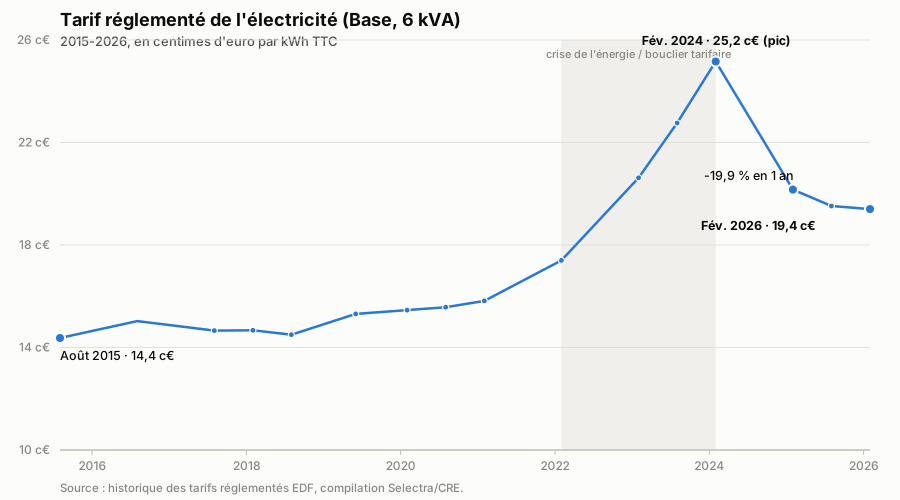 Regulated electricity tariff (Base, 6 kVA), 2015-2026.
I was wrong — well, half wrong. In April 2024, I bet that tax increases would cancel out the theoretical drop in electricity prices announced by Transitions & Energies. The article was clear on this point: the supply component of the regulated tariff was mechanically set to fall in 2024 (2022, the year of the price spike, dropping out of the rolling 24-month calculation), “unless taxes go up.”
Two years on, the numbers say I was right on one point and wrong on the essential one. Taxes did go up as expected — the excise duty returned to its pre-crisis level in February 2025. But the regulated tariff fell anyway, and not by a little: about 15% in February 2025, then another 3% in August 2025, before stabilising in 2026 (a slight increase of about 1% expected in August, tied to the TURPE, the grid transmission tariff).
The tax increase did happen, then, but it was largely offset by a drop in wholesale prices I hadn’t anticipated. And contrary to the easy intuition, this isn’t primarily a story about solar and wind. The main factor, for France, is the nuclear rebound: the fleet had hit its historic low in 2022 (stress corrosion cracking), which is precisely what had driven the price spike that year. EDF has since rebuilt its availability — 371 TWh produced in 2025, with the Flamanville EPR also coming online in late 2024 — which correspondingly reduces reliance on gas plants, the most expensive and the ones that often set the marginal price. On top of that, there’s the lasting easing of gas prices in Europe, and finally, as a supporting factor only, the growth of solar, wind and hydropower.
A lesson in humility about energy predictions: I had read the article carefully and correctly anticipated the tax risk, but I underestimated a far heavier factor — the French nuclear fleet’s ability to return to normal.
Since we’re on the subject, a word on the TURPE — it’s probably the real indicator to watch for the coming years, more than the wholesale price. The TURPE is the tariff that RTE (transmission) and Enedis (distribution) charge for delivering electricity, independent of its production price. It already accounts for about a quarter of the bill, and its dynamic runs opposite to that of supply: the wholesale price can fall when the market eases, but the TURPE only tracks grid investment, decided by the CRE every four years.
And this undertaking looks set to be massive: RTE and Enedis together plan close to €200bn in investment by 2040 — connecting renewables, electrifying usage, renewing an ageing network — with an annual pace that must triple by 2030. In the short term (2026-2028), the increase remains contained, though, roughly in line with inflation (+1 to +2% a year), because these investments are amortised over several decades rather than passed on all at once. The real unknown, then, isn’t so much the amount invested as the pace of electrification: the more that uses (electric cars, heat pumps) scale up as planned, the more the network’s cost is spread across more kWh consumed. If they fall behind — as the mild winter of 2025 showed, which cost Enedis €231.6m in lost revenue — then the price per kWh has to climb faster to compensate. Worth watching, then, on the grid side rather than the gas side.
One caveat to this reading, though: the drop in the regulated tariff masks a wholesale volatility that is, itself, exploding. According to ACER (the European energy regulator), intraday price swings today are about five times larger than in 2020 — the famous midday “solar bell,” which crushes prices when photovoltaic output floods in, followed by a sharp rebound in the evening when it fades and demand, for its part, doesn’t. This isn’t a contradiction of what I wrote above — it’s an annual average that’s falling, not a volatility that’s disappearing — but it has a cost you don’t see in the regulated tariff: forced modulation of the nuclear fleet, which wasn’t really designed for that, and whose premature wear an internal EDF report (made public in February, then watered down at the government’s request) is said to already document. Worth watching, then, alongside the TURPE: not the average price level, but its stability.
For a sense of scale (and this is very much a personal extrapolation, not a CRE forecast — nothing is published beyond 2028), here’s what the TURPE component alone of my current tariff (4.81 c€/kWh out of 19.40 c€/kWh in February 2026) would give by extending the known trajectory and then the announced investment pace:
| Deadline | Assumption | TURPE (c€/kWh) |
|---|---|---|
| August 2026 | +3.04% (already decided) | 4.96 |
| August 2027 | +1.5% (close to inflation) | 5.03 |
| August 2028 | +1.5% (end of TURPE 7) | 5.11 |
| August 2029 | +3% (start of TURPE 8, investment peak) | 5.26 |
| August 2030 | +3% (investment peak sustained) | 5.42 |
That’s roughly +13% on the TURPE alone over five years. Holding the rest of the bill (supply, taxes) at its current level — a simplification, since those will move too — that would bring the total tariff from 19.40 to about 20.0-20.6 c€/kWh by 2031: a rise of +3 to +6% over five years, entirely due to the grid. Moderate, then, even with a €200bn undertaking under way: post-ARENH nuclear and gas will remain far more decisive factors than the grid for the real price trajectory.
Source: La jungle des prix de l’électricité, Transitions & Energies, April 2024. Additional source: Le solaire crée le chaos sur le marché de l’électricité en Europe, Transitions & Energies, 17 July 2026.