End-of-life law: a debate that touches us all
15 July 2026 — the National Assembly gives final approval to the bill creating a right to assisted dying. On 14 August, the Constitutional Council declares it consistent with the Constitution.
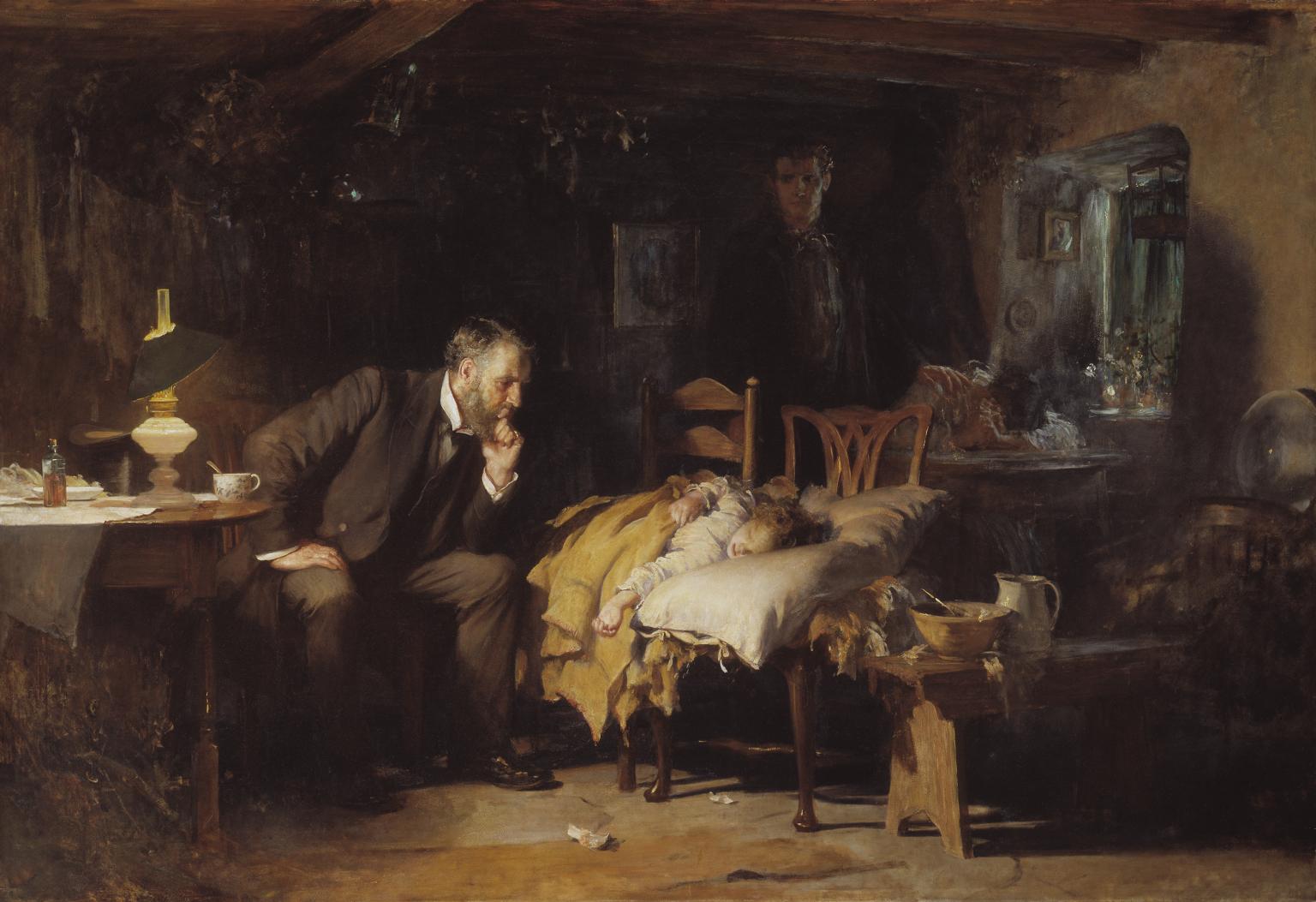 The Doctor, Sir Luke Fildes, 1891 — Tate Britain, London (public domain)
This text, born of a citizens’ convention and carried for four years by MP Olivier Falorni, closes a legislative process begun in 2022. It creates a right to assisted dying, accessible under conditions to certain patients suffering from a serious, incurable condition, with self-administration of the product remaining the rule — a caregiver may only step in if the patient is physically unable to do so themselves.
The result of public vote no. 8280 (final reading) is strikingly clear: the law passes because the left voted massively in favour, joined by the majority of the centre, while the right and the National Rally voted against — the handful of internal splits within groups remain anecdotal:
| Group | For | Against | Abstention |
|---|---|---|---|
| Rassemblement National | 12 | 106 | 4 |
| Ensemble pour la République | 64 | 18 | 9 |
| LFI-NFP | 61 | 2 | 3 |
| Socialistes et apparentés | 57 | 4 | 6 |
| Droite Républicaine (LR) | 5 | 41 | 2 |
| Écologiste et Social | 33 | 2 | 1 |
| Les Démocrates (MoDem) | 20 | 16 | 0 |
| Horizons & Indépendants | 16 | 18 | 1 |
| Others (LIOT, GDR, Ciotti’s UDR, non-attached) | 23 | 34 | 3 |
| Total | 291 | 241 | 29 |
Source: National Assembly, public vote no. 8280 of 15 July 2026. The “Others” line aggregates the smaller groups and non-attached members, whose detail isn’t published separately; it is calculated by difference from the official totals.
This is a subject I’ve thought about for a long time, and the same-day publication of a Michel Houellebecq op-ed in Le Figaro gave me the occasion to test my own arguments against his — and against those of the bill’s supporters.
Houellebecq’s argument: dignity turned against itself
Houellebecq frames his opposition within a civilisational context: for him, legalising euthanasia is one symptom among others of a broader decline of the West. But his strongest argument, independent of that framing, concerns the word “dignity” itself. He observes that the discourse of euthanasia’s supporters implicitly ties human dignity to the capacity to act, to communicate, to interact with others — thereby reducing the human being to their use value. He opposes this with the Kantian view that a human being must always be treated as an end, never merely as a means, and points out that a state of profound physical dependence has historically never been enough to strip someone of their dignity — it is, on the contrary, that very dignity that is amputated when a person is judged solely on their capacity to communicate.
This is a serious philosophical argument. But it bears above all on the aestheticisation of euthanasia in public discourse — advertising campaigns, the vocabulary of choice and serenity — more than on the precise criteria of the legal mechanism actually voted into law.
I’ve seen many statements in the press, and the word care comes up often, with interpretations that are nearly opposite, even irreconcilable. The sharpest disagreement is precisely over this word.
On one side, fulfilling someone’s wish would itself be a form of care, so euthanasia would be care. On the other, it’s the opposite: the old Claeys-Leonetti law had the merit of never presenting “the right to kill” as care, and this semantic slide would amount to dressing up in kindness what remains an act of putting someone to death. It’s on this second point, though, that this position touches a truer chord — and one that connects directly to what I try to say further on about the word we don’t dare speak. Supporters of the text are criticised for invoking Seneca and the Stoics, when Seneca spoke of everyone’s right to dispose of their own life — not of bringing in a third party to give it. “It’s the assistance that’s the problem, the call on a third party,” one reads, “never the personal decision to take one’s own life.” That’s exactly the distinction I make myself: no one seriously disputes each person’s right to dispose of their own death; what changes in nature is the moment that right becomes a service administered by someone else.
The supporters’ argument: a response to a real-world inequality
The bill’s defenders, including Green MP Danielle Simonnet, present the law as the culmination of nearly half a century of campaigning, dating back to the first bill introduced in 1978. Their central argument is twofold:
- The current framework (Claeys-Leonetti law, deep sedation) doesn’t cover all situations of incurable suffering for conscious patients who aren’t at the very end of life.
- Without a law, the practice already exists, unequally: those with the means or the connections go to Belgium or Switzerland to be euthanised (110 French citizens did so in Belgium in 2025), while others are left with nothing.
For them, a strict legal framework — a voluntary, considered and repeated request, a serious and incurable condition — protects vulnerable patients better than a legal void resting on the individual courage of a doctor or a relative.
What the law actually covers: well beyond deep sedation
One point the public debate has done little to clarify: the precise eligibility criteria set out in the final text. One must be an adult, capable of expressing a free and informed will, suffering from a serious and incurable condition that threatens life — and be either in a terminal phase, or at an “advanced” stage, defined as “an irreversible process marked by a worsening of health that affects quality of life,” with no requirement to estimate how long before death. Suffering must be physical and unresponsive to available treatment (or judged unbearable if treatment is refused); psychological suffering alone is not enough.
This point shifts the focus of the debate. Continuous deep sedation until death (SPCMD), permitted since the 2016 Claeys-Leonetti law, only applied to patients in a terminal phase — those whose dying process had already begun. Some already saw a grey zone there: triggered early and combined with the withdrawal of hydration, it could function as a slow-motion euthanasia, dressed in the stated intention of relieving suffering. The 2026 law doesn’t close that grey zone by clarifying it — it goes well beyond it by adding the “advanced” stage, which assumes no imminent death at all: a patient with ALS or a progressive cancer, still far from the terminal phase but whose condition is irreversibly deteriorating, is now eligible.
The Constitutional Council censored nothing
Five referrals were waiting for it, including one from the Prime Minister and one from the President of the Senate. On 14 August, the Council declared the law entirely constitutional: not one article struck down, not one line to rewrite. The objections based on human dignity and on the principle of fraternity were dismissed, and the eligibility criteria judged precise enough.
Three interpretive reservations come with the decision, none of them requiring any change to the text. A private establishment may refuse to have the procedure take place on its premises, but only “when other establishments are in a position to meet local needs” — the wording is lifted word for word from what already exists for abortion. The pharmacist tasked with preparing or dispensing the lethal product may invoke a conscience clause, which the law had forgotten to grant them. And the doctor ruling on the request of a protected adult must gather the observations of their legal guardian, without being bound to follow them.
The word Houellebecq was disputing with the law’s supporters, the decision hands to them without discussion: the legislature, the Council writes, intended to guarantee “personal liberty and the right of every person to a dignified end of life.”
The reservation on pharmacists says something about the text itself. In four years of parliamentary shuttling, nobody had asked who would prepare the product. The one on protected adults answers the Prime Minister’s concern — the law only rules out people whose judgement is “severely impaired” — with an opinion that binds no one.
The third was welcomed as a victory for charitable and faith-based homes. Yet it only holds where the local care supply is sufficient: an establishment standing alone in its département, with no neighbouring structure to take over, will have no admissible grounds for refusing. The Council does not put it that way; it is what its condition implies.
Nothing will change straight away. Promulgation follows the decision by a few days, but the Health Ministry has six months to publish the implementing decrees, and the minister’s office is already saying the law will not be applicable before early 2027.
Source: Conseil constitutionnel, decision no. 2026-910 DC of 14 August 2026.
A useful law? What the French numbers say
Before talking principles, we need to look at the numbers on how end of life is actually handled in France today — and they raise a real question about the priority the legislature has set for itself.
France counts around 600,000 deaths a year, a number expected to reach 770,000 by 2050 as the population ages. Yet between 61% and 79% of people who die would have needed palliative care — and only 12.19% of French people actually die in a Palliative Care Unit or an Identified Palliative Care Bed. The figure comes from the ADMD itself, the campaigning association for euthanasia: it can hardly be suspected of painting palliative provision blacker than it is. The country has 180 palliative care units for the whole territory, and fifteen départements still have none at all. Provision is growing — nine more units than in 2021 — but slowly, and very unevenly across regions.
In other words: the overwhelming majority of French people at the end of life don’t die badly because the law forbids them euthanasia — they die badly, or in unmanaged conditions, because the palliative care they’ve been entitled to since the 1999 law simply isn’t accessible to them. It’s this 30-to-40-point gap between need and actual access that constitutes the real public-health emergency — not the absence of a right to die. Spending four years of parliamentary debate and the political energy we’ve all witnessed on a mechanism that, in Belgium after twenty years, still accounts for only 4% of deaths, rather than on closing this gap that potentially concerns seven French people out of ten, strikes me as the wrong order of priorities.
The weight placed on caregivers
An aspect the public debate touches on little: what this law asks, in concrete terms, of those who will have to administer or supervise the lethal dose.
In Belgium, a doctor’s individual conscience clause has existed since 2002, but it has gradually weakened: as early as 2017, the Belgian Order of Physicians introduced a professional obligation to refer the patient to a colleague or a facility willing to perform euthanasia — which, for many reluctant practitioners, amounts to becoming, against their will, a link in the procedure. Belgian specialists now observe that while the individual conscience clause survives on paper, implicit pressure is exerted within care teams, with some doctors lamenting that it’s always the same ones who take on what they themselves call “the dirty work.”
The testimonies of doctors who have practised euthanasia for years, gathered by the press, are revealing despite themselves: those who agree to describe the act almost all stress its considerable emotional weight, describing scenes where they cry with the family, where the technical gesture comes bundled with an emotional commitment that marks them for a long time. It’s no accident that this experience is systematically presented as proof of the caregiver’s humanity — it is also, seen differently, the sign that general practitioners or hospital doctors, trained to heal and relieve, are being asked to take on a radically different role: that of an agent executing an administrative right. That this burden weighs on caregivers over the long term, year after year, case after case, is a human cost the French law doesn’t measure, and that the parliamentary debate barely addressed.
On the word we don’t dare speak
I know the word is strong, and that it will shock some readers: what this law organises, in my view, amounts to assisted killing — a homicide made lawful by the victim’s consent and the procedural dressing of a medical and administrative framework. I recognise the legal and moral distinction the text’s supporters draw against this word: the intent is not to harm, the request is voluntary and repeated, the act is a gesture of compassion rather than aggression. I don’t dispute the sincerity of that intent. But the material fact remains the same: a third party — doctor, nurse, institution — administers or makes possible the death of a human being. That consent transforms the moral nature of the act to the point of entirely erasing the word that would describe it in any other circumstance is precisely what I am not convinced of.
My own objections
I don’t ground my opposition in the sacred — I’m an atheist. What troubles me is what this law transfers: the power to give death, taken from a small circle (family, doctor, loved ones) and handed to a system.
On non-reproducibility. A tacit agreement within a small circle has a virtue that’s wrongly held against it: it isn’t a system. Each situation is judged on its own, with no binding precedent, no statistic to justify it. A system, by contrast, works the other way: it codifies, produces case law, and each validated case becomes the argument for the next, a little broader each time.
The Belgian figures confirm this: euthanasia accounted for a little under 2% of deaths in 2015; it accounts for 4% in 2025, with a 51% increase in just three years. Cases linked to “multiple pathologies” — associated with simple ageing — are exploding, and a third of requests now concern people whose death wasn’t expected in the near term.
The same mechanism has played out on who is eligible, not just on the medical criteria: the 2002 Belgian law only covered adults; its 2014 extension removed any age limit for minors, making Belgium the only country in the world to allow the euthanasia of a child with no age condition. Seven minors have been euthanised since then, one of them in 2025 — and the debate isn’t closed: in an opinion adopted unanimously on 10 November 2025, the Belgian bioethics committee proposes an “extended advance directive” that would open euthanasia to people who are conscious but have become unable to decide for themselves. The Chamber took up the file in July 2026.
This isn’t an accidental slippage: it’s the natural mechanics of any administration handling cases in series. And this ratchet didn’t even wait for the French law to be put into practice before turning once: as I noted above, the 2026 text already goes beyond the scope of continuous deep sedation by covering the “advanced” stage and not just the terminal phase. The system widened its target before the first concrete case.
On inequality. The supporters’ argument rests on an inequality of access that should be corrected. But we are unequal from birth — that’s a fact built into life itself, not an injustice the law can repair. Wanting to erase that inequality through an egalitarian system amounts, I believe, to denying a reality that is part and parcel of human existence.
On giving up and offloading responsibility. This is my deepest objection. Deciding the end of a loved one’s life is a weight one must carry oneself, in one’s own conscience — not delegate to a committee that dilutes responsibility into a protocol. Handing over to a system what used to be an intimate, owned dilemma is to shrink from one of the most human trials there is.
I must, however, acknowledge the limit of this position. What relatives who’ve lived through this from the inside report is a very concrete feeling of powerlessness and abandonment: they witness a loved one’s request to die with no way to answer it. The small circle I defend offers, outside of an informal and clandestine arrangement with an understanding doctor — unequal by nature, since it depends on the luck of who you happen to know — no real answer to this distress. All that’s left, then, is the hope of a brief dying process, and the quality, very uneven across France, of the palliative care available. I don’t claim the law solves this problem better — it shifts it, it doesn’t erase it — but I must admit that my opposition leaves open a question to which I have no fully satisfying answer.
On the argument from numbers. I may be told that a majority of French people support this text. But the cited polls vary considerably depending on who commissions them and what words they use: 87% according to an IFOP poll commissioned by ADMD, the historic pro-euthanasia advocacy group, whose question already framed assisted dying as a “regulated choice”; only 59% according to an earlier IFOP poll, less invested in the debate, and less than half among 18-35-year-olds. The mere choice of word — “euthanasia,” “assisted suicide” or “aid in dying” — is enough to shift the result by several dozen points, which alone should invite caution before brandishing a figure.
But even granting, hypothetically, a genuinely massive and honestly measured level of support — even at 80% — I don’t see what that would change about the substance of the problem. That a majority, however large, approves of giving someone death does not make that act more just; it only makes it more consensual. The number legitimises a democratic procedure; it doesn’t settle a moral question.
A personal experience
I’m not writing on this subject as a mere observer. My first wife, Jacqueline, died at 40 of metastatic cancer, after seven years of struggle and alternating hope. I was at the hospital for her last breath. Her final words were for me: “my poor darling” — until the very end, in exhaustion and pain, she was still thinking of the man who would have to raise our two children alone.
During those final days, my only fear wasn’t the suffering that was coming, nor the question of ending it sooner. My only fear was being absent at the moment she needed me. Assisted dying, shortening the process, controlling the moment: none of that crossed my mind, nor, I believe, hers. What mattered was presence. I cried, yes, at the foot of her bed, in silence, while the care staff worked around her, crying too.
I don’t claim my experience holds universally — other patients, other dying processes, involve suffering I never knew with Jacqueline, and I’m careful not to judge those who, in a different situation, would have made a different choice. But I know that what mattered, in those days, wasn’t a right to control the moment of death. It was being there, until the last breath, and receiving that last word as the gift it was. A law doesn’t replace that. It can’t even take it into account.
A nuance I don’t want to dodge
While writing the above, an objection occurred to me, and it would be dishonest not to mention it. My experience with Jacqueline could just as easily be turned into an argument in favour of the law. In a long, unpredictable illness, relatives can’t keep watch indefinitely: they have to sleep, step away, catch their breath. My fear of not being there for those final moments was rooted precisely in that uncertainty. A planned mechanism, by contrast, guarantees that no one will be caught off guard: the family knows when, they can organise, be all present. On this specific point, I have to admit the law would answer something real.
But this leads me to an even more unsettling question: is this relief of guaranteed presence for the patient, or for the relatives? In a prolonged dying process, the patient most often loses consciousness well before the end — at that stage, they no longer feel the anguish of uncertainty weighing on those around them. Planning death to soothe the fear of the living then amounts to organising the mechanism around the psychological comfort of the survivors, rather than around the dying person themselves. And that may be, by a path I hadn’t anticipated when I started writing, another way of arriving back at my original objection: a system, whatever it is — family or administrative — always tends to reorganise itself around its own need for predictability, rather than around the person it’s supposed to serve.
I won’t settle it. Leaving the question open seems more honest to me than too neat a conclusion.