Getting Insured at 72 in Thailand
 Waiting room at Bangkok Hospital, Hua Hin
In June I started looking for private health cover. We arrived in Hua Hin on 11 May, on a one-year retirement visa, with CFE membership in place and a travel policy running until May 2027. What was missing was the layer above, the one that pays what the CFE does not.
Seven hospital visits since we arrived. Either we really are getting old, or it has picked up speed out here. Paid directly every time, without ever having to make a claim.
In expatriate groups you read everything and its opposite. Some say they found Thai cover for next to nothing. Others complain about a hospital bill or a premium that has doubled. And some are shown a pre-existing condition clause at the moment of paying. All three are telling the truth. Everything depends on how old you were when you signed.
Hospitals are modern and clean, a consultation costs 30 euros, all of that is accurate. It says nothing about the day you are admitted to hospital, and nothing at all when you are 72.
We are 72 and 73. I made seven approaches in three months. Two refusals on age without anyone opening our files, one refusal with no reason given, two silences, and one door left open that I did not walk through. The seventh went through, with a premium loading, and with no exclusions at all.
What follows is that file, with the dates, the amounts and the exact wording. Sources are listed at the bottom of the page. I read the policy terms rather than the sales brochures, which is not the same exercise. Chasing insurers and brokers, going through the answers, is a proper job. Just as well I am on holiday! I keep forgetting to go and look at the birds…
I have no connection with any of the companies named here, and I recommend no contract. The question was worth following to the end: at 72, can you still get insured.
The wall
I started with April International, the first name that comes up when you look for French expatriate cover. Both refused, immediately, with no medical questionnaire. The reason is an age limit of 64. Nobody looked at our files.
Then Mondassur, a French broker specialising in expatriation. I asked about their Gold Expat Nomad plan, capped at 300,000 euros per person per year. Their answer on 15 June: “not available beyond the age of 70 at the date of subscription”. Again, no medical file requested.
Owello, which distributes a Malakoff Humanis package designed to top up the CFE, did assess the file. I was accepted, my wife was refused. The refusal came as a two-line email, with no reason given. We assumed it was her medical history, but the insurer never wrote anything of the sort, so there is nothing to contest. You cannot argue with a refusal that says nothing.
Henner Expat Duo never answered my enquiry. Neither did MSH International, despite a follow-up.
That left the local market. AA Insurance, in Hua Hin, works with Thai insurers. The broker sent me a comparison of four plans open to our ages on 16 June, and offered to file an application in January. We never went back to him.
| Insurer or broker | Outcome | Reason given |
|---|---|---|
| April International | both refused | age limit of 64 |
| Mondassur — Gold Expat Nomad | both refused | not available beyond 70 |
| Owello / Malakoff Humanis | him accepted, her refused | none |
| Henner Expat Duo | silence | — |
| MSH International | silence | — |
| AA Insurance, Hua Hin | application possible, never filed | deferred to January, never started |
Of the six approaches before the last one, only a single medical file was actually assessed, at Owello. That is what surprised me. I expected to be judged on the hypertension, on the glaucoma, on the knee replacements. Most doors close on a date of birth, before a doctor has seen anything at all.
One lead remained, and it was the company that had already turned us down.
The crack
On 18 June, Mondassur offered something else. Not the Gold Expat Nomad, but a plan called GoldVisa Safe CFE, designed to sit on top of the CFE and capped at 100,000 euros per person per year. Two named quotations, 2,064 euros per person per year, with both our dates of birth on the first line.
I downloaded the policy terms before replying. It is a group contract taken out by an association with Groupama Gan Vie, number 210/655482. Article 14.1 states that membership is reserved for anyone “aged 18 or over and under 70”. A few lines further down, article 14.4 states that registering a spouse “aged 70 or over is not admissible”.
So the product offered to replace the one I had just been refused carried the same age limit, this time written into the contract itself. We were both ineligible, and my wife twice over.
I wrote on 30 July to ask whether a waiver existed, or whether the quotations had been issued in error. I preferred to know before committing to a health declaration and a premium.
The answer came on 11 August:
a waiver is indeed in place from the insurer allowing Mondassur to offer this GOLD VISA SAFE, either first-euro or as a CFE top-up, for people over 70 and under 75 at the date of subscription
So the door exists, between 70 and 75, and it is written down nowhere. A 71-year-old who downloads the policy terms and reads article 14 concludes that it is closed, and he is wrong. A broker has to ask for it.
The same message said that the policy terms were being updated. On 17 August, when I signed the membership application, the terms attached were still the December 2020 version, article 14.1 intact.
I am not an isolated case. A reader wrote to tell me he had taken out the CFE and this same contract in early 2025, at 71, with a basic medical questionnaire and a blood test. The waiver does not date from this summer.
Another writes that at 75 he has the CFE chained to a Humanis top-up, for around 500 euros a month, and has never had a reimbursement problem. He does not say at what age he took it out, and that is the whole question.
The verdict
I signed the membership application on 17 August, for both of us, with the health questionnaires filled in completely. Hypertension treated since 2005 and moved to dual therapy in April 2025, an inguinal hernia repaired in 2018, a normal endoscopy in 2023 for me. For my wife, mixed glaucoma operated on in 2007 and stable on eye drops, two knee replacements fitted in 2017 and 2021, a damaged lumbar spine at L5-S1, osteoarthritis in the feet.
The medical officer’s answer came on 20 August. Both accepted, with a premium loading of 15% for me and 30% for my wife. No exclusions.
That last point is what matters. A loading raises the price, an exclusion removes part of the body from the contract. We were accepted with all of our medical histories covered. I asked for written confirmation, and the answer fits in one line: “that is indeed the only specific condition recorded”.
In practice that comes to 162 euros a month for me and 182 for my wife, 4,128 euros a year for the two of us. The loading applies only to the health premium, not to the repatriation assistance and liability options, and the figures confirm it to the cent.
The gap with what came before is worth measuring. My wife had been refused by April without assessment, and by Owello with no reason given. The same file, assessed by a medical officer, produces an acceptance at 30% more.
Her health did not change between June and August. What changed is that an insurer finally looked.
What the contract actually covers
The quotation says at the top of the page, in bold: hospitalisation 100%, direct settlement, ceiling of 100,000 euros per year per person. That is accurate and it does not say much. What limits you are the per-item limits, and they are in the policy terms rather than on the quotation.
| Item | Limit |
|---|---|
| Surgeons’ fees and surgical procedures | 6,000 € per hospitalisation |
| Room and board, standard care | 140 € per day |
| Room and board, intensive care | 280 € per day |
| Imaging, laboratory, drugs in hospital | 1,400 € per hospitalisation |
| Outpatient consultation and treatment | 170 € per procedure |
| Routine care | 2,000 € per year, reimbursed at 90% |
| Dental and optical | not covered |
One sentence in the policy terms changes how that table reads. Actual costs are understood “after deduction of the reimbursement by the basic social security scheme”. The CFE pays first, GoldVisa tops up what is left, within those limits.
An example. Surgery with five days in hospital in a private hospital easily comes to 20,000 euros. The CFE reimburses 42% of the actual cost in zone 3, so around 8,400 euros. GoldVisa comes on top and fills in item by item, without exceeding 6,000 euros of surgical fees, 140 euros a day for the room, 1,400 euros of imaging and laboratory work. A few thousand euros are left to pay. With the CFE alone, 11,600 were left.
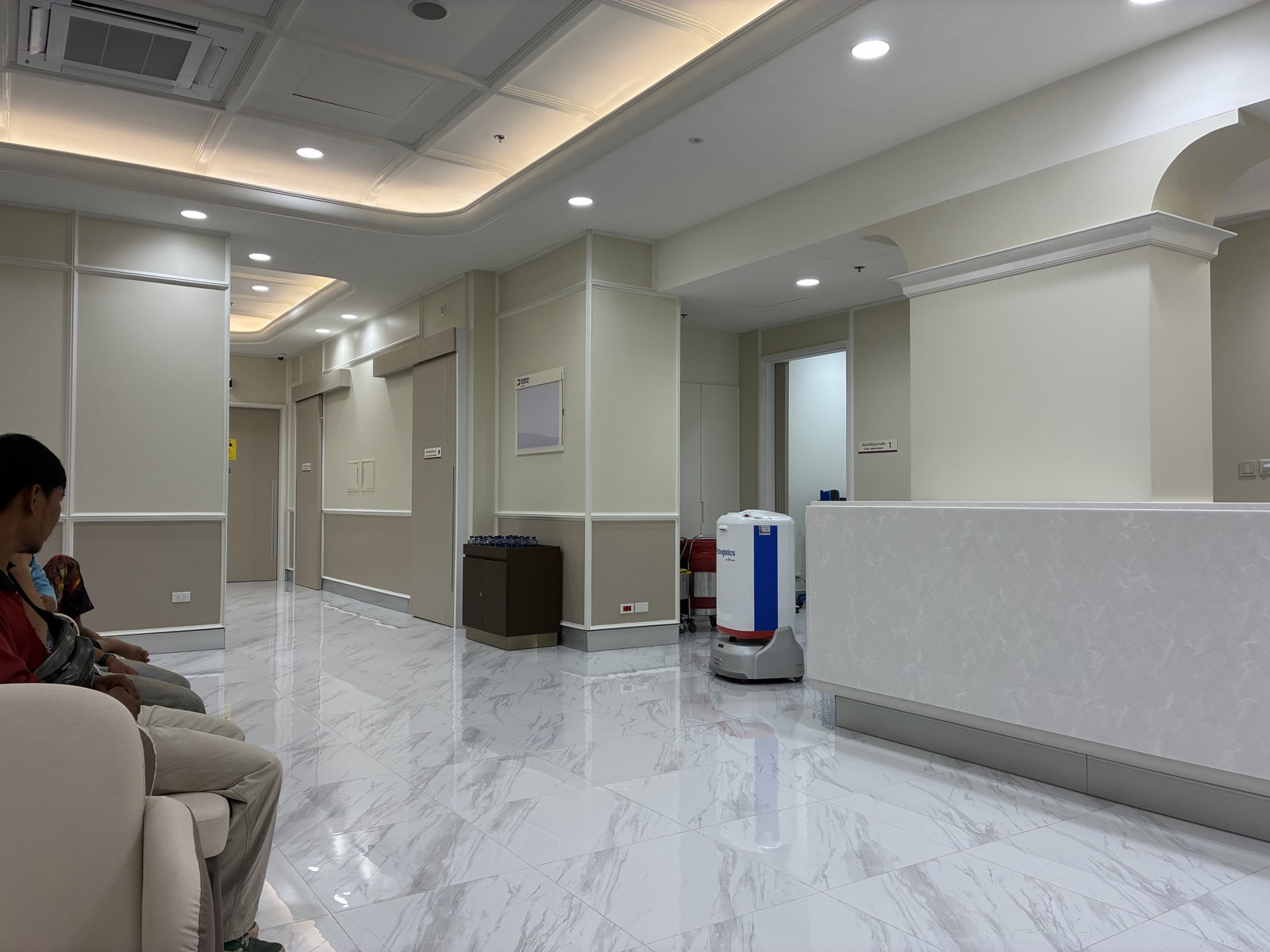 A logistics robot carries files and samples from one department to another, Bangkok Hospital
There is also an administrative trap, which is not in the brochure either. Any hospitalisation of more than 24 hours and any procedure above 1,000 euros require prior approval. Without that approval, cover drops to 70% for hospitalisation and 50% for everything else, even when the procedure was justified and covered.
There is another gap, which I have not measured because we never had to trigger a claim, but which several accounts in expatriate groups describe: between being insured and being paid.
The mechanism keeps coming back. The insurer delegates emergencies to an assistance platform based in France, which decides on the spot whether the file goes through. So you have to reach someone, at night, with a seven-hour time difference, while the hospital waits. A member of a large French mutual insurer describes battling a whole night and a morning to get her husband operated on, his leg shattered in a road accident. Another time, approval given before surgery was withdrawn afterwards: two stents fitted, then a refusal on the grounds of a pre-existing condition, because she had already had a heart attack. Sixteen thousand euros on her own account. Others in the same thread describe full and rapid reimbursements.
I cannot verify these accounts, which is why I name no one. What is verifiable is that the pre-existing condition clause does not only serve to filter applicants at entry. It also serves to refuse a bill years later, on a policy in force.
Two clauses are worth knowing before signing. Membership ends on permanent return to the country of origin, and France is only covered for stays of less than 90 consecutive days. An expatriate who goes home loses the cover, and the quarterly premium already started stays with the insurer.
A word on repatriation, since it is the guarantee everyone assumes they have. The health contract explicitly excludes it from its transport cover. It sits in the assistance contract, sold as an option, and it is not triggered by asking for it: “the decision to repatriate is taken by our medical officer”, and only for care “that cannot be provided locally”. Refusing the solution proposed by their medical team cancels the assistance cover altogether. So you are repatriated if their doctor judges that Thailand cannot treat you. Loss of independence gives no right to repatriation. Repatriation of the body, on the other hand, is covered at actual cost.
Dental and optical are covered nowhere, neither by the private contract nor by the CFE beyond a few euros. The CFE does however cover cataract surgery at 100% up to 1,500 euros per eye, which is not nothing at our age.
That leaves routine care, which we have been paying for directly for ten years without thinking about it. On 19 August I went back to the chiropractor for back pain, too much time sitting at a computer. Manipulation then Thai massage, same practice, same session: 2,700 baht, around 71 euros. Elisabeth comes with me. The masseuse is energetic, she goes for the spots that hurt. I am certain Elisabeth enjoys watching me suffer. She says I ought to be signed off sick.
On 24 August I went to stock up at Boots in Hua Hin: an anti-inflammatory and a stomach protector. Ibuprofen 400, ten capsules, 110 baht. Nexium 20 mg, fourteen tablets, 680 baht. 790 baht in all, around 21 euros. Two bills in five days, a pharmacy chain and a practice: it proves nothing about Thai prices in general. But 92 euros of routine care in five days is not what “healthcare costs nothing here” means. Here you buy the original brand, at full price, without a prescription and without direct billing.
The CFE reimburses pharmacy costs at a rate that depends on the zone. Except that you have to file a claim from Thailand to recover ten euros or so, with a prescription you do not have because it was an over-the-counter purchase. Some people do it. I don’t. So the rate on the schedule is not necessarily the rate you receive.
The consultation works the same way. The schedule announces 21 euros for a GP or a specialist, which reads as a fixed amount. The table of guarantees says otherwise: reimbursement is a flat rate capped by the actual expense, with a 70% rate applied to it. The 21 euros are a ceiling, reached only when the consultation costs 30 euros or more. Below that, you get 70% of what you paid.
The other market
That left the Thai market, which in the end we never approached. I went back to it on paper, and the file the AA broker sent me on 16 June says something I had not noticed at the time.
The document is titled “comparison of all options eligible for your age”. Four plans, priced, for 72 and 73. So age was not the problem. That is the opposite of the French market, where the first two doors closed on a date of birth without anyone opening a file.
| Plan | Ceiling | Annual premium, two people |
|---|---|---|
| Pacific Cross Maxima | 5 million baht per confinement (€132,000) | 319,110 THB (€8,400) |
| Pacific Cross Maxima Plus | 10 million (€263,000) | 356,688 THB (€9,390) |
| Pacific Cross Ultima | 20 million (€526,000) | 407,442 THB (€10,720) |
| AXA International Exclusive Silver | 58 million per year (€1,526,000) | 701,859 THB (€18,470) |
The first comes to roughly the same price as the French arrangement with the CFE. And on a serious hospitalisation it is better: no 6,000-euro cap on surgical fees, oncology and intensive care at actual cost, emergency evacuation included. Five million baht per confinement, with no breakdown by item.
What blocks it is elsewhere, and it is written in their underwriting guidelines. The exclusions do not depend on the medical file, they depend on the age band at entry. From 70, a full physical examination is required, and:
| Item | Treatment from age 70 |
|---|---|
| Eyes | excluded, except accidents |
| Joints and back | not covered for 3 years, then reassessed with a 30% client co-payment |
| Prostate | excluded |
| Skin lesions | not covered for 3 years |
| Dental and optical | no cover |
At 75 and over, those same items become permanent exclusions.
So my wife’s glaucoma and her two knee replacements would have been set aside automatically, purely on the basis of her age, before a doctor opened her file. Groupama accepted her with a 30% loading and excluded nothing.
I asked the broker what he made of it, after the fact. His answer: “I am pretty sure that both of you would have been accepted with exclusions but you did not make an attempt.” So we would probably have been insured, with eyes and back outside the contract.
I put five questions to the broker at the end of August, for this article. He answered the next day. The policy runs to age 99. Renewal happens with no new exclusions, however large the claims. And the age-band exclusions apply “only at entry age, then benefits remain the same, no matter what age”.
That is the important point. The contract does not empty itself as you age, it is fixed at entry. Someone who takes out a policy at 65 keeps eyes and back covered until 99. Someone who takes one out at 70 loses them for good.
Two reservations. Premiums are only published up to age 75, so you commit until 99 on a price nobody shows you beyond that. And after the three-year wait on joints, it is not automatic: “in case of any new joint problems they will consider an exclusion”. The three years are not a waiting period, they are an observation period.
The contract that ticks the box
There is one last contract in the June file.
To obtain an O-A retirement visa, Thai immigration requires health insurance. The amount is public, on the Thai insurers’ association website: 100,000 US dollars for a first application, which comes to three million baht, with Covid treatment included in the wording, which has never been removed since 2021.
In June the broker had offered a plan calibrated exactly on that. Three million baht displayed, around 545 euros a year for two. He described it himself as the cheapest option to obtain the visa, with very low cover. In detail: 200,000 baht per illness, after a 200,000 baht deductible. He added that on that particular contract, if we declared our full medical histories, a refusal was close to certain.
Between the legal minimum displayed and what the contract will pay, the ratio is fifteen to one. You tick the box, you get the visa, and you are not insured.
Alongside it, the O-X visa, which lasts five years and is renewable once, requires only 400,000 baht of inpatient cover. The long visa asks for seven and a half times less than the one-year visa. Both pages are on the same website, one tab apart.
What it costs, depending on what you earn
One last thing, which has nothing to do with insurance and changes the whole calculation.
In France, health protection is paid as a percentage of income. On a pension, CSG, CRDS and CASA come to 9.1% at the full rate, 7.4% at the middle rate, 4.3% at the reduced rate, and nothing at all for the smallest pensions, which are exempt. It is proportional, and for many people it is free. For a couple, the full rate applies above 40,604 euros of reference tax income, the middle rate between 26,168 and 40,604, the reduced rate below that, and exemption under 20,016 euros.
In Thailand, health protection is paid as a flat amount. The CFE costs 1,968 euros a year for a single person, 3,576 for a couple, whatever the income. The top-up at our age, loadings included, adds 4,128 euros for the two of us. The same amount whether the pension is 20,000 or 90,000 euros.
Expatriation removes the CSG, provided you have transferred your tax residence, which is not automatic. Against that you have to pay the flat amount. The two cross at a precise point, around 45,000 euros of gross household pensions if you settle for the CFE, around 89,000 euros if you add the top-up at 72. The first threshold is no accident, it is roughly where a couple moves from the middle rate to the full rate. I am leaving aside a health contribution that may apply to non-residents and that I could not settle; it would push those thresholds higher.
Which gives a result I was not expecting to find. The smaller the pension, the more expatriation costs in social protection. Someone who paid no CSG in France saves nothing by leaving and pays the flat amount in full. Someone who paid 9.1% on 80,000 euros recovers enough to fund it. That is the opposite of what people say, where Thailand is the answer for small pensions that no longer stretch in France.
It needs qualifying, because the CFE has planned for this. Below 24,030 euros of resources there is an assisted category, and the contribution drops to 912 euros a year instead of 1,968. You have to be registered with the consulate and apply through it. That does not change the direction of the calculation, it makes it less brutal. And the help applies only to the basic cover, the top-up stays at full price. A retiree on a small pension who wants real cover pays 912 euros plus around 1,950, for what they had for free.
One clarification to finish. This calculation compares cover, not living standards. Someone who loses 7,000 euros of social protection may well live better in Hua Hin than in Nice, with a rent three times lower. Those are two different questions, and I am only dealing with the first.
The door closes at 75
I did not go ahead. We are moving back to France.
Nothing to do with the price. The climate first, which you take less well at 72 than you imagined on arrival. And the language. I do not speak Thai and I am not going to learn it. Day to day it is no trouble, we manage perfectly well. Over ten years, it means the only people you really talk to are other French speakers.
The policy would have changed nothing there. Membership ends on permanent return to the home country — the clause I flagged earlier is the one that applied to me.
I asked whether the acceptance stayed valid for later. It does not. It is closed with the withdrawal, and any new application would start again from a fresh health questionnaire, “only possible before your 75th birthday at the date of membership”.
The limits are not the same on both sides. Mondassur stops at 75 at subscription. The Hua Hin broker writes that an application can still be filed up to 74 with Pacific Cross, and up to 80 with AXA International Exclusive, noting that AXA is hard to get into. The Thai door stays open longer than the French one. It opens onto a contract that has already removed the eyes, the back and the prostate.
The Hua Hin broker added something, after three years of files. Age and Thai residency are entry conditions; beyond them, everything depends on the medical file, and the outcome cannot be predicted. “There were cases where I thought impossible and they were accepted and on the other hand cases where I was sure that I can get them insured and then failed on all fronts.” His conclusion: always apply, and see what the underwriter comes back with. Twenty minutes, unless a medical test is involved.
Our own file shows it the other way round. Of seven approaches, only two led to a medical assessment. One refused my wife without saying why, the other accepted us both. You cannot know in advance, and that is a reason to ask rather than to give up.
So yes, you can still get insured at 72 in Thailand. I had to find out that the waiver existed and ask for it, accept a premium loading, and read the policy terms rather than the quotation. I did it at 72. What is excluded at entry stays excluded for the life of the contract.
Sources
Policy terms of group contract GoldVisa no. 210/655482, Groupama Gan Vie, Interproge association, December 2020 version — articles 14, 16, 18 and 22, and the schedule of benefits. Repatriation assistance contract, VYV International Assistance, article 3. Mondassur quotation no. 435771 of 17 August 2026 and the acceptance proposals of 20 August 2026. Correspondence with Mondassur, June to August 2026.
Caisse des Français de l’Étranger: individual contribution schedule of April 2026, schedule of benefits 2026, membership guide. The rates quoted apply to zone 3.
Pacific Cross Health Insurance: Underwriting Guidelines, Maxima and Ultima brochures. Named comparison prepared by AA Insurance Brokers on 16 June 2026, and the broker’s answers of 24, 25 and 28 August 2026.
Thai General Insurance Association, longstay.tgia.org, pages Guidelines Non-Immigrant Visa (O-A) and (O-X), consulted on 24 August 2026.
CSG, CRDS and CASA rates on pensions and reference tax income thresholds: service-public.gouv.fr, factsheet F2971, updated 1 June 2026.
Chiropractic practice invoice, Hua Hin, 19 August 2026. Boots Health & Beauty receipt, Hua Hin, 24 August 2026.
Baht amounts are converted at 38 baht to the euro.