Diesel, electric, Chinese EVs: the Judgment of Solomon that can never really be rendered
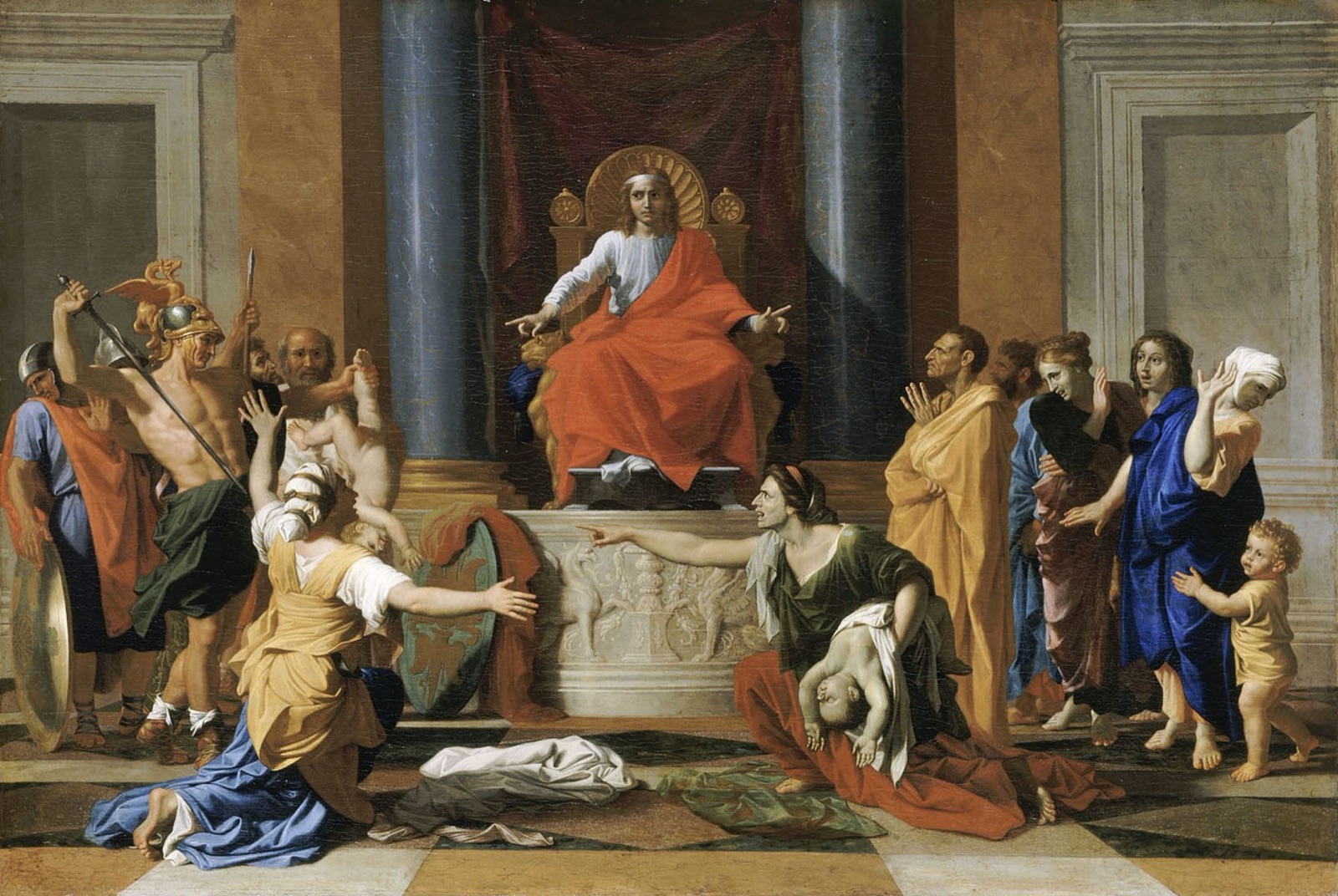 The Judgment of Solomon — Nicolas Poussin, 1649, Musée du Louvre
The Judgment of Solomon remains the most fitting image for talking about the diesel saga — but not for the reason people usually think. This isn’t a story about uncovering the truth. It’s the story of an arbitration between four legitimate claims — sometimes only three are heard, depending on the era — raised either at the same moment or decades apart, that no cleverness can ever resolve without one of them coming out genuinely amputated.
A video, an investigation, a question that goes beyond diesel
The YouTube channel Le Vendeur Automobiles published, in late July 2026, a sprawling investigation into what it calls “the diesel scandal” (watch the video, full source list): thirty years of fiscal and advertising pressure in favour of diesel fuel, followed by ten years of methodical demonisation, ending in 2026 with a quiet revival of combustion engines by carmakers themselves, for lack of sufficient demand for electric. All of it backed by reports from the Court of Auditors, the Senate, and IFPEN — solid sourcing, even if the tone remains deliberately aggressive, even polemical.
One could stop there and see nothing but a French story, almost quaint, of administrative U-turns. But dig a little, and the diesel story tells something far more general — and far more current, since the same mechanism is playing out again, right in front of us, with Chinese electric cars.
What Solomon actually gives back, and what he never does
Poussin’s painting is striking: a king, a child suspended above two mothers fighting over him, a raised sword. We remember the threat — cutting the child in two — but we often forget the essential part: Solomon never cuts anything. The gesture is only a ruse. By observing which of the two women would rather give up the child than see him die, he unmasks the real mother and returns the child to her, intact. It’s a story about truth revealed, not about arbitration truly carried out. No one in that story walks away empty-handed or diminished — except the impostor, who is exposed.
The diesel case — like the Chinese EV case today — offers no such way out. There’s no real mother to unmask, no lie to pierce so the right answer reveals itself. There are four simultaneously legitimate claims — sometimes raised at the same time, sometimes forty years apart, which makes the whole thing even more insidious — and no cleverness, no wisdom, however great, can satisfy all four at once. Here, something really has to be cut. And someone really does walk away with the smaller half.
Four claims, never reconciled, sometimes staggered across time
In the diesel case, the claims at the table are:
- Public health: air pollution kills — Santé publique France estimates around 40,000 premature deaths a year from it. No one serious disputes this, including in LVA’s own video.
- Industrial and energy sovereignty: in the 1980s, saving PSA and Renault, absorbing the surplus heavy fuel oil produced by France’s nuclear programme. Today, protecting what’s left of Europe’s car industry against China.
- Consumer purchasing power: the person who bought a diesel they were sold as the future, who paid €1,500 to fix an AdBlue failure, who watched their car lose most of its resale value overnight because of a Crit’Air sticker.
- The state’s own appetite for tax revenue: a fourth party too often forgotten, distinct from industrial sovereignty. At its peak, diesel fuel had become the country’s fourth-largest source of tax revenue — a budgetary argument all by itself, independent of any industrial or health consideration. That same appetite is resurfacing today, identically, with electric vehicles: fuel-tax revenue (TICPE) is collapsing as the fleet electrifies, and the state is already looking for ways to make up the shortfall, with a weight-based surcharge and a mileage tax leading the list.
What makes the diesel case particularly tricky is that these four claims have almost never been raised at the same moment before the same judge — with one exception: the state’s appetite for tax revenue never actually left the courtroom. It was already there in the 1980s (diesel as a budgetary godsend), it stayed there once tax policy turned against diesel (catch-up taxation, low-emission zones and their fines), and it resurfaces today with electric vehicles. The other three claims rise and fall by decade; this one never really leaves the table. In the 1980s, the arbitration favoured industry and tax revenue together, and the consumer benefited too, for a while — the balance seemed to hold, because the public-health claim hadn’t yet been raised with the same force. Forty years later, it’s public health that comes back demanding its due, without industry ever having truly solved its dependence on diesel, and without the consumer ever having been warned — and this time it’s the consumer who walks away with the amputated share. The judgment was never rendered once and for all: it was handed down in instalments, decades apart, each time at the expense of a party that hadn’t yet been called to the stand at the previous judgment — except the state itself, which, one way or another, always finds a way to recover its share.
The exact same imbalance, with Chinese electric cars
If the diesel story were just a French accident of the 1980s, it would only merit an article on economic history. But the same impossible judgment is playing out again, in an almost identical form, with Chinese electric vehicles.
A decade ago, China made a deliberate industrial bet — leapfrogging straight to electric rather than catching up a century of delay in combustion engines — while also responding to a very real public-health emergency (the extreme pollution spikes in Beijing in the early 2010s). The result: manufacturers like BYD or Chery/Jaecoo now offer electric vehicles at prices the European industry cannot match — sometimes half the price in markets like Southeast Asia, where import tariffs don’t apply.
Faced with this, the European Union came down on the side of industrial sovereignty: countervailing tariffs of up to 45% on Chinese EVs, decided in 2024 in the name of a competitive distortion linked to Chinese state subsidies. Two years on, the results are mixed — a study by the NGO Transport & Environment shows that China’s market share in Europe has only dropped from 22% to 17%, while the price paid by the European consumer has genuinely risen. Once again, it’s purchasing power that comes out of the judgment amputated — at the very moment that same consumer is being told to go electric, urgently.
And what if the judge were no longer the state? The market hypothesis
There’s a way of testing this story that hasn’t been tried yet: what if, at every stage, it wasn’t the state arbitrating between these claims, but the market itself? What happens when the judge leaves the courtroom and it’s capitalism, left to its own logic, that decides?
The hypothesis deserves to be taken seriously, because it radically changes the nature of the problem. In a market where the price signal genuinely reflects costs — including the health costs of pollution, via a neutral carbon tax or a legal liability regime for polluters rather than an imposed technical standard — the claims would no longer collide the same way. The 1980s consumer wouldn’t have been pushed toward diesel by artificially distorted taxation: they would have paid the real price of diesel fuel, including its health cost, and would have chosen with full knowledge — probably buying less diesel, but above all buying whatever actually matched their real use, without a ministry having to bet on their behalf.
On reliability, the gap would likely be even more dramatic. A Stellantis subject only to the market’s own sanction — without the safety net of a uniform standard imposed on all its competitors at once — wouldn’t have had ten years to fix the PureTech engine’s defect. Reputational damage would have been immediate, sales would have collapsed faster than any administrative procedure could have forced, and pressure from insurers, lawyers and consumers — through product liability rather than mere regulatory compliance — would likely have forced a technical fix within months rather than a decade. This is where the free-market argument is strongest: Schumpeter’s creative destruction punishes error faster than a standard does, precisely because it hits the responsible company rather than the captive customer.
On Chinese EVs specifically, the hypothesis is just as revealing. Without tariffs, European consumers would already have access to the lowest prices on the global market today — exactly what’s already happening in Thailand and the rest of Southeast Asia. Europe’s car industry, meanwhile, would have to adapt or disappear, with no safety net — brutal for industrial employment, but exactly what capitalism is supposed to do: reallocate capital and labour toward whoever produces the cheapest value for the consumer, even if the losers of that process are real, not merely hypothetical.
But the hypothesis has its limits, and they need to be faced rather than brushed aside. The judge disappears, but the problem it was trying to settle — air pollution, a cost nobody pays spontaneously because it’s diffuse and collective — doesn’t disappear with it. This is the classic argument against the purely free-market solution: without some minimum price imposed on pollution (whether through a standard, a carbon tax, or a liability regime), nothing guarantees the market will internalise it on its own — which is exactly why even the economists most attached to markets (Pigou1, and later Coase2, with his reservations about transaction costs) acknowledge that a diffuse polluter, with millions of emitters and victims impossible to identify individually, doesn’t regulate itself through private negotiation alone. And on industrial employment, the sudden collapse of entire swathes of Europe’s car industry — even if it “frees” the consumer — leaves tens of thousands of workers without income overnight, a cost the market doesn’t spontaneously compensate for either, unless one assumes a mobility and retraining capacity that, in practice, is never instant or free.
There’s an additional irony to removing the judge from the equation: in this story, the state was never a neutral arbiter, external to the claims. It is itself a stakeholder — the fourth party, the one that needs its own tax revenue to function. A judge with a direct interest in the outcome of the trial is no longer quite a judge. That may be the deepest limit of this whole story: it isn’t just that arbitrating between four claims is hard, it’s that the one supposed to arbitrate is never fully disinterested in the result.
In other words: removing the judge doesn’t make the arbitration between claims disappear. It simply changes who carries it out, and how fast the penalty falls on the mistake — faster on the failing company, but with no guarantee that the public-health claim or the fate of displaced workers is ever truly accounted for without some minimum set of rules fixed in advance.
The next chapter is already being written: the mileage tax on electric cars
It didn’t even take waiting for the diesel case to close before the next one started brewing. French car taxation has historically rested almost entirely on fuel taxation — the TICPE — which mostly feeds the state’s general budget, with a share passed on to the regions. Electric vehicles escape it almost entirely. Mechanically, as the fleet electrifies, that revenue collapses — a shortfall in the state’s general revenue, not in some narrowly targeted budget line — and a Court of Auditors report from October 2025 opened the debate on how to make up for it.
Among the options floated, and widely covered in the press — notably by economic columnist François Lenglet in Le Figaro — is a mileage tax specific to EVs, on the order of €0.02/km, roughly €200 to €300 a year for an average driver. Nothing has been voted yet; the 2026 finance bill still keeps all the exemptions in place for now. But the shift has already started elsewhere: since 1 July 2026, EVs weighing over 1,500 kg have lost their exemption from the weight-based surcharge, now treated the same as combustion vehicles on that criterion, and the TVS (the tax on company vehicles) applied to corporate EVs has risen from €100 to €130 a year.
The parallel with diesel is almost too neat to be comfortable. Electric was first sold as the obvious solution — cheap to run, no fuel tax, no surcharge — exactly as diesel had been sold forty years earlier. And already, while the fleet transition is still only just beginning — fully electric and plug-in hybrid vehicles together made up just 5.5% of France’s total car fleet as of 1 January 2026, according to the SDES3, far behind the 34.5% they already represent in new-car sales — the state is starting to reload the purchasing-power side of the scale to make up for what electric costs it elsewhere. The consumer who just bought an EV thinking they’d finally escaped the diesel mechanism may well discover, a few years from now, that they’ve only changed seats in the same courtroom.
What to take away from a judgment that can never really be rendered
The lesson isn’t that some hidden trick exists, waiting to be found, the way Solomon found his. It’s that no arbitration between public health, industrial sovereignty, purchasing power and the state’s appetite for tax revenue can satisfy all four at once — and that the real danger isn’t a lack of wisdom among those who decide, but the time lag between these claims, which lets each generation wrongly believe it has finally rendered a fair, final judgment. All the more so since one of them — the state’s own claim — never really lags at all: it stays, unchanging, in the background of the painting, generation after generation.
In the diesel story as in the Chinese EV story, the share that gets amputated has been, almost systematically, the same one: the ordinary driver’s, who has neither the power to set the standard nor the ability to pass the cost on in a selling price. Heating, food, tomorrow’s mobility will likely carry the same impossible judgment. So maybe the question to ask at every new public policy isn’t “have we finally found the right answer,” but rather: this time, who isn’t yet standing before the judge — and who will have to answer for it in twenty years?
Sources: the full investigation by Le Vendeur Automobiles on YouTube, with the complete list of its sources; the Transport & Environment study on the effect of European tariffs (2026); reports from the Court of Auditors and the Senate on diesel taxation.
-
Arthur Cecil Pigou (1877-1959), British economist, one of the founders of welfare economics. He formalised the idea of the “Pigouvian tax”: when an activity generates a cost to society that the market price doesn’t reflect — a negative externality, such as pollution — the state should impose a tax equal to that hidden cost to force the market to account for it. This is the underlying argument behind a carbon tax. ↩︎
-
Ronald Coase (1910-2013), British-American economist, 1991 Nobel laureate in economics. In his article “The Problem of Social Cost” (1960), he qualifies Pigou: if property rights are clearly defined and the transaction costs of negotiating between parties stay low, private actors can negotiate an efficient solution themselves without state intervention. But Coase himself acknowledged this assumes low transaction costs — which no longer holds once there are millions of polluters and victims impossible to identify individually, as with air pollution. ↩︎
-
SDES (Service des données et études statistiques), France’s Ministry of Ecological Transition statistics office — “Parc et circulation des véhicules routiers,” data as of 1 January 2026: 3.5% of the fleet fully electric, 2.0% plug-in hybrid, out of a total of 40 million cars on the road. For comparison, fully electric and plug-in hybrid vehicles made up 34.5% of new car sales in Q2 2026 — the gap between the pace of sales and the pace of actual fleet turnover shows just how marginal the transition still is at this stage. ↩︎