Khok nong na
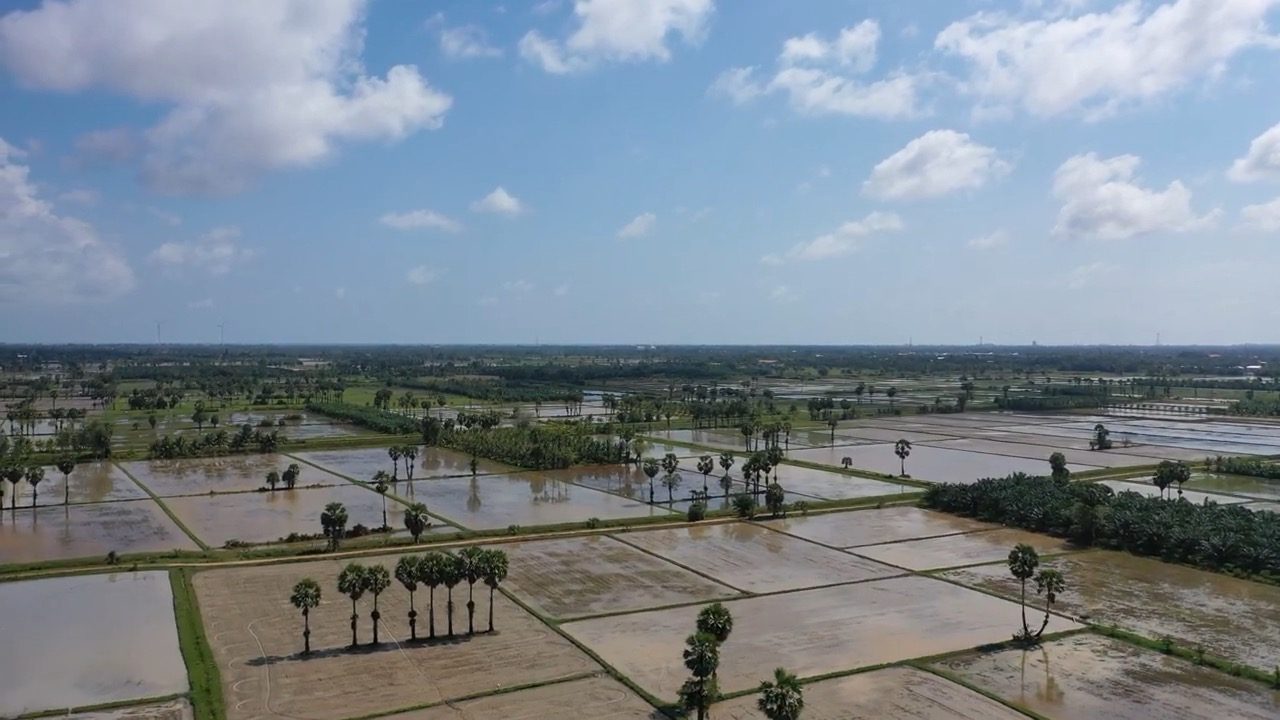
Rice fields west of Phatthalung.
A post caught my attention in an Isan Facebook group. Well written, interesting. It describes “a multitude of khok nong na” that you would see flying over the region, and it explains the principle. Khok, the raised mounds planted with trees. Nong, the pond that stores water and gives fish. Na, the rice field. All of it connected by ditches following the contour lines, the idea being to keep the rain water all year, limit floods and droughts, and produce rice, fruit, vegetables and wood on the same plot.
As often with this kind of post, no figures. The subject interested me, so with Claude’s help I did my own research.
The design is good. It is sound water management and layered planting, you find the same principles in permaculture and agroforestry everywhere else. But a good design does not make a good programme. For a plot like this to work you need three things together, water that stays in the pond, hands to maintain it, and someone to buy the surplus. Isan does not provide any of the three on its own. That is where the gap between the picture and the ground comes from.
Where it comes from
Khok, nong and na are ordinary Thai Lao words, you find them in hundreds of place names, Nong Khai, Nong Bua Lamphu, Khok Si. The village built on high ground to stay out of the floods, the ponds below, the rice fields, all of that is old.
The object described in the post is much less old. A traditional pond is dug by hand. A khok nong na needs an excavator, a pond three to four meters deep, mounds built with the spoil, channels traced on the contour lines. It is a recent stack, the vernacular topography, plus the New Theory of agriculture from Rama IX in the 90s which is where the 30% rice 30% water 30% trees 10% housing ratio comes from, plus the sufficiency economy philosophy after 1997, plus western permaculture, and finally the brand and the budget around 2020.
And the diversified system it claims to restore had been destroyed between 1960 and 1990 by cassava, sugarcane and jasmine rice for export. It is not a thousand year continuity, it is a reconstruction of a pre war situation.
What was done
In 2020 the government funded a rollout on the Covid loan. A bit more than 4 billion baht for 25 179 households in 76 provinces, with standardised plots of one or three rai and a budget around 100 000 baht per plot. Out of 5.7 million farming households in Thailand that is less than 0.5%. So what you see from the plane is mostly farm ponds dug thirty or forty years ago, not plots from the programme. Nobody counts the private khok nong na.
The Thai State Audit Office published its report in 2022. At the planned closing date only one of the six activities was completed and two extensions were needed. The community learning centres were mostly not built to specification, some not built at all. The equipment delivered was not used and the training sessions had practically not taken place.
First condition, water that stays
People often say the soils in Isan are sandy so a pond cannot hold. That is a shortcut. The sand is at the surface, twelve to twenty centimeters, and below it there is a clay accumulation horizon. A pond dug deep enough cuts into that clay and holds very well. Farmers have been doing this forever.
The problem is that it is not true everywhere. In the lowlands the profile is more loamy and holds well. On the high terraces you find red loess sitting on an old river gravel bed, and there a badly placed pond becomes a soakaway. The difference can happen over a few hundred meters and it is not visible from the surface.
There is a second risk, more serious, that the promotion of the model never mentions. The plateau sits on a geological formation containing thick layers of rock salt. When the water table rises it dissolves the salt and brings it to the surface, in patches of five to ten meters that sterilize the plot. This has been documented since the 80s and it got worse with the deforestation of the recharge areas. So digging deep and changing the local water regime can trigger exactly what you were trying to avoid.
This is where the national template becomes a problem. The vernacular adapted to the soil and the water table plot by plot. A one or three rai standard applied in 76 provinces does not do that.
Second condition, hands
The system needs daily presence, manual work, and someone able to do many different things. That is exactly what Isan does not have anymore.
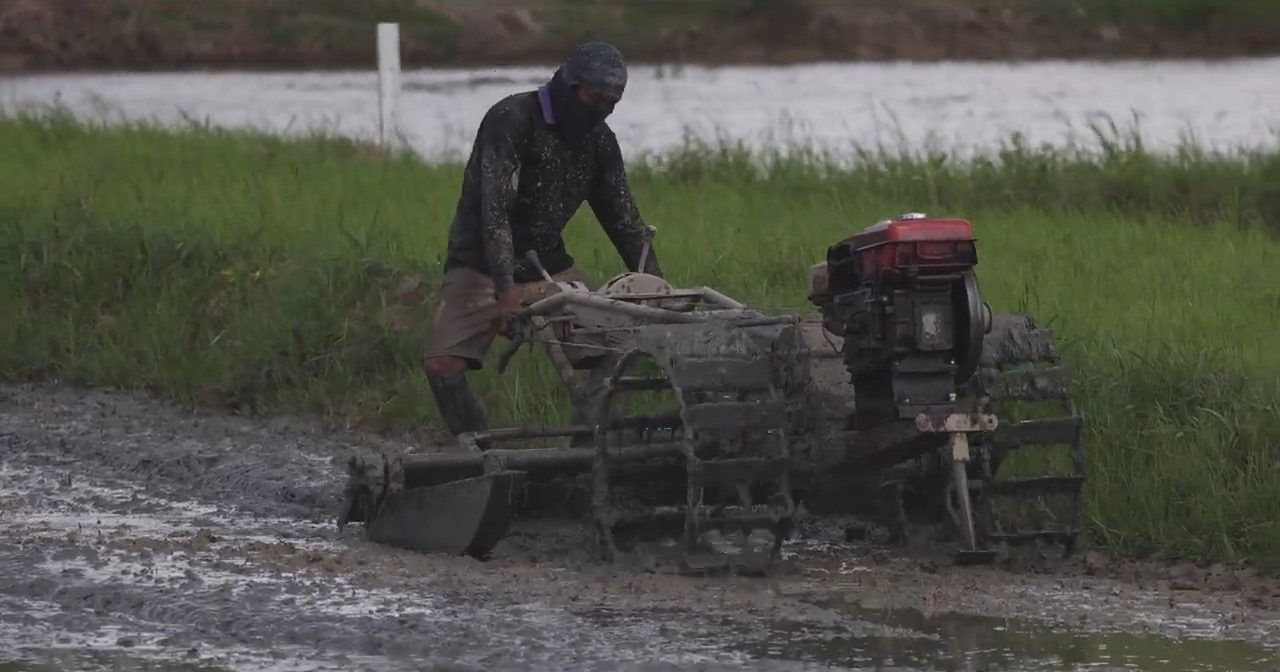
Walking tractor with cage wheels, preparing a paddy.
The typical household in the Northeast does not live from its farm. Field studies show that even the households most dependent on agriculture get only a third of their income from farming, the rest coming from non farm work, pensions, and above all the money sent by the children who left for Bangkok, around 40% of the income for rice growing households. The grandparents raise the grandchildren, the working age people are elsewhere. And two thirds of those households carry debt above their annual net income.
The constraint is already active, not something for later. For years now the irrigated areas have been under used in the dry season, partly because there is nobody to work them.
And when hands are missing people do not stop farming, they switch to a technique that needs less of them. Transplanting by hand means sowing a nursery, pulling the seedlings, carrying them and planting them one by one, twenty to thirty working days per hectare. Broadcast sowing needs two or three. The yield is lower and weeding is harder, but the trade off is quickly made. Khok nong na goes the other way.
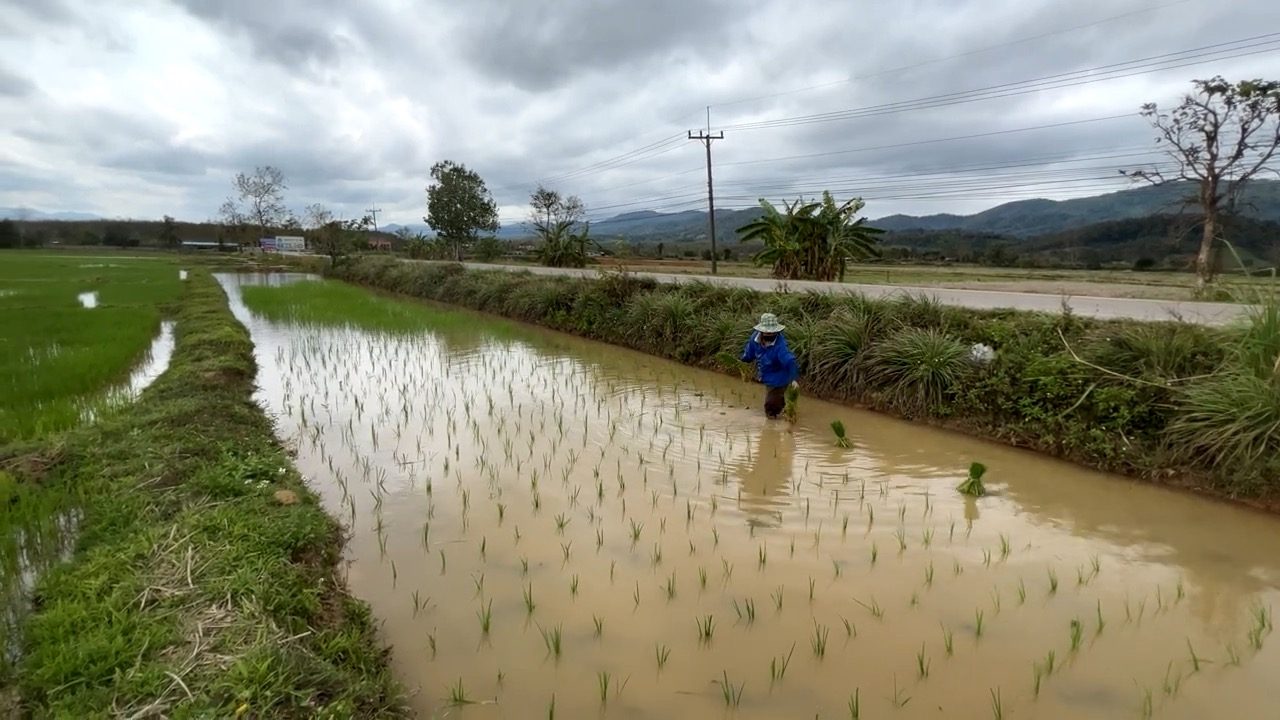
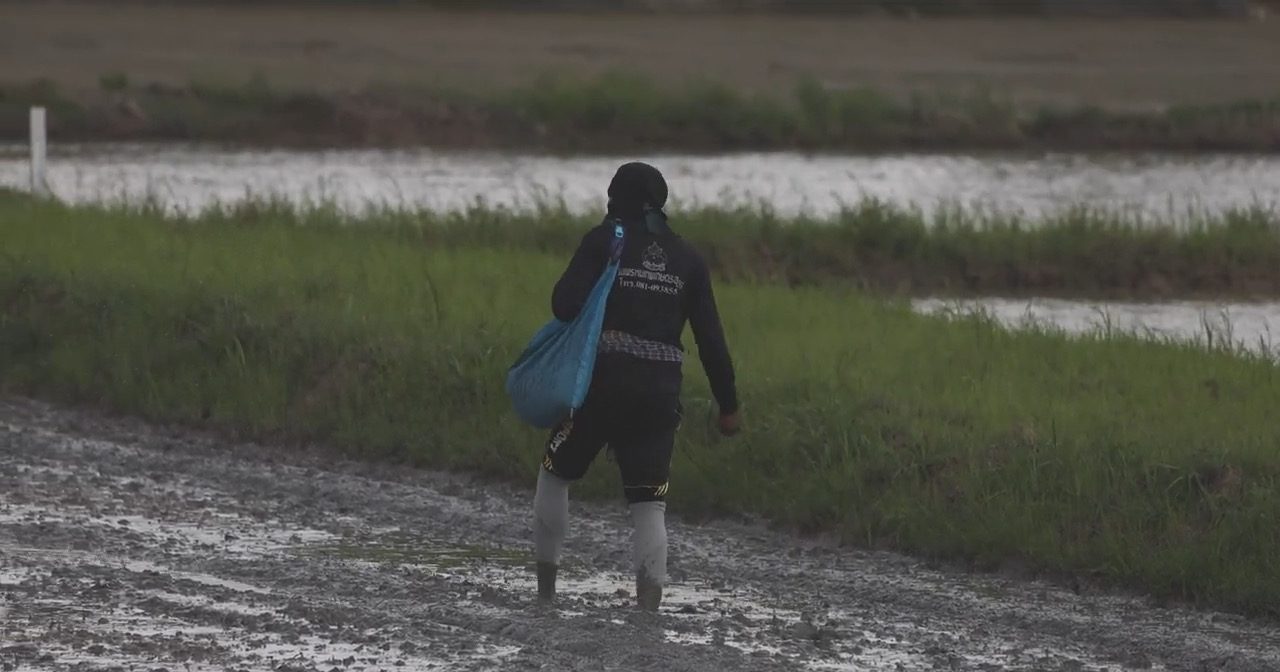
Demography will not help. Thailand recorded 416 574 births in 2025 against 559 684 deaths, the lowest number of births in 75 years and the fifth consecutive year of population decline. Isan is ahead of that curve since the region has been exporting its working age people for forty years.
Third condition, a buyer
A diversified plot produces small quantities of many things. So you need to sell small varied volumes, which requires short circuits and proximity. But 44% of the villages in the Northeast have no road access usable all year. That raises transport costs and weakens bargaining power.
On the other side monoculture already has its logistics, the collectors come, the price is known even when it is bad. Rice around 6 000 baht per tonne against a production cost close to 6 500 is a bad price, but it is a price.
So who adopts
The most recent field study covers Kut Chum district in Yasothon, 134 farmers, published in 2025. The profile is not the one in the official story. 61.5% earn between 100 000 and 300 000 baht per year, 35.5% less than 100 000, and 82% own their land.
The main result is that income and education level are the best predictors of adoption. The authors say it plainly, the initial earthworks are expensive, and without a dedicated financial mechanism adoption stays limited to the better off households.
That fits with the three conditions. You need capital to have the digging done properly, free time to maintain it, and enough cash flow to wait until the trees produce. A model presented as the answer for the poor farmer ends up adopted by those who already have something.
On the ground these are often people coming back to the village, retired civil servants, migrants back with some savings, city people looking for something else. As a way of life it makes complete sense. As a general answer to rural poverty the numbers do not follow.
What I do not know
How many plots from the programme are still working six years later. Nobody seems to have done that count, and it is the only measurement that really matters. A pond that leaks empties out, a mound left unplanted goes back to being a pile of dirt in two seasons. The 2022 audit was about budget execution, not about the installations surviving.
How many plots were dug in areas at risk of salinisation, and whether that risk was even mapped before the works.
Whether the additional income figures in the official documentation have ever been checked against a real sample. I only found projections, never a measurement afterwards.
And the question that interests me most, whether this self sufficiency story is not being used as a substitute for an agricultural policy. As long as you explain that the answer fits on three well designed rai, you do not have to deal with the price of rice, household debt, or the roads that are missing.
So when you fly over Isan, what you see is not really what the post describes.