Thailand Has Stopped Catching Up
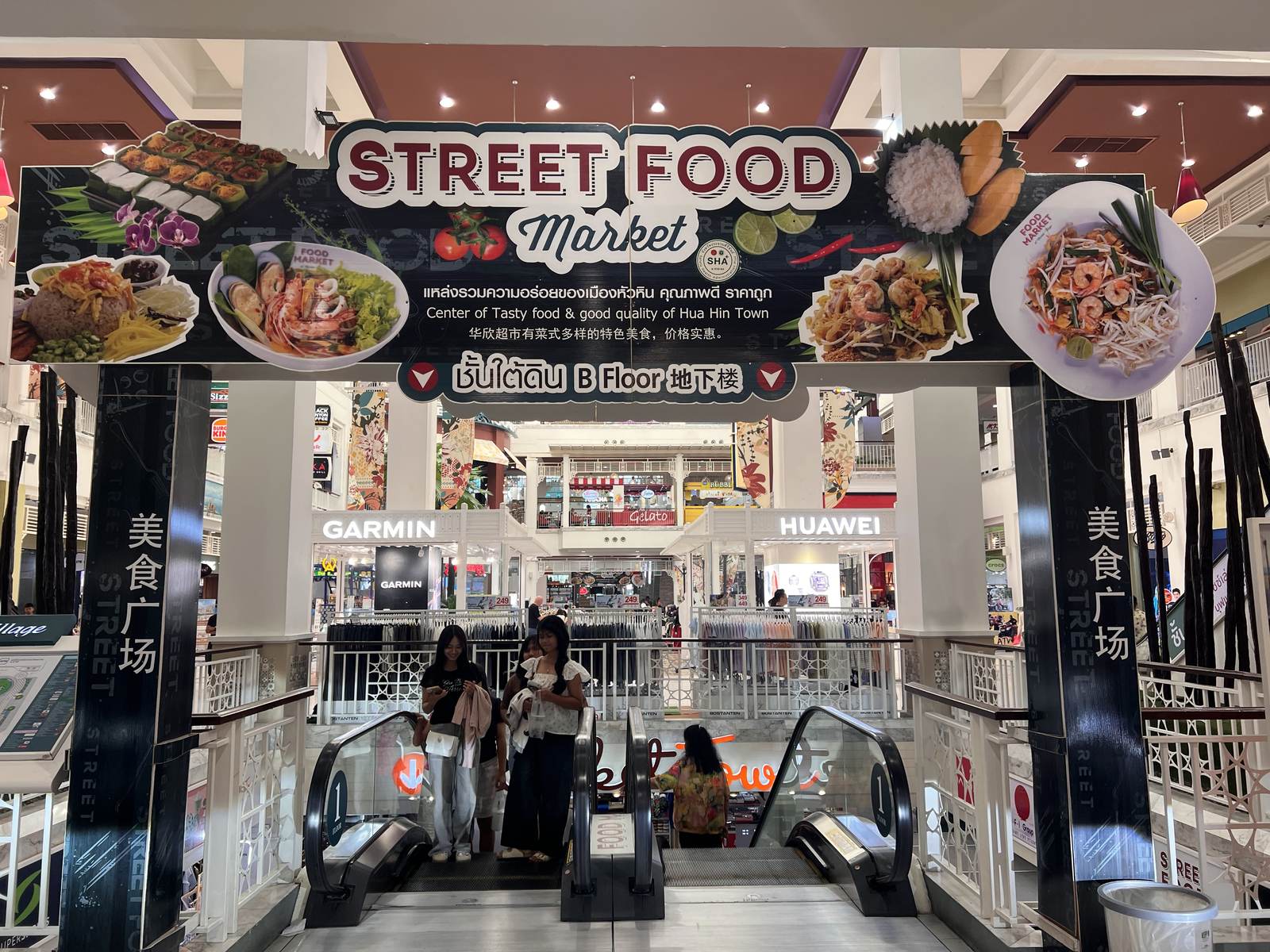 The basement of Market Village, Hua Hin, on a weekday afternoon
I. The same-day appointment
Since we have been living here we have turned up at the hospital six or seven times without an appointment, and we were seen the same day every time. Blood test, phlebologist, rheumatologist, physiotherapist, general practitioner, dermatologist, ophthalmologist, all seen the same day. A mammogram was booked straight afterwards and done within five days. None of it required a referral letter or a fixed care pathway.
In France the median wait for a cardiologist is 42 days. In the Gers, the worst-served department, it is 164. In 2025, according to Doctolib’s figures, 63% of patients gave up on at least one consultation because of the delay or the time slot offered. I am not comparing two health systems in the abstract, I am comparing two patient experiences, and that is the gap.
The other thing you notice is the price. That specialist consultation without an appointment, at the private hospital, cost 1,300 baht, about 35 euros. Rent, transport, food, everything is in the same ratio. It is the reason most of the Western retirees I meet came here, and it is an honest reason.
For food, the prices from my own receipts at the Market Village food court on 22 August: papaya salad 60 baht, spicy minced pork 55, a whole chicken leg 55, a portion of sticky rice 10, a skewer 10, a bottle of mineral water 17. A full meal comes to under three euros, and this is not a street stall, it is the basement of a shopping mall.
A preliminary case for Thailand entering its second lost decade.
Pravit Rojanaphruk, Khaosod English, 20 August 2026
Meanwhile the Bangkok press is explaining that the country is entering its second lost decade. One piece stopped me, Pravit Rojanaphruk’s column in Khaosod English. Then six more came in ten days, with nothing to do with each other. The gap with what I live every day was odd enough that I went to look at the numbers. This post is what I found. I am not an economist and I had no thesis when I started, I tried with Claude to track down the economic data and to understand, or at least to try. It ends up explaining my same-day appointment, in a way I was not expecting.
II. Seven texts in ten days
On 20 August, Pravit Rojanaphruk published a column in Khaosod English titled “A preliminary case for Thailand entering its second lost decade”. He lists the week’s news — the lowest growth in ASEAN in the second quarter, tourist arrivals down, Toyota demanding an overhaul of car taxation while Indonesia courts the Japanese manufacturers, the floods in Nan — and concludes that the country is drifting for lack of any collective goal. Pravit is a journalist critical of those in power, prosecuted several times for what he writes.
Two days earlier, on 18 August, Jareeporn Jarukornsakul published a piece of an entirely different kind. She runs WHA Corporation, Thailand’s largest industrial estate developer, and she argues that the question “Thailand or Vietnam” no longer makes sense, that the answer now is “Thailand plus Vietnam”. The text is corporate communication and has to be read as such: WHA has committed around 360 million dollars in Vietnam and is aiming for a billion. Anyone selling land on both sides has an obvious interest in explaining that it is not either-or. What is interesting is how she divides up the roles. Thailand’s asset, in her account, is a mature industrial ecosystem, integrated supply chains, decades of experience in cars and electronics. Vietnam’s asset is growth and trade agreements. A stock on one side, a flow on the other.
On 21 August, the Thailand Development Research Institute published a note picked up by The Nation. TDRI is the country’s reference economic research institute, independent, and it has no land to sell. It sets out three figures from the second quarter of 2026: private investment up 13.4%, manufacturing output up 0.1%, and industrial capacity utilisation down to 57.47%, its lowest in twenty-four quarters. It calls this an enclave economy.
A journalist, a company chief executive, a research institute. Three positions with no reason to agree, and the same diagnosis inside four days.
And it did not stop there. On 23 August the National Economic and Social Development Council published company-register figures showing the capital behind new businesses in free fall. The same day, the Thai Retailers Association asked the government to act against the flood of cheap foreign goods. On the 26th, the Federation of Thai Industries published its vehicle sales and raised the alarm about the collapse of the pickup. On the 27th, a roundtable brought together TDRI, PwC, a former commerce minister and the secretary-general of the National Council to say that the country must stop measuring its success by the capital it attracts.
Seven texts in ten days, from 18 to 27 August, coming from a journalist, a company, an institute, two trade federations and the state itself. I went looking for none of them: they arrived while I was writing. That does not prove they are right, but it rules out the idea that this is one columnist’s mood.
I should add that the field is already crowded. The phrase “sick man of Asia” has been attached to Thailand since late 2025, at Capital Economics, at the East Asia Forum, at Krungsri Research, and TDRI itself used it in July. Most of those pieces stop at tourism, because tourism is the only engine you can see from the street. That is where I part company with them.
III. The dating does not hold
Pravit dates the first lost decade from May 2014 to August 2023 and puts it down to General Prayut Chan-o-cha, who took power in a coup and kept it for nine years. It is the most widespread explanation and it does not survive contact with the World Bank series.
Average growth between 2008 and 2014 was 2.9% a year. Between 2015 and 2019, that is to say under Prayut, it was 3.4%. So the decade that is supposed to be lost opens with five years that did better than the seven before them. What crushes the average is the 6.1% contraction of 2020, and above all the rebound that never came, under the generals and under the elected governments that followed. Srettha, Paetongtarn, Anutin: the curve does not move.
There is plenty to hold against Prayut. The 2008 step down is not one of them, and neither is 1997.
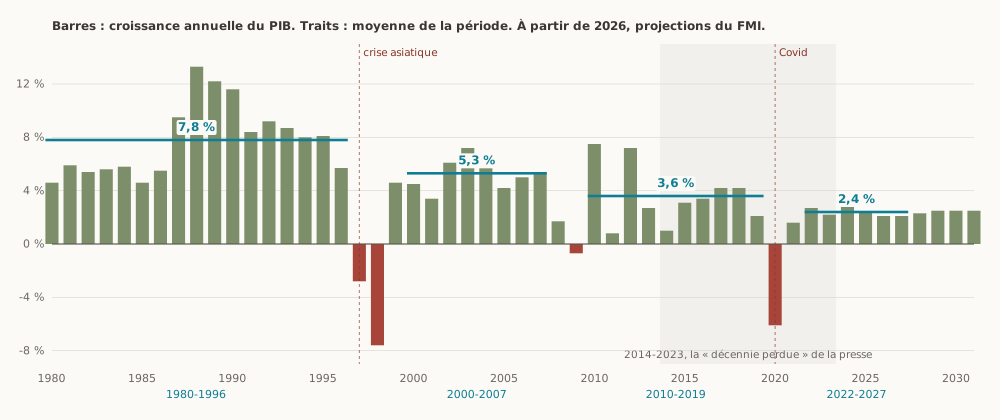 Annual GDP growth (bars) and the average for each period (lines). The grey band is the “lost decade” the press attributes to General Prayut: the plateau crosses it unchanged. IMF series, projections from 2026
Because that is where the real break is. Across sixty-five years of data there is only one point at which something snaps and never mends, and it is the Asian crisis.
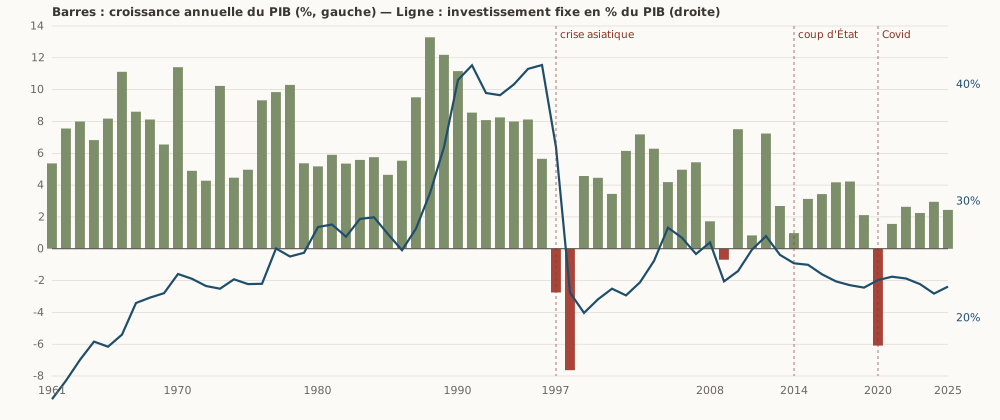 Annual GDP growth (bars, left axis) and fixed investment as % of GDP (line, right axis), 1961-2025 — World Bank
Between 1961 and 1996 Thailand averaged 7.5% growth a year, for thirty-six years. GDP per head multiplied seventeen times between 1968 and 1996. And the investment rate climbed steadily, from 19% of GDP in the sixties to 41.7% in 1996. Put another way, every year more than 40% of what the country produced went back into factories, ports and machines instead of being consumed.
Then 1997.
IV. What broke in 1997
The mechanics of the crisis are well documented. In 1993 the Bank of Thailand created the Bangkok International Banking Facility, meant to turn the capital into a regional financial centre. In practice it let banks, and above all finance companies, borrow dollars abroad at 5 or 6% and lend them on in baht at 13 or 15%. With the baht pegged at 25 to the dollar for fourteen years, the margin looked risk-free. External debt doubled between 1992 and 1997, and close to half of it was short term.
The problem was what that money was funding. A good share went into Bangkok offices and condominiums, which produce nothing you can export. By 1996 growth was already back to 5.6% against 8.1% the year before, exports had stalled, and the current account deficit reached 8% of GDP.
On 2 July 1997 the baht floated. It went from 25 to 54 to the dollar by January 1998. Every dollar-denominated debt doubled in baht overnight, with no company decision involved. Firms that were profitable in operation became insolvent on the balance sheet. Fifty-six finance companies closed for good that December. Non-performing loans reached 47.7% of total bank lending in 1999, and 52.3% in property. GDP fell 2.8%, then 7.6%.
Up to that point, nothing exceptional. A balance-sheet crisis, like Japan in 1990 or Sweden in 1992, and those last three to five years.
The Thai anomaly is not the fall, it is that the fall was never made up. Fixed investment went from 41.7% of GDP in 1996 to 22.2% in 1998. It climbed painfully back to 27% in 2005, fell again, and has held between 22 and 23% for fifteen years. It stands at 22.7% in 2025. Thirty years on, the country still invests half what it invested before the crisis.
This is not a savings problem. Thailand saved 34.6% of GDP in 1996 and still saves 24% today. The money is there.
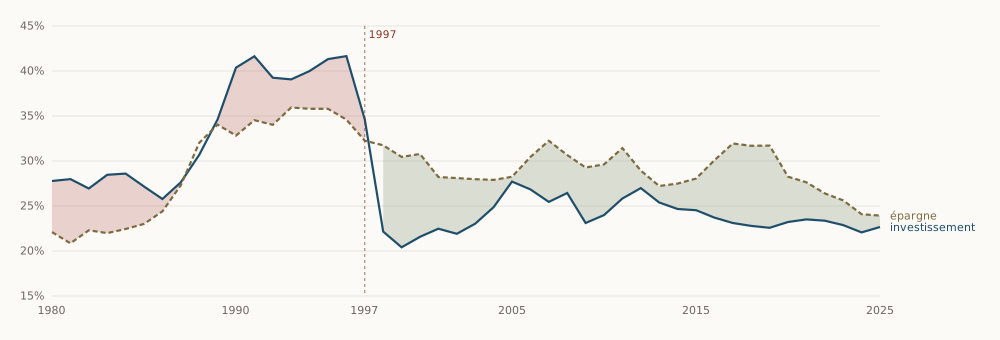 Gross savings and fixed investment, as % of GDP. Red: the country imports capital. Green: it exports capital — World Bank
The gap between the two lines is exactly the current account. Before 1997 it is negative and the country absorbs foreign capital. After, it turns positive and stays there for twenty-five years, reaching 7% of GDP in 2019. In other words Thailand lends its savings to the rest of the world for want of placing them at home. The constraint was never the supply of capital, it has always been the demand.
Two reasons explain the immediate aftermath. Firms that came out of 1998 deleveraged and never went back to the debt levels of before, because a generation of managers learned that debt kills. And the stock that had been destroyed was property, which took Bangkok a decade to absorb. But that does not explain twenty-five years.
V. Why nobody builds a factory any more
A factory gets built when the expected return beats the cost of capital. After 1997 that calculation stopped working, and nothing has put it right.
The Thai model of the eighties came down to a single sentence. Rent out cheap, disciplined labour to Japanese manufacturers, offer them tax breaks through the Board of Investment, let them import the components and re-export the finished product. It worked very well for twenty years, and it stops working the day a cheaper country offers exactly the same thing.
That country arrived in 2001, when China joined the WTO, with Vietnam behind it. Thailand’s advantage in anything labour-intensive evaporated. The minimum wage raised to 300 baht a day nationwide in January 2013, after an increase of around 40%, closed that position for good. Studies find no marked effect on employment, so it is not that the measure emptied the factories. It is that after it, selling yourself as a cheap country was no longer possible.
And it is not only wages. Electricity costs 4.15 baht a kilowatt-hour in Thailand against 2.69 in Vietnam. Vietnam and Malaysia have coal and gas of their own, Thailand has been importing at world prices since the Gulf fields began to decline, and so pays for its power at the price of liquefied natural gas. For a plant running around the clock, that gap shows up directly in the accounts.
And the gap has reversed. Nopparuj Chindasombatcharoen, of TDRI, put it this way at a Bangkok roundtable on 27 August 2026: when the Japanese manufacturers came, Thai costs really were lower than Japanese ones, but manufacturing in China is now cheaper than manufacturing in Thailand. Steve Yang, of PwC Thailand, puts the gap at 15 to 20%. The country has not merely been caught up on cost, it has ended up on the wrong side of it.
Getting out of that trap means moving from assembly to design. It takes engineers, research, suppliers capable of innovating.
| Research and development spending | % of GDP |
|---|---|
| South Korea | 4.94 |
| China | 2.58 |
| France | 2.18 |
| Malaysia | 1.01 |
| Thailand | 0.94 |
| Vietnam | 0.41 |
Korea spends five times more, and as a share of a GDP per head almost three times larger. It did not do that by accident: technology transfer imposed on foreign partners, export discipline, public research, credit steered towards moving up the value chain. An industrial policy, run for forty years. Thailand offered tax exemptions and hoped for spillovers. That is precisely what TDRI holds against the model: success is measured by how much investment is attracted, not by what capability is created. With PISA results at their lowest since 2001, the step up is higher today than it was twenty years ago.
But the main reason lies elsewhere, and it is less often said. The money did not disappear, it went where it earned more, inside the country.
After 1997 Thai capital concentrated into a handful of conglomerates: retail, telecoms, energy, agri-food, drinks, banks. These are domestic and protected sectors, where foreign competition is limited, not least by the Foreign Business Act. The margins are those of an oligopoly and the risk is low. Why build an export plant that has to face China on margins of a few percent, when you can hold a position in Thai retail or telecoms on far better terms with no serious competitor? Every decision taken on its own is rational. The sum of them is a country that stops manufacturing.
That is also what explains private credit at 146% of GDP going into housing and consumption while productive investment stays at 22%. Close to one loan in ten, 9.2% of outstanding credit, is more than ninety days overdue, and of the debtors who entered government assistance schemes only 15% have managed to resume normal repayments. It was not banking blindness, it was the best available return for the risk taken.
Two more things on top. The domestic market stopped growing, with the working-age share peaking in 2013 and household debt at 85.9%. And two coups, repeated street conflict and some twenty constitutions since 1932 make a twenty-year commitment hard to justify.
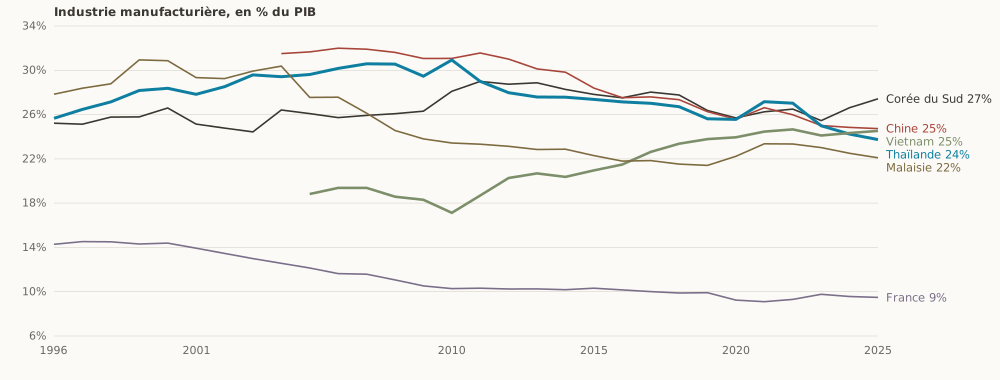 Manufacturing value added as % of GDP — World Bank
The result shows up on a single curve. Manufacturing fell from 30.9% of Thai GDP in 2010 to 24.2% in 2024. Vietnam’s went from 17.1% to 24.3% over the same period. The two lines have crossed. Korea has stayed at around 26% while becoming rich.
France is on the chart to give a sense of scale. It went from 14.3% in 1996 to 9.6% today, and losing industrial weight is the usual path of a rich country, where services take over. Thailand is doing the same thing at 7,400 dollars a head, which is to say before being rich. Economists call that premature deindustrialisation, and it is a problem of a different order: you leave industry without having the incomes, the skills and the high-value services that are supposed to replace it.
This chart also corrects something I wrote above. The 1997 break brings down the investment rate, but the industrial share holds until 2010 and only falls afterwards. So there are two phases, not one. The first is financial and comes out of the crisis. The second is competitive and demographic, and it begins when China and Vietnam take the place Thailand used to occupy.
So Thailand did not decide to stop investing. Investing in a factory stopped paying, faster than the country built the capabilities that would have made it pay again, and the money went to protected domestic sectors where it earned more with less risk.
VI. Catching up has stopped
This is where comparison with Europe becomes interesting, provided it is not done carelessly. Comparing growth rates means nothing: France does 1%, Thailand 1.9%, and you would conclude Thailand is doing better. For a middle-income country the only question that counts is whether the gap with rich countries is closing or widening.
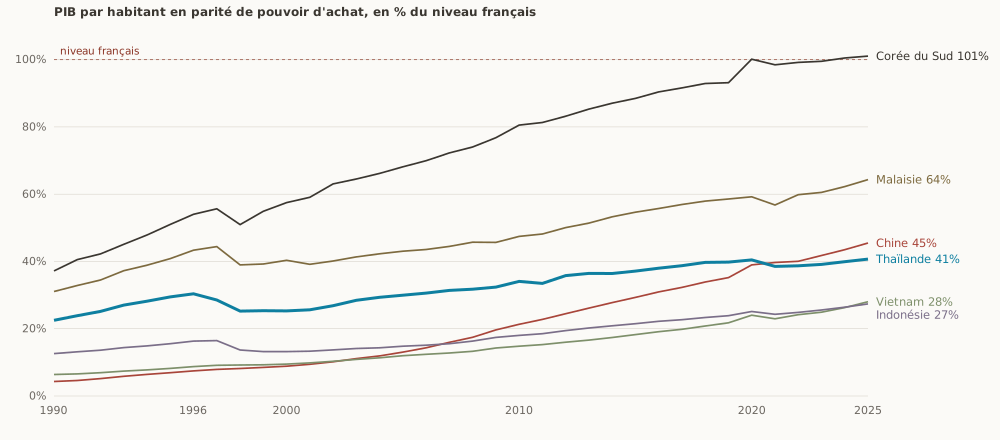 GDP per capita at purchasing power parity, as % of the French level — World Bank
In 1990 Korean living standards stood at 37% of the French level, Thai ones at 22.5%. Two Asian economies of the same generation, often named in the same sentence. By 2024 Korea is at 100.5%, it has caught France. Thailand is at 39.9%, and slipping slightly since 2020.
China, which was at 4.3% in 1990, is at 43.5%. It has overtaken Thailand in real living standards, which was not something you could have predicted twenty years ago. Vietnam has multiplied its living standard by 5.8 since 1990, Thailand by 2.5. Malaysia went from 31 to 62%.
So Thailand has not collapsed, it has stopped catching up. It reached roughly halfway to France and stayed there, while three of its neighbours kept going. That is the middle-income trap, and it is not a risk ahead as it is often described here, it is a fact of the last fifteen years.
VII. What it looks like on the ground
The second-quarter figures for 2026 show how it translates. Manufacturing output rose 0.1%. In June exports jumped 21.1% and imports 48.9%, both driven by technology products, with the Bank of Thailand noting that these activities rely heavily on imported inputs. Exports up 21% while industry manages only 0.1% describes a country that moves goods through rather than makes them. That is what TDRI calls the enclave economy: foreign investors install production lines or data centres, import the components, and leave with the profits. All that is left is assembly and wages.
The clearest figure comes from the Board of Investment. In the first quarter of 2026, investment applications reached 1,010 billion baht, about 31.8 billion dollars. Of that total, 873.7 billion, or 26.35 billion dollars across 48 projects, went to digital, mostly data centres. That is where the rise in foreign investment is going, and it explains why it does not show up in output. A data centre consumes a great deal of electricity and water, imports all of its equipment, employs a few dozen people and sends its profits home. The Federation of Thai Industries is worried about it too, because these sites compete with factories and households for power and for water. The state has drawn the consequences: on 15 July 2026 the National Energy Policy Council set a separate tariff for data centres, at 5 to 6 baht a unit, with a bond required for grid access and a mandatory water management plan, while the first two hundred residential units come down to 3 baht. The stated reason is to stop the cost of these facilities being passed on to ordinary users. A data centre will therefore pay roughly twice what a household pays.
In cars, the erosion happens without a headline. Suzuki closed its Rayong plant at the end of 2025, eight hundred employees. Nissan consolidated assembly onto a single site, around a thousand jobs cut or transferred, while denying the word closure. Honda stopped production at Ayutthaya and moved it to Prachinburi, inside the country. One manufacturer gone, one shrunk, one consolidated. Nobody slammed the door.
While the Japanese retreat, the Chinese are moving in. Seven manufacturers — BYD, Great Wall, Changan, SAIC-MG, Chery, GAC Aion — have built or are building plants in Thailand, for more than three billion dollars in total and an announced capacity of over 600,000 vehicles a year. BYD’s Rayong plant, opened in July 2024, is to reach 150,000 units. In the first quarter of 2026, Chinese brands accounted for 27.5% of the Thai market.
And the consumer gains from it, which has to be said. In the shopping mall where I have my coffee, an electric MG Urban 5 with 435 kilometres of range is listed at 579,900 baht, fifteen and a half thousand euros, half the European entry price. Its specification sheet says “made in Thailand”. The one on the Changan Deepal S07, at 1,219,000 baht, says “made in China”.
This is the strongest argument against everything above, and it is a solid one: three billion invested, 9,600 jobs created, 85 to 95% Thai staff. What remains is to work out what was traded away. The state subsidised up to 100,000 baht a vehicle in 2024, at first on imported cars, before requiring local production from December 2026. An electric vehicle has far fewer parts than a combustion one, and the supplier ecosystem built around the Japanese over fifty years does not transfer. An industry is replaced by an assembly shop whose suppliers are Chinese. This is exactly what TDRI asks to be measured: not the investment attracted, but the capability created. The National Economic and Social Development Council has in fact put a number on the trade: more than 110,000 workers, or 16.3% of the automotive workforce, will have to move into other industries as the electric transition accelerates. Against that, the seven Chinese manufacturers have created 9,600 jobs.
 A Geely in a Hua Hin shopping mall. Chinese brands accounted for 27.5% of the Thai market in the first quarter of 2026
Figures from the Federation of Thai Industries, to the end of July 2026, spell out what was traded away. Over seven months Thailand sold 406,162 vehicles, up 15.4%. Electric passenger cars accounted for 125,411 of them, nearly double a year earlier, and 30.9% of the market. But only 46,924 were produced locally, or 37.4%: close to two thirds of the electric cars sold were imported.
Meanwhile the one-tonne pickup is collapsing. 37,369 units over the period, down 17.4%, with monthly sales falling from over 30,000 to little more than 10,000, a drop of 60%. The federation puts it down to banks tightening credit, itself a consequence of weak growth. And the pickup uses up to 90% Thai-made parts. It is the backbone of the industry, the segment that keeps the suppliers alive and feeds the industrial production index.
The segment with 90% local content is collapsing, and the one replacing it is two thirds imported. The federation is calling for an overhaul of excise duties on imported electric cars, which is word for word Toyota’s complaint as relayed by Pravit.
What Thais themselves say about it is worth quoting. Steve Yang, of PwC Thailand, at the same roundtable: the incentive schemes did attract Chinese manufacturers and their assembly plants, but the value created locally remains thin compared with the supplier networks built around the Japanese. “I don’t think Thailand wants to be just a showroom for Chinese cars.” And Danucha Pichayanan, secretary-general of the National Economic and Social Development Council, applies the same reasoning to data centres: they should generate cloud and artificial-intelligence businesses rather than consume large amounts of public resources, particularly energy, without creating sufficient value. The state’s own economic planner is making the enclave argument, and his council is preparing conditions with the Board of Investment that would require major foreign investors to transfer expertise to Thai workers. Which is, fifty years later, what Korea imposed from the start.
Property tells the same story another way. Greater Bangkok has around 350,000 unsold homes, five to six years of absorption at the current rate, and a vacancy rate of 24.8% in the condominium segment. One in four is empty. The causes given are household debt, tighter bank lending and stagnant wages. The foreign buyer was the intended way out of that overhang. In the first half of 2026, condominium transfers to foreign nationals fell 8.8% by unit, to 6,533. Chinese buyers, the largest group, were down 27.7% by value, in the same year Chinese tourist arrivals fell 30%. A 75.9% rise in Russian purchases makes up only part of it, and it is concentrated in Phuket and Chonburi rather than Bangkok.
The company register says the same thing another way, and it may be the clearest figure of all. In the first half of 2026, 44,773 businesses were registered, 2.1% more than a year earlier. But their combined registered capital fell to 111.2 billion baht from 149.1 billion, down 25.4%. Over the same period 7,024 businesses closed, 12.5% more, and the capital of those closing rose from 30.5 to 98.9 billion, more than tripling. Net capital entering the register is therefore 12.3 billion baht, against 118.6 billion a year earlier. It has fallen by 90% in a year. Average capital per new business drops from 3.4 to 2.5 million baht: more companies are being created, each with a quarter less capital, and the ones disappearing are getting bigger.
Retail tells the same story from the other end. The Thai Retailers Association, speaking for a sector of 3.3 million small businesses and 13.6 million jobs, close to 70% of private employment, is asking the government to act against the flood of cheap foreign goods sold through cross-border platforms. Online sales are up 23.5% where physical stores manage 7.5%, and most of the best-selling items come from foreign sellers rather than local producers. The association describes international manufacturers who, blocked by Western trade barriers, redirect their surplus into Southeast Asia, and merchants who avoid duties and VAT because customs cannot process the volume of low-value parcels.
This is a trade body asking for protection and it has to be read as one. But it throws light on the closures noted above in clothing and beverages. Having lost the export contest, Thai producers are now losing it on their own market, and this time without even a local importer standing between them and the foreign seller.
Tourism, which gets talked about more than everything else combined, does not fill the hole. It was worth 12 to 17% of GDP before the pandemic and was still only 8.9% at the end of 2024. Arrivals are down 3.11% over the first half of 2026, and that figure comes from a single market: Chinese visitors fell from 6.73 million in 2024 to 4.47 million in 2025, a third fewer. The sector is not in ruins, it is running. But a country of sixty-six million people does not close a productivity gap by serving hotel rooms, however many of them there are.
One order of magnitude to finish, reconstructed from public figures, because a margin per kilo means nothing to anyone. Prachuap Khiri Khan, the province I live in, carries 37% of the country’s planted pineapple area — those are the fields you drive past. Thai yields run at 23 tonnes per hectare, where a well-run plantation elsewhere produces 50 to 80. The median holding is under ten rai, or 1.6 hectares, which gives roughly 37 tonnes a harvest. Processing-grade pineapple fetched 12 to 13 baht a kilo in 2025 against a cultivation cost of 4.5 to 4.8, so eight baht of margin, or about 294,000 baht a harvest. And it takes eighteen to twenty-two months to the first crop, then two ratoon crops from suckers: roughly three harvests in four years.
The household working those ten rai therefore clears something like 220,000 baht a year, 18,400 baht a month, 490 euros. The equivalent of a single average Thai wage, for the whole family’s labour, before the cost of land and before debt service. It is a reconstruction rather than a published figure, and I say so, but it gives a sense of what it means for a farm worker to produce a third of what an average worker produces.
And selling fresh rather than to the cannery barely changes it. The farm-gate price for fresh pineapple, same variety, was 14.10 baht a kilo in March 2025 against 12 to 13 for processing: income would go from 220,000 to about 262,000 baht a year. The same fresh pineapple trades at around 22 baht a kilo wholesale. The grower sells at fourteen, the chain resells at twenty-two, and the fresh premium passes him by. Which is exactly what Krungsri describes: producers waiting for a buyer instead of being entrepreneurs.
And that income is about to fall. The National Economic and Social Development Council projects an 8% drop in farm income in 2026, with 62 billion baht of losses attributable to El Niño through the first half of 2027, 43 billion of it on rice alone. Drought was already affecting five provinces by early summer, and the council warns the episode could turn into a “super El Niño” by the end of the year.
A word about employment, because a French reader instinctively assumes that a stalling economy produces unemployment. It does not here. The Thai unemployment rate stands at 0.94% in the first quarter of 2026, about 390,000 people out of 41.2 million in work. That is a level of full employment Europe has not seen in half a century.
What is moving is underneath. Long-term unemployment rose 27% over the quarter. Underemployment, meaning people working fewer than twenty-four hours a week, is up 3%. And disguised unemployment passed 220,000 people in 2025, up 17.8% in a year, concentrated among the least educated and in agriculture. The headline rate therefore says nothing; it hides a slide towards shorter, less skilled and less productive work.
That disguised unemployment has a location, and it is the other half of the economy, the half nobody mentions when they discuss industrial decline. Agriculture still employs 28.6% of Thai workers and produces 8.7% of GDP. A farm worker therefore produces about a third of what an average worker produces. In Korea, agriculture employs 5.1% of the workforce; in France, 2.3%.
The shift did happen: agriculture’s share of Thai employment fell from 44.4% in 2000 to 28.6% today, sixteen points in twenty-five years. This is the classic development escalator, the one that moves hands from the fields into the factories, and it is exactly the one Korea rode to the top. Except that in Thailand the factories are contracting while the fields empty.
Yields say the rest. Thailand harvests 3,072 kilos of cereals per hectare, Vietnam 5,995. One of the world’s leading rice exporters produces half per hectare what its neighbour produces. Here too it is not land that is missing, it is investment: machinery, seed, irrigation, training. Krungsri Research, the research arm of Krungsri bank, reached the same diagnosis in September 2025: smallholders’ limited access to capital and technology is a critical bottleneck that keeps them in a cycle of debt, high costs and unstable income.
Demography closes the file. The share of 15 to 64 year-olds in the population peaked in 2013, a year before Prayut’s coup, and has declined since. Fertility was 6.3 children per woman in 1960, 2.1 in 1990, it is around 1.2 today, and Thai civil registration gives lower values still. Since 2021, deaths have outnumbered births. In the 2022 PISA tests, Thai pupils recorded their worst result since they first took part in 2001, with sixty points lost in reading over ten years. The country ranks 63rd out of 81, and fifth within ASEAN behind Singapore, Vietnam, Brunei and Malaysia. So Vietnam, whose real living standard is two thirds of Thailand’s, educates its pupils better. More than three hundred international schools now operate in the country, which says enough about what those who can afford to leave the state system think of it. And the poverty rate has risen back from 3.41% to 4.89%.
Underinvestment, for its part, can be seen from a pavement. Last Thursday a transformer blew up a little further along our street and our building was without power for one to two hours. The hotel next door still had its lights on. The transformer was replaced very quickly, which implies spare parts held locally and crews that turn out, and that is to the credit of the electricity authority. But look at the photograph and the new unit is bolted onto weathered poles, old crossarms and insulators, tired cut-outs. The part that failed was replaced. The structure was not.
The pole next to it carries a hundred kilos of telecom cable, much of it abandoned, and twenty-metre coils that nobody cuts to length. This is not the electrician’s fault: the medium-voltage conductors are clean, up top, properly spaced. The mess is underneath, it belongs to four or five different operators, and nobody is responsible for taking down what no longer serves. In Bangkok, the programme to bury the cables was launched after a decade of delay, for 51.7 billion baht and 127 kilometres. Ninety-seven kilometres have been done, the target is 317 kilometres by 2032, and the company running the works has said it does not have the 19 billion baht needed to finish. The state got moving in 2016, after Bill Gates posted a photograph mocking Bangkok’s cables.
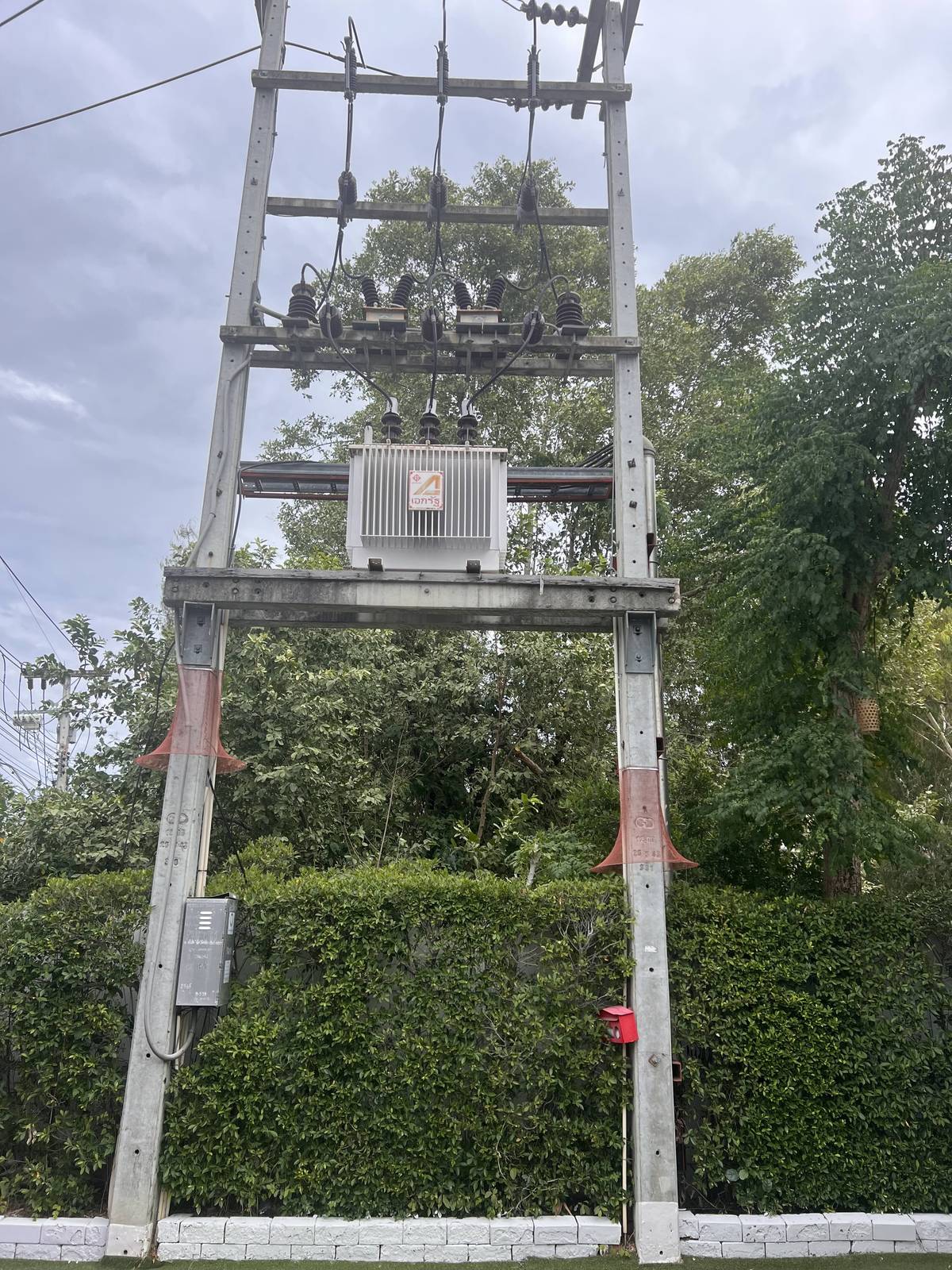 The replaced transformer, new, on poles and crossarms that are not
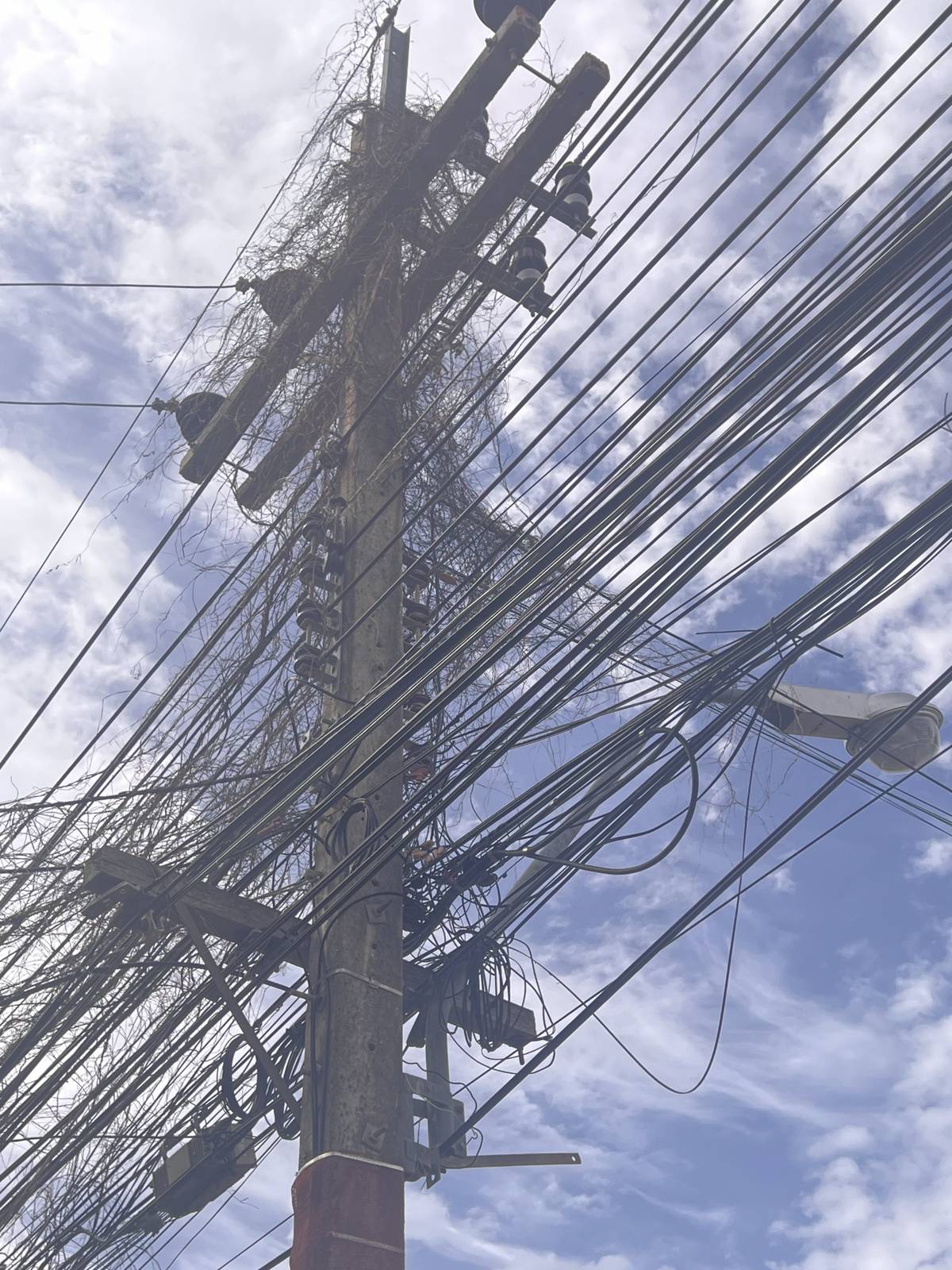 An ordinary pole in the street. The medium-voltage conductors are the clean cables up top; the rest is telecom, much of it abandoned
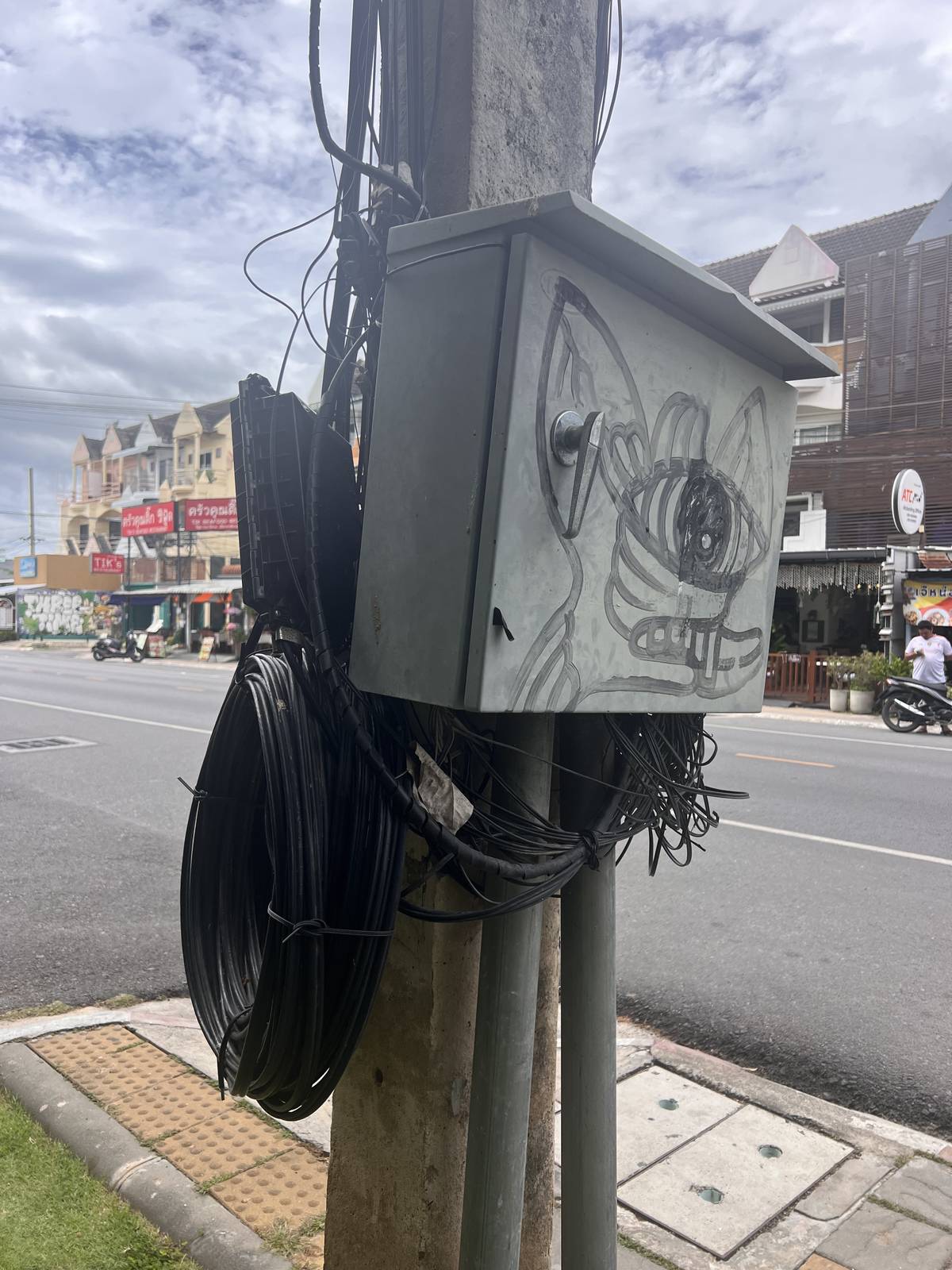 Same street, another pole: tactile paving for the blind, and fifty centimetres away a tagged cabinet with twenty metres of coiled cable
VIII. And yet living here is good
Everything above describes a country that has stopped catching up. It does not describe a country falling apart, and it is worth being precise about that, because this is where most articles go wrong. Thailand has huge foreign exchange reserves, no debt crisis, zero inflation, and infrastructure well above the average for its income bracket. Public debt does stand at 66.7% of GDP as of April 2026, against a legal ceiling of 70%, and net borrowing space has narrowed to 1.5% of GDP. No crisis, then, but no room either: if the state wanted to carry an investment recovery itself, it could barely do so.
Health is the best example. The universal coverage scheme introduced in 2002 leaves households paying 9.9% of health spending. That is the same order as France, at 9.2%, and far better than Korea at 33.7% or Malaysia at 37.1%. Life expectancy is 76.6 years against 83 in France, but it is achieved with 4.5% of GDP spent on health where France spends 11.5%. It is a public policy success and it is regularly cited as one.
Here are the prices, from our own receipts of summer 2026, at about 37.5 baht to the euro.
| Item | Baht | Euros |
|---|---|---|
| Specialist consultation, private hospital | 1,300 | 35 |
| Orthopaedist consultation, X-ray and physiotherapy session, same visit | 3,901 | 104 |
| Physiotherapy session alone: hot pack, ultrasound, rehab exercise | 2,155 | 57 |
| One hour of chiropractic and physiotherapy massage, private clinic | 2,700 | 72 |
| Full visit with five prescribed medicines | 2,351 | 63 |
| Dermatologist: consultation, liquid nitrogen, procedure room | 4,375 | 117 |
| Mammogram, bilateral breast ultrasound and consultation | 5,380 | 143 |
| Dentist: examination and two X-rays | 700 | 19 |
| Dentist: five composite fillings, 1,000 baht a tooth | 5,000 | 133 |
Two qualifications are needed on my same-day appointment. Thailand has 0.5 doctors per thousand people, France has 3.3. So it is not medical abundance that produces this access. And these amounts are those of an international private hospital, paid directly. It is the experience of a foreigner who takes out his card, not that of a Thai covered by the universal scheme, for whom the queues at the public hospital are another story. Forget that and the comparison with France stops meaning anything.
That availability is not an accident, there is an industry behind it. Thailand has 65 facilities accredited by the Joint Commission International, more than any other country in Southeast Asia, and expects around four million foreign patients this year. The private circuit that sees me the same day was built for people who travel a long way to be operated on, and I benefit from its spare capacity.
The rest is in keeping. Electricity reaches 100% of the population, as in France. Fixed broadband puts the country thirteenth in the world, at around 237 Mbps on average, third in Southeast Asia. On safety, I compared the Thai and French figures in an earlier post and I will not go over it again.
Optimism has its spokespeople too, and they are worth listening to. At the Bangkok Post’s eightieth anniversary forum, the head of Citi Thailand, Narumon Chivangkur, argued that the country is stronger than it thinks: Detroit of Asia, Kitchen of the World, Land of Smiles, a base to build on. She proposes moving from assembling foreign chassis to building autonomous software, and from agricultural raw materials — rice, sugar, cassava — to bio-circular products.
The sorting does itself, given what comes before. Autonomous software, on 0.94% of GDP spent on research and with pupils at a twenty-year low, is a wish, and it is precisely the kind of symbolic ambition TDRI holds against Thai industrial policy. Moving up the food-processing chain is defensible, the base is there. On health she is simply right. And the three nicknames she cites all describe what the country has been, which is the heart of the problem. Her conclusion, on the other hand, is exactly TDRI’s: be precise about what you want to do.
IX. The two halves are the same fact
Which brings us back to the question at the start. Why is it so cheap?
The general price level is worked out by comparing GDP per head in current dollars with GDP per head in purchasing power parity. Done for Thailand and for France, it puts the Thai price level at 40% of the French one. A euro converted at the market rate buys two and a half times here what it buys in France.
Now, Thai real living standards are at 39.9% of the French level.
The two figures are the same. It is not a coincidence: a country is cheap in exactly the measure that it is less productive.
It is worth saying where, though. That 40% is an average, and it covers a gradient rather than a single price. In the basement of the Market Village, which is already not the pavement, a chicken leg, sticky rice and mineral water come to 82 baht, two euros twenty, and the street goes lower still. At the Hyatt Regency, which is the top of the range in Hua Hin and which I am using here as an upper bound, two teas at the Barai cost 859 baht on 17 August, twenty-three euros, and two pizzas with a Spritz and a beer 1,743 baht the same evening, forty-six euros. Paris prices, if not above.
In between there is everything you like. At the Nescafé counter in that same shopping mall, where I often have a coffee, a cappuccino is 65 baht, an americano 55, an Italian soda 60. Under two euros, roughly half the French price. At the Barai, tea works out at 429 baht each, eleven euros fifty, which is what it would cost in an equivalent place in France.
The gradient is there, and it can be read over three kilometres. The street, then the food court at two euros twenty for a full meal, then the mall counter at half the French price, then the luxury hotel at the French price outright. The gap narrows the further you move from the local circuit, and at the very top it has gone completely. That is why an expatriate’s basket rises faster than the general Thai index, and it is the same reason health insurance becomes harder to pay for with age.
That gradient shows up item by item, which is probably what interests anyone thinking of coming here.
| Item | Here | In France | Ratio |
|---|---|---|---|
| Full meal | €2.20 | about €15 in a restaurant | 15% |
| Coffee at a counter | €1.75 | about €3.50 | 50% |
| Household electricity | €0.105/kWh | €0.200/kWh | 52% |
| Petrol | €0.95/l | about €1.75/l | 55% |
| Two teas in a luxury hotel | €23 | about €23 | 100% |
The ordering is not random, it follows how much Thai labour there is in the price. A meal is almost entirely local labour. A coffee in a mall adds an imported product and a brand. Electricity and petrol contain a fuel that both countries buy at the same world price, and what gap remains comes from French taxation and Thai subsidy. Tea in a luxury hotel is sold to an international clientele and there is no gap left at all.
Housing deserves a sentence of its own, because it is the largest item in a budget and the most misunderstood. The two flats I rented this summer, two rooms, a hundred metres from the beach, with a pool and a gym, cost me 27,000 and 30,000 baht a month, or 720 and 800 euros. Those are low-season rates: in December the same flats go for 40,000 or 45,000 baht, and the contract I signed for the second one provided for a trial month at that rate, then renewal by the month or by the year. An ordinary two-room flat in a mid-sized French provincial town rents for 600 to 800 euros, and more than a thousand in a seaside resort. Like for like, the gap is therefore still about half. But for someone comparing with what they paid before leaving, the rent does not fall: it is the flat that changes category. For a car, I rent a small Japanese saloon at 575 baht a day on a two-hundred-and-nine-day contract, fully insured and delivered, which comes to 17,500 baht a month or 467 euros. That is another item where the gap closes: an equivalent long-term rental in France is in the same range, and most retirees there own their car rather than rent it.
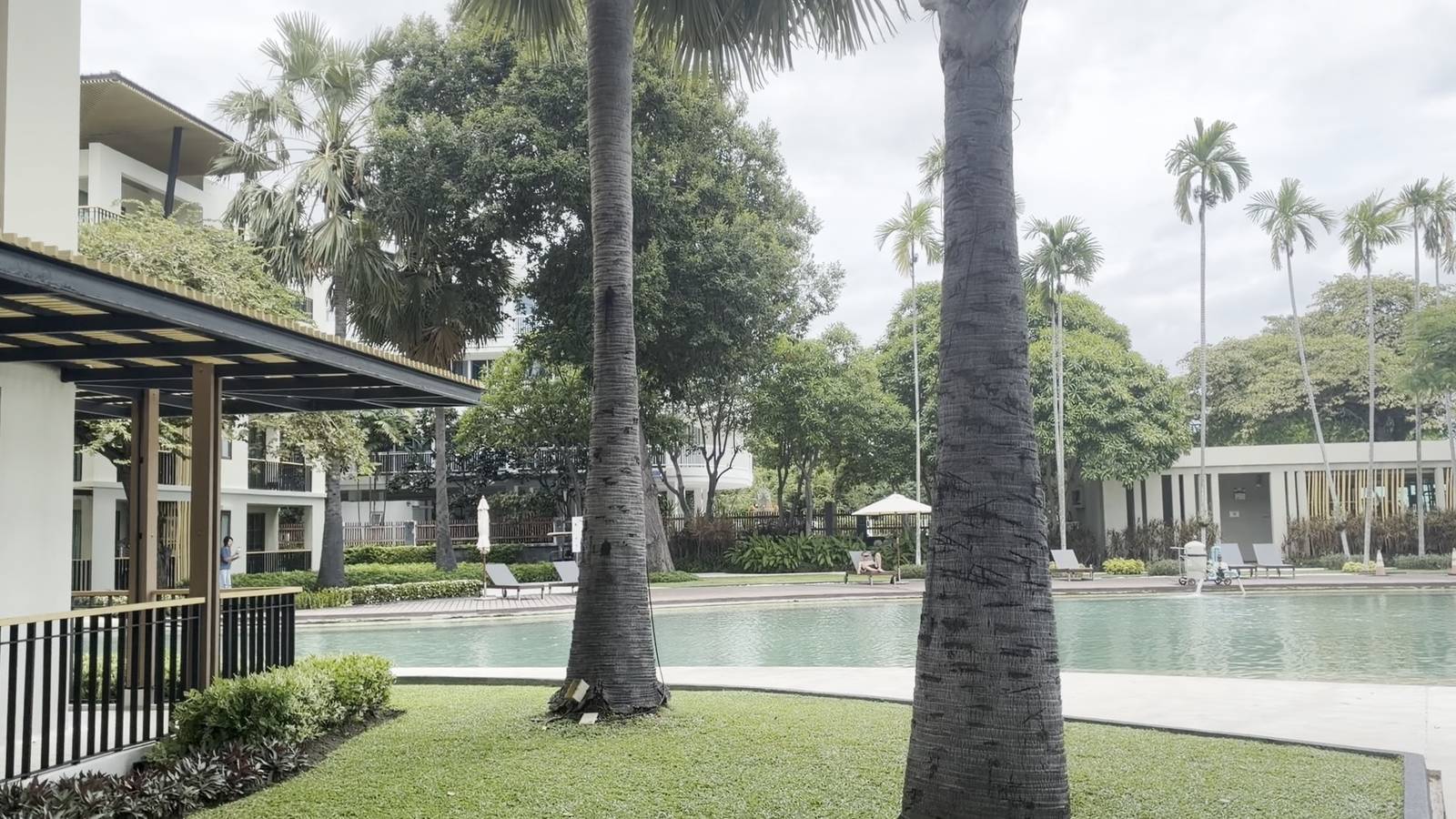 The Khao Takiap residence: two rooms at 30,000 baht a month, pool and maintained garden included, a hundred metres from the beach
It is worth saying what the person serving me earns. The Thai minimum wage has been 337 to 400 baht a day depending on the province since 1 July 2026, or 8,800 to 10,400 baht a month. The national average wage is 15,700 baht, 22,300 in Bangkok. And more than half the workforce is informal, so the legal floor covers fewer people than the figure suggests.
My own receipts read differently in that light. The 82-baht meal is a fifth of a day at the minimum wage. The two teas at the Barai, two days. The specialist consultation, three days. The full mammogram, two weeks. And the rent I pay each month comes to nearly two months of the average Thai wage.
Put another way, the prices I pay are low because Thai wages are low, and wages are low because the country stopped catching up. An expatriate’s purchasing power is therefore measuring exactly that shortfall. It is not very comfortable to write when you have lived here for years and you like the place.
It should be added that the arbitrage is eroding, but not for the right reason. It is not eroding because Thailand is catching up, it is eroding through the exchange rate and through prices. In 2005 the euro was worth 50 baht, today it is worth 37. Taking a French pension from 2005, uprating it by French inflation, converting it each year at the European Central Bank rate and deflating it by Thai inflation gives this.
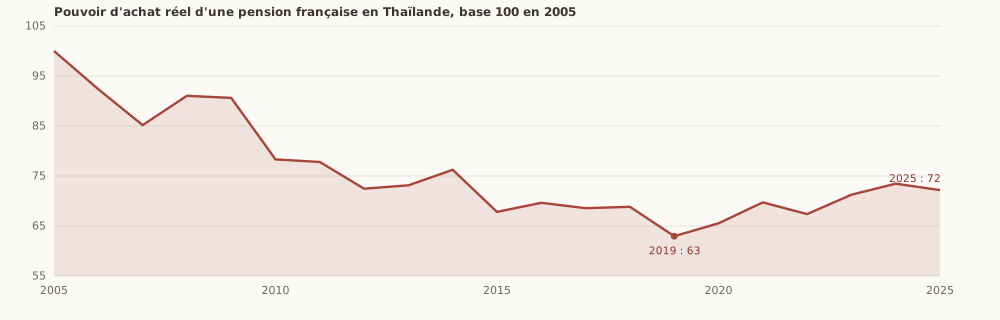 A 2005 French pension uprated by French inflation, converted at the annual ECB rate, deflated by Thai inflation. Base 100 in 2005
A quarter of real purchasing power gone in twenty years, the loss reaching 37% at the 2019 trough, with a partial recovery since. And it is an optimistic calculation, for two reasons. An expatriate’s basket — private healthcare, condominium rent, imported goods — rises faster than the general Thai index. And it assumes a pension indexed to French inflation, which is less and less certain: the freeze planned for 2026 helped bring down a government, and the 2027 budget is studying a partial freeze above 3,000 euros. A pension frozen for five years would lose another ten points on that curve.
So Thailand remains a very good deal for a European retiree, and on the face of it will remain one for as long as it has not caught up.
But caught up with what?
Notes on method
- Two breaks, not one. The fall in the investment rate dates from 1997, but industry’s share of GDP holds until 2010 and only declines afterwards. The article treats them separately, a financial phase and a competitive one. Presenting the whole decline as a consequence of 1997 would be wrong.
- The 43.6 billion dollars of foreign investment in 2025 are applications filed with the Board of Investment, not realised balance-of-payments flows. The two measures always differ, sometimes widely. That is precisely why the rise does not show up in gross fixed capital formation.
- Thailand’s current account surplus reversed in 2026, with a record deficit of 7.6 billion dollars in April and 3.5 billion still in June. The Bank of Thailand considers the move temporary, driven by oil and capital goods imports. If the balance does not close again, the reading in section IV will need revising.
- Registered capital is not realised investment. It is a legal declaration to the register, and a Thai company can be formed with minimal capital. The 224% rise in the capital of closing firms may also come down to a small number of very large entities. What makes the figure meaningful is that the fall in new-business capital is recorded across every size band.
- The medical prices quoted are those of an international private hospital, paid directly. They say nothing about what a Thai covered by the universal scheme pays, nor about waiting times in public hospitals.
- Thailand’s medical tourism ranking is not used. Rankings vary depending on whether arrivals, revenue or a composite index is counted. Only the number of facilities accredited by the Joint Commission International is cited, because it can be verified.
- The rents quoted are two personal tenancies from summer 2026, not a market average. One of the two was booked through a platform and billed in euros, fees included. These are low-season rates; high season runs 40 to 50% higher for the same flats, and the figure for a twelve-month lease negotiated up front has not been verified against a quotation. And a beachfront flat with a pool has no direct equivalent in the ordinary French rental stock, which makes the comparison indicative.
- The income from a pineapple holding is a reconstruction, not a published figure. It combines the national average yield (23 t/ha), the median holding size, the 2025 price and cultivation cost from the Office of Agricultural Economics, and a cycle of three harvests in four years. The cultivation cost probably excludes family labour, the price used is for processing-grade rather than fresh fruit, and a well-run holding beats the national average. It is an order of magnitude, not an observed income.
- The Hyatt is an upper bound, not an average price. It is there to show where the gradient stops, not to describe the cost of living.
- The pension calculation assumes uprating in line with French inflation. Pensions are often uprated by less, and an expatriate’s basket rises faster than the general Thai index. The real erosion is therefore greater than the 26% shown.
- Thai fertility differs by source: 1.20 in the World Bank and UN series for 2024, 0.87 on births registered in Thailand in 2025. The two do not measure the same thing; the article uses the international series, which is the more cautious.
- Grid reliability is not compared. The outage-duration figures in circulation rest on inconsistent definitions. Only access, at 100%, is cited.
- Industrial electricity prices vary by band and tariff period. The figures used are published national averages, useful for an order of magnitude, not for a quotation.
Sources
Long series — IMF, real GDP growth, World Economic Outlook database, October 2026 edition · World Bank, GDP growth · gross fixed capital formation · gross savings · current account · domestic credit to private sector · GDP per capita · GDP per capita, PPP · manufacturing value added · research and development · fertility rate · population aged 15 to 64 · consumer price index · access to electricity · employment in agriculture · agricultural value added · cereal yield · Chaiwat Sowcharoensuk, Agricultural Transformation, Krungsri Research, 19.09.2025
Thailand, press and institutes — Pravit Rojanaphruk, A preliminary case for Thailand entering its second lost decade, Khaosod English, 20.08.2026 · NESDC, second-quarter 2026 growth · TDRI, urges Thailand to build technology, not just host FDI, The Nation, 21.08.2026 · TDRI, Rescuing the sick man of Asia through the Productivism paradigm, July 2026 · Jareeporn Jarukornsakul, Beyond 50 Years of Diplomacy, WHA Corporation, 18.08.2026 · The Nation, education roundtable, 31.05.2026 · The Nation, unsold housing in Greater Bangkok · The Nation, condominium transfers to foreign nationals, first half of 2026, REIC data, 29.08.2026 · The Nation, data centre rules · The Nation, tariff reform of 15.07.2026, households and data centres · Khaosod English, births at a 75-year low, 17.01.2025 · Bangkok Post, Thailand-EU trade talks · Bangkok Post, June 2026 current account deficit · Bank of Thailand, lessons from the 1997 crisis · Ammar Siamwalla, Anatomy of the Thai Economic Crisis, TDRI, 2000 · Asian Development Bank, financial restructuring after 1997 · PIER, effects of the 300-baht minimum wage · Asia News Network, Chinese EV plants in Southeast Asia · BOI, EV incentives · The Nation, vehicle sales January to July 2026, Federation of Thai Industries, 26.08.2026 · The Nation, KT Dialogue roundtable, TDRI, PwC and NESDC, 27.08.2026 · The Nation, long-term unemployment and the automotive transition, NESDC data, 2026 · NESDC, Thailand’s Social Outlook, first quarter 2026 · NESDC, second-quarter 2026 social outlook, presented 24.08.2026: employment, household debt, El Niño · SCB EIC, household debt · Bangkok Post, public debt and the legal ceiling, 2026 · minimum wage by province, 01.07.2026 · Nikkei Asia, Chinese arrivals · Reccessary, foreign investment 2025 · The Nation, company register, first half of 2026, 23.08.2026 · The Nation, Thai Retailers Association, 08.2026
Health, education, comparisons — OECD, PISA 2022, Thailand country note · World Bank, out-of-pocket health expenditure · Doctolib via franceinfo, forgone care in 2025 · Europe 1, median waiting times by department · European Central Bank, euro-baht reference rates · Speedtest Global Index, fixed broadband · Bangkok Post, Vision Thailand forum, remarks by Narumon Chivangkur, Citi Thailand, 08.2026 · Joint Commission International, accredited facilities in Thailand · East Asia Forum, lagging post-Covid recovery · LCP, French debate on pension indexation
Own records — medical invoices from Bangkok Hospital Hua Hin, Nana Dental Clinic and Spine Clinic, July and August 2026 · receipts from the Street Food Market and the Nescafé counter menu, Market Village Hua Hin, 22.08.2026 · receipts from the Hyatt Regency Hua Hin and the Barai, 17.08.2026 · photographs taken at Ban Sansuk and Khao Takiap, August 2026.
Statistical series retrieved on 22 August 2026, press sources up to 26 August. The 2026 figures are partial. The long-series charts can be regenerated from the raw data.