Ten Years of Violence in Thailand
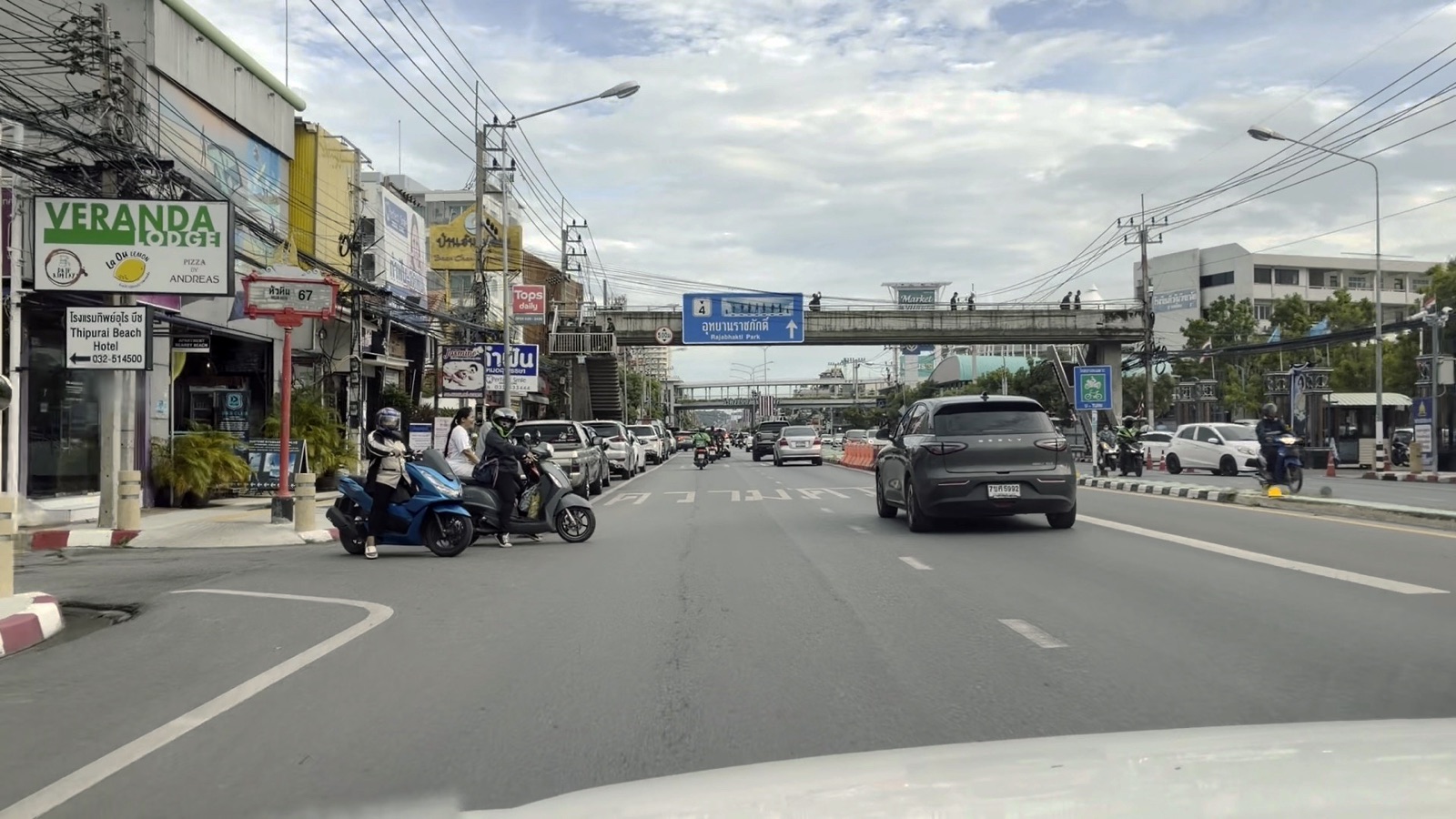 Route 4 in Hua Hin, a weekday afternoon
On 7 August, a fourteen-year-old boy killed eight people at his school in Nonthaburi, on the outskirts of Bangkok.
Three weeks earlier, on 22 July, around ten armed men attacked a checkpoint in Narathiwat, in the south of the country. Five soldiers killed, six civilians wounded, two of them children.
In between, in early August, the bodies of Diana Nazimova, a 22-year-old Russian, and her 17-year-old brother Roman were found near Pattaya. Then those of a Thai family of three, buried alongside them. The main suspect had been released from prison seven weeks earlier; he is alleged to have killed in order to steal motorcycles. That case shocked everyone, foreigners and Thais alike. The victims’ mother came to thank the Thai people at a memorial in Chon Buri, the prime minister called it a crime that damages the country’s reputation, and a former deputy prime minister — also a former justice minister — called for executions to resume as soon as a death sentence becomes final. Thailand has not carried one out in nine years.
I wanted to know what the figures actually said — with Claude’s help, we went looking for the numbers for Thailand and France. The sources are listed at the bottom of the page. Four measures of violent death in Thailand, each compared with France. The ones people talk about most are the ones that kill least. Both countries also measure the feeling of insecurity. It does not follow the homicide curve — which does not mean it is groundless.
I. Orders of magnitude
On Thai roads, around fifty people die every day. On French roads, about ten — for almost the same population. That is the largest gap between the two countries, and it has nothing to do with the violence people usually discuss. Murders, terrorist attacks, mass shootings, the southern war: all of it together amounts to one eighth of Thailand’s road deaths.
1 · What kills every day — scale from 0 to 30 deaths per 100,000 people
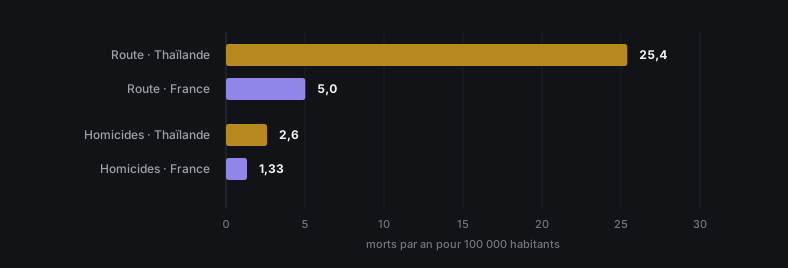
Thailand’s roads kill five times more than France’s, and ten times more than every murder in Thailand combined. It is the only genuinely massive gap between the two countries — on homicide, they are almost level.
2 · What kills in bursts — scale from 0 to 0.5, sixty times finer than above
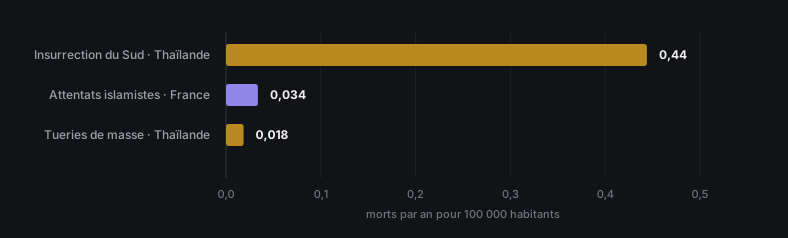
The forgotten war in southern Thailand kills thirteen times more than terrorism in France, and twenty-four times more than the shootings people talk about. And yet: the southern insurgency kills in a year what Thailand’s roads kill in a week.
Watch the change of scale between the two charts. End to end, Thailand’s roads kill 1,400 times more than Thailand’s mass shootings.
The same quantities in absolute numbers, for comparable populations — 72 million people in Thailand, 68 million in France:
| Thailand | France | |
|---|---|---|
| Roads | ≈18,000 a year | 3,432 in 2024 |
| Homicides | ≈1,800 a year | 976 victims in 2024 |
| Political violence | ≈320 a year (southern insurgency) | ≈23 a year (islamist attacks) |
| Mass shootings | ≈13 a year | — |
II. Homicide, since 1990
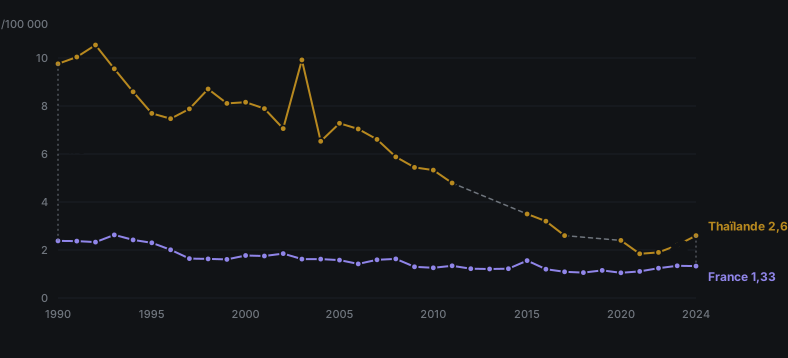 Homicide rate per 100,000 people. Thailand: World Bank up to 2011, then UNODC compilations — the dotted segments mark years with no published figure, not estimated values. France: SSMSI, continuous series
In 1990, Thailand killed four times more than France. In 2024, twice as much. The Thai rate has been divided by four in one generation.
Beware the reading trap, the one every commentary is repeating right now. Comparing 2024 with 2021 gives a 40% rise. But 2021 was Thailand closed, with no tourists and intermittent curfews — the quietest year ever recorded in the country. Compared with 2016, that same year 2024 is a 19% improvement. On the French side, the rise since 2020 is real but only brings the rate back to its 2011 level. The French peak in 2015 contains the January and November attacks.
One detail I did not expect: France has 19.6 firearms per 100 inhabitants, Thailand 15.1. Same source, same year. Thailand leads Southeast Asia, but France holds more. The stock of weapons therefore does not explain the gap in armed violence between the two countries.
III. The roads, the only slaughter
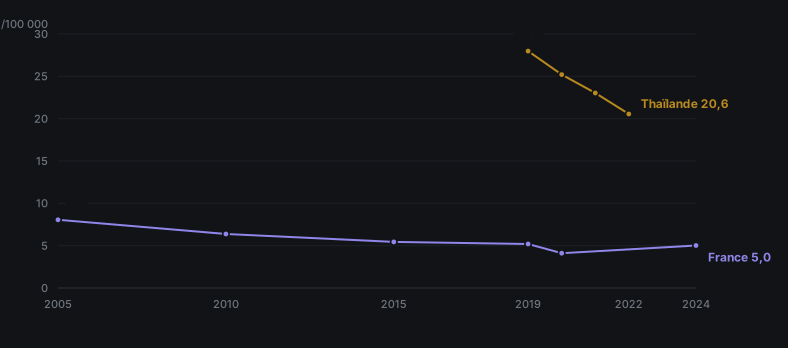 Road deaths per 100,000 people, official figures from both countries divided by population. Only the available years are plotted: the solid lines connect widely spaced points, they interpolate nothing
A Thai person is roughly four to five times more likely to die on the road than a French person, and ten times more likely to die there than to be murdered at home. About 84% of those deaths are on motorcycles.
The figures are disputed: for 2021, competing estimates for Thailand range from 7,000 to 22,000 deaths, depending on whether a death occurring in hospital is attributed to the crash.
Deaths are falling, serious injuries are not
Counting the dead is convenient: the criterion is clear and nobody disputes it. But it says only part of what happens on a road, and France publishes enough to check.
| France | 2024 |
|---|---|
| Killed | 3,432 (against 4,120 in 2010) |
| Seriously injured | 16,000 (≈18,000 a year over 2010-2019, rising; 16,600 in 2025) |
| Injured, all degrees | ≈236,000 |
The two curves do not move together: mortality falls, serious injuries stagnate and start climbing again. Two explanations compound each other, and neither is reassuring. Emergency medicine turns into a serious injury what would once have been a death. And the composition of traffic is changing: pedestrians, cyclists, scooters and motorcycles account for 45% of deaths but 66% of serious injuries. These are crashes people survive more often than a head-on collision in a car.
On the Thai side the scale is far heavier: the Ministry of Public Health records 1,170,708 serious injuries between 2018 and 2022, around 234,000 a year. Road crashes are estimated to cost the country close to 7% of its GDP.
Two warnings. The two serious-injury figures are not comparable: France applies a precise medical criterion, the Thai count is a broader hospital tally. And above all, neither country publishes the number of people left with a permanent disability. On the Thai side there is a unit cost — 4.8 million baht per permanent disability — which implies a count exists somewhere, but nobody makes it public.
IV. Mass shootings, terrorist attacks, insurgency
A mass shooting and a terrorist attack are the same act: one or two individuals, weapons, many deaths in a few minutes. The motive changes, the body count does not. Separating them would mean choosing what to count according to what one wants to prove.
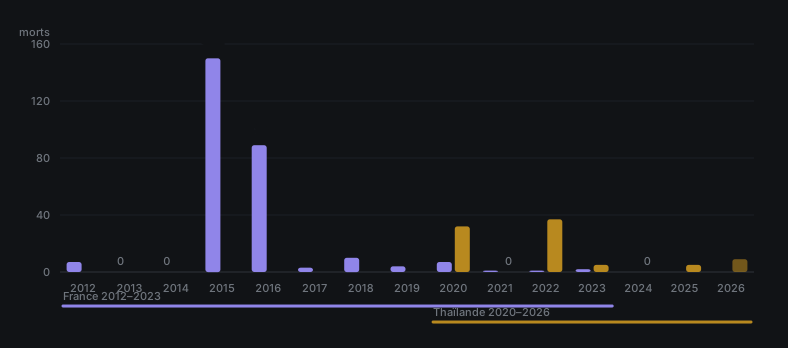 Deaths per year, victims only — the perpetrator is not counted. France: Le Figaro / DGSI tally of islamist attacks, 274 deaths between March 2012 and December 2023. Thailand: AP list of notable shootings since 2020, 88 deaths. The two series do not cover the same years
Eight Thai episodes in seven years:
| Date | Place | Deaths | Perpetrator |
|---|---|---|---|
| 9 Jan 2020 | Lopburi | 3 | school headmaster, 38 |
| 8 Feb 2020 | Nakhon Ratchasima | 29 | soldier, 32 |
| 6 Oct 2022 | Nong Bua Lamphu | 37 | former police officer, 34 |
| 23 Mar 2023 | Phetchaburi | 3 | man, 14-hour siege |
| 3 Oct 2023 | Bangkok, Siam Paragon | 2 | boy, 14 |
| 28 Jul 2025 | Bangkok, Or Tor Kor | 5 | man, personal grudge |
| 11 Feb 2026 | Hat Yai | 1 | boy, 17 |
| 7 Aug 2026 | Nonthaburi | 8 | boy, 14 |
Two years out of seven are at zero — and a single day, 6 October 2022 at Nong Bua Lamphu, accounts for 42% of the total.
What has changed on the Thai side is not the volume but the age. The last three shootings were the work of minors — 14, 17 and 14 years old. The first two, of men in their thirties whose careers had collapsed.
The conflict nobody counts
Since January 2004, the separatist insurgency in the three southern provinces — Pattani, Yala, Narathiwat — has killed around 7,000 people. That is twenty-five times the toll of islamist terrorism in France over a comparable period, and eighty times that of Thailand’s mass shootings.
The exact count depends on who is counting: 5,999 deaths according to the joint police-army-administration committee that certifies compensation (10,116 incidents, 3,661 civilians, 2,338 state personnel, January 2004 to December 2025), but 7,000 to 7,700 in wire reports and academic tallies, which include insurgents killed and uncompensated cases. The gap between the two — close to two thousand deaths — is itself a piece of information.
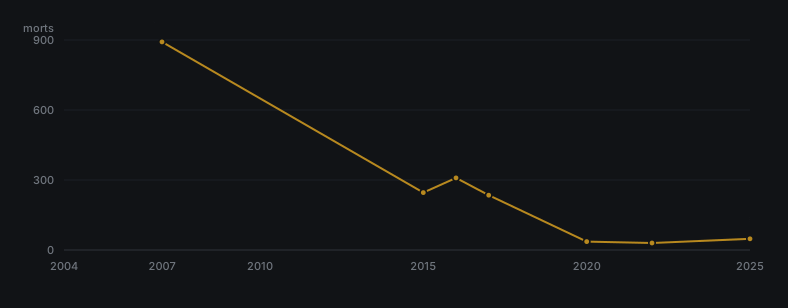 Deaths per year in the southern Thai insurgency. Verified official figures, January 2004 to December 2025. Only the publicly cited years are plotted
And it continues. On the evening of 22 July 2026, around ten men in black, arriving by pickup and motorcycle, attacked the Bukeh Sami checkpoint in Ra-ngae district, Narathiwat. Firearms and homemade bombs: five rangers killed, six civilians wounded including two children, and three AK-47s, three bulletproof vests and three phones taken. Prime Minister Anutin Charnvirakul called it a terrorist attack. It was three weeks before the Nonthaburi school shooting.
That is the omission that struck me while building this page. People talk about Thai shootings because they happen where the tourists go, and as for the South — 7,000 deaths in twenty-two years, three hours’ drive from Hat Yai. The deadliest conflict in either country is also the only one whose toll is not precisely known.
V. Online fraud, the crime that is really rising
Ten years ago online fraud was invisible. In a decade it has become Thailand’s leading crime by number of victims. Around 277,000 cases a year, and losses of close to a billion euros.
A crime that kills nobody but destroys lives.
| Thailand | France | |
|---|---|---|
| Fraud victims | ≈277,000 a year | 411,700 in 2023 (250,900 in 2016) |
| Per 100,000 people | 386 | 605 |
| Losses | ≈€800M a year | €4.5bn in 2023 (€2.3bn in 2016) |
And here the ratio reverses. France records more fraud victims than Thailand, and losses six times heavier per head. With the same caveat as everywhere else: France has an online complaint platform and a statistical service that has been counting since 2016, Thailand has been recording since 2022. Part of the gap measures the quality of the reporting channel, not the industry of the fraudsters.
Both countries have seen a mass crime appear within a decade that leaves neither bodies nor any trace in the street.
Then there are drugs, which have no French equivalent. Thailand seized 130 tonnes of methamphetamine in 2024, the first country in the region to pass 100 tonnes in a single year, along with a billion yaba tablets. Production in the Golden Triangle has changed order of magnitude since the Burmese coup of 2021. It is the quiet link between the curves: most ordinary provincial violence — the score-settling, the shots fired at village fairs — probably has a drug file somewhere.
VI. What gets counted, and what does not
In France, the homicide rate has fallen by 44% since 1990. And since 2007, the first year fear was measured, the share of French people naming insecurity as their top concern has risen from 15% to 25%.
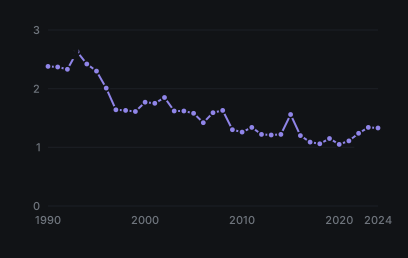 What gets counted — French homicide rate per 100,000 people, 1990-2024 (SSMSI)
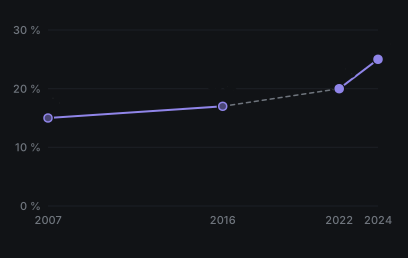 What gets felt — share of French people naming insecurity as their top concern. Cadre de vie et sécurité surveys (2007-2021) then Vécu et ressenti en matière de sécurité (since 2022). Solid circle = published value; pale circle = value read off the curve. Methodological break in 2022
The scales have nothing in common, which is why the two charts are separate rather than stacked on twin axes. French road mortality follows the same slope as homicide: 18,034 deaths in 1972, 3,432 in 2024, divided by five.
In 2020, Éric Dupond-Moretti, then justice minister, replied to interior minister Gérald Darmanin, who had spoken of “ensauvagement” — a return to savagery: “Ensauvagement is a word that develops the feeling of insecurity.” He put that feeling down to economic hardship, Covid and rolling news channels.
The figures prove him partly right and partly wrong. Right on homicide. Wrong on the rest: recorded assaults rise from 222 per 100,000 in 2003 to 633 in 2024, sexual violence from 43 to 145. Part of that comes from tougher law and greater reporting. Not all of it.
In Thailand, the same gap seen differently
There is no equivalent Thai series: nobody measures fear there year after year. What exists is a snapshot — the Thailand Institute of Justice surveyed 8,445 people across ten provinces in 2018.
So it does not show the same thing as the French curves. Those set two trends against each other over seventeen years; the Thai survey compares ten provinces at a single moment. The gap appears in space instead of in time: the provinces where people feel least safe are not the ones where people are most often victims.
Nationally, 78.4% of respondents say they feel safe walking alone at night in their neighbourhood — 96.5% during the day, 87% alone at home at night. And 4.1% report having been a victim of a crime over the past year: 336 people out of 8,179, of whom 259 for simple property offences and 38 for bodily harm. The national average is reassuring; its distribution is not.
| Province | What people feel | What people suffer |
|---|---|---|
| Khon Kaen (Mueang district) | 59.7% feel safe at night — the lowest of the 22 districts surveyed | low victimisation |
| Nakhon Si Thammarat | population declares itself safe | 2nd highest victimisation rate of ten |
| Phuket | same sense of safety as elsewhere | 3rd highest victimisation rate of ten |
The Khon Kaen neighbourhood in question is full of student rentals and nightlife, and the authors note an absence of any neighbourly life there. A fear that comes from anonymity, not from risk.
The two provinces where the risk is highest are the ones where fear is lowest. One of the two measures tracks a trend over seventeen years, the other compares ten provinces at a single moment. Neither finds any link between fear and the homicide rate. That is a result about what these surveys measure — not proof that the fear is groundless. What feeds it may lie elsewhere, in what none of these indicators counts.
Three limitations, two of them stated by the authors themselves. The survey dates from 2018 and has not been repeated: it predates the shootings of 2022 and 2026 and the wave of online fraud, so it measures the state of things before. The report publishes no numerical table by province — it gives one district percentage and a set of rankings, reproduced here as such rather than inventing values. And above all, the authors warn that “the victimisation rate should be used with caution”: the questionnaire was built to measure fear, not victimisation.
VII. What happens to complaints
There is a missing link between what is counted and what is felt, and it explains a good part of the gap: filing a complaint almost never leads to a trial. In 2024, French prosecutors handled 4,219,463 cases.
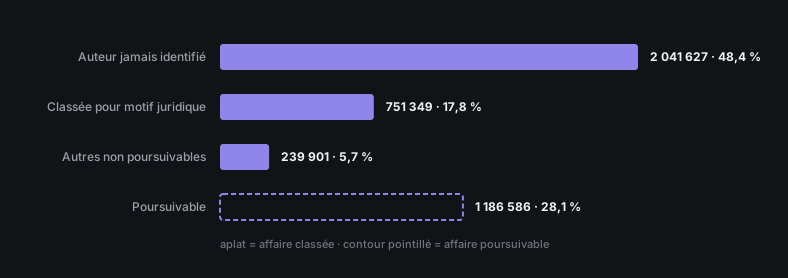 Ministry of Justice, Références statistiques Justice*, 2024 edition*
Seven cases out of ten are judged non-prosecutable — but in two thirds of those, the perpetrator was simply never identified. That is an investigative failure, not a decision to drop the case.
The genuinely discretionary share is smaller, and it is not zero: of the million prosecutable cases, the criminal-response rate is 82.9%. The remaining 17% — around 203,000 cases a year — are dropped because prosecutors judge prosecution inappropriate. On domestic violence, a joint Interior-Justice study covering 2018-2023 finds that 42% of cases are dropped.
In Brittany, the Rennes public prosecutor’s office recorded 3,870 proceedings for sexual violence against minors, 2,000 of them ongoing in Ille-et-Vilaine alone. The jurisdiction has 5.1 investigating magistrates per million inhabitants, a shortfall of fifteen posts.
On the Thai side, the question has no answer
There is no published equivalent of the dropped-case statistic. What exists says exactly the opposite: the Royal Thai Police claim a 93% clearance rate, 479,516 cases solved out of just over 500,000 recorded in 2024.
But France records 4.2 million for 68 million inhabitants, around 6,200 cases per 100,000 — against 700 in Thailand. Nine times fewer. These two numbers are not comparable, and that is the whole point: the French figure aggregates everything that reaches prosecutors, the Thai one counts only cases opened by the police. Thai justice does not abandon complaints: it never receives them. A 93% clearance rate on a funnel nine times narrower does not measure efficiency, it measures selection at the entrance.
Two mechanisms explain that narrowness. Settlement: a large share of Thai offences are compoundable — assault, fraud, defamation, breach of trust, some sexual offences. Victim and accused can agree on compensation, and payment extinguishes the right to prosecute; the case disappears before it becomes a statistic. Non-reporting: documented by the Thais themselves, a national victimisation survey has been running since 2008 precisely to measure this “dark figure”.
What the figures do not count
An example that appears in no statistic. In my Breton village, on the coast, very quiet, several neighbours have been burgled. In most cases, nothing followed. Another acquaintance reports thefts of his work tools in the countryside; the gendarmes did not come out to collect the CCTV footage. So people have stopped filing complaints, they are losing confidence in the system.
Methodological caveats
- These are recorded facts, not committed facts. Under-reporting remains significant on both sides, especially for sexual violence and assaults between people who know each other. A rise may be nothing more than a rise in complaints.
- Reporting improves over time, which mechanically inflates recent years. Thailand’s rate of 10.5 per 100,000 in 1992 was probably underestimated, not overestimated — so the real gap with today is wider still.
- The homicide rate underestimates violence over long periods. Advances in emergency medicine turn into a serious injury what would have been a death thirty years ago. The section on roads shows the same effect on cleaner data.
- The Thai homicide series changes source in 2015. The 1990-2011 block comes from the World Bank; the 2015-2024 block from UNODC compilations. The join is plausible but not certified.
- Road deaths vary by a factor of three depending on the Thai source. The figures used here are the official ones, the lowest of the serious estimates. On the French side, the definition changed in 2005 — deaths within 6 days before, within 30 days after.
- The measure of insecurity changed instrument in 2022, when the Cadre de vie et sécurité survey gave way to Vécu et ressenti en matière de sécurité. Part of the jump measured between 2019 and 2022 is down to the change of questionnaire, and nobody knows how to quantify it.
- Counts of the southern insurgency differ by nearly two thousand deaths. This page uses ≈7,000 for the averages, but the annual curve follows the lower count, the only one available year by year.
- A mass shooting and a terrorist attack are counted together here because the motive does not change the number of dead. That is a choice, and it can be disputed: it brings together phenomena whose causes and remedies have nothing in common.
Sources
Thailand — Crime in Thailand (Wikipedia) · TheGlobalEconomy, homicide rate · WHO Thailand, road safety · Asian Transport Observatory, Road Safety Profile 2025 · AP, high-profile shootings since 2020 · Royal Thai Police, cybercrime figures · UNODC, Synthetic Drugs in East and Southeast Asia 2025 · Khaosod English, 2024 clearance rate · Sudarak Suvannanonda, Fear of crime in Thailand, TIJ · The Nation, 22 years of insurgency · Al Jazeera, 22 July 2026 attack · Bangkok Post, Down with the death penalty? · Thai Examiner, call to resume executions · The Star, Chon Buri memorial
France — Crime rate in France (Wikipedia, FR) · SSMSI, crime and delinquency in 2024 · ENS Lyon, measuring the feeling of insecurity · ONISR, key road-safety figures 2024 · Ministry of Justice, statistical references 2024 · Franceinfo, 42% of domestic-violence complaints dropped · France 3 Brittany, Rennes prosecutor’s office · Islamist terrorism in France (Wikipedia, FR) · SSMSI, fraud 2016-2023
Both — World Bank, intentional homicides · Small Arms Survey, Civilian Firearms Holdings 2017
Compiled on 14 August 2026. Figures for 2026 are partial.