The State Pays the Press. Now It Wants to Grade It.
 For a subsidised press, money falls from the sky. A miracle that has been repeating itself for fifteen years.
I never voted for this. Neither did you, probably.
Every year the French state pays roughly 4 billion euros to the media. 3.8 billion go to public broadcasting — France Télévisions, Radio France, Arte, France Médias Monde. The rest, in the order of 230 million in direct aid, goes to privately owned newspapers. Two very different pockets, and they need looking at separately.
Nobody asked your opinion, and nobody has ever shown you what you get for it.
Who receives press subsidies
The Ministry of Culture publishes the detail of direct aid every year, title by title, “in the interest of transparency”. The latest table covers 2024 and was published on 6 August 2025. Of 527 subsidised titles, 41 received more than a million euros.
Here are the first.
| Title | Direct aid, 2024 |
|---|---|
| Aujourd’hui en France / Le Parisien | €12.24m |
| Le Figaro | €9.89m |
| La Croix | €8.75m |
| Le Monde | €7.80m |
| Libération | €6.63m |
| Ouest-France | €6.43m |
| L’Humanité | €5.66m |
| Télérama | €5.06m |
Consolidated by shareholder group, it is clearer still.
| Group | Main shareholder | Direct aid, 2024 |
|---|---|---|
| Les Échos – Le Parisien | Bernard Arnault | €17.97m |
| Groupe Le Monde | Xavier Niel | €17.26m |
| Sipa Ouest-France | — | €12.88m |
| Bayard | — | €10.19m |
| Le Figaro | Dassault family | €9.89m |
| Ebra | Crédit Mutuel | €9.18m |
The richest man in France and a telecoms billionaire hold the top two places in a scheme meant, in theory, to save the pluralism of a fragile press.
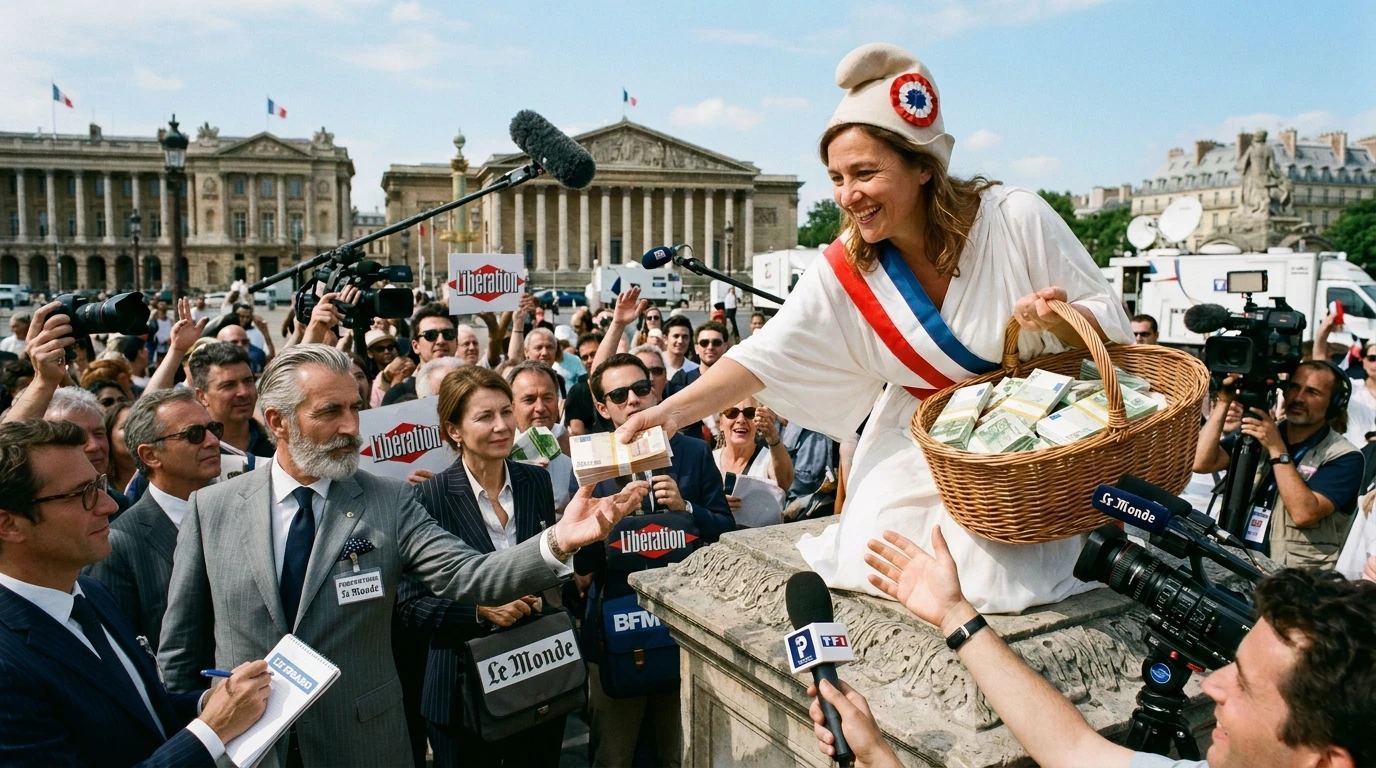 The big-hearted state hands out our money.
Four titles are even officially classed as “structurally dependent” on subsidy for want of sufficient advertising revenue: La Croix, L’Humanité, Libération, L’Opinion. They shared 10.35 million euros in 2024 under the single scheme reserved for them, on top of ordinary aid. Libération, owned by Patrick Drahi’s Altice group and listed in Amsterdam, saw its subsidies rise that year.
What the Court of Auditors has been writing for ten years
On the effectiveness of all this, there exists a document that admits of no ambiguity. The Court of Auditors, in a series of reports now spanning more than ten years, has established that the system “has not proved its effectiveness”.
The detail is worth reading line by line.
The 2009 plan doubled the Ministry of Culture’s spending on the written press. Without producing the effects sought. Home-delivery aid? Its effect is “not established”: since 1990 the growth of home delivery has followed a path independent of the level of subsidy. Distribution aid? It produces effects that contradict the support given to postal transport. Some budget lines have generated pure windfall effects, financing activity that would have happened anyway.
Ten years of findings, no consequence.
A system its own financial court declares ineffective, renewed every year for fifteen years.
And it is being renewed again. The 2027 finance bill, under discussion since 13 October, sets 176.3 million euros for the “press aid” programme, against 177.3 million in 2026. A fall of 0.18%. The mission that houses it rises from 700 to 710 million. Aid for distributing the printed press stays at 122.2 million, pluralism aid at 23.2 million. Nineteen amendments have been tabled on media funding; as I write, none has been adopted.
And the 3.8 billion of public broadcasting
This is the bigger pocket, and the less visible one. It became so in 2022.
Until then every household paid a licence fee of 138 euros — 88 overseas — printed on its tax notice. It was abolished and replaced by a share of VAT, voted each year in the budget. An organic law of December 2024 made the abolition permanent.
The spending did not disappear. Only the line disappeared. You still pay, you just no longer see it.
France is not the country that spends the most on its public broadcasting — Germany puts in considerably more, Poland far less. Per-head comparisons vary from one source to another depending on what is counted, and they settle nothing about the question of principle.
The management, though, is another matter. The Court of Auditors speaks of a “worrying financial situation”: 81 million euros of accumulated losses between 2017 and 2024. And on the wage bill it puts a figure on the gap — at equal operating costs, on the BBC’s ratio, France Télévisions would cut its staff costs by about 140 million euros.
The group draws 86% of its resources from public funding.
What remains is the principle, which depends on none of these figures.
The licence fee was owed by households that owned a television set. The share of VAT is owed by everyone. Someone who watches only YouTube and Netflix funds France Télévisions exactly as much as someone who switches it on every evening.
Public or private, it is the same mechanism: you pay for what you did not choose.
The pretext
Why do we pay? The official answer fits in two words: pluralism and distribution. Behind it lies an older doctrine, the French cultural exception — the idea that a newspaper is not an ordinary commodity and that a country leaving it to the market would lose something irreplaceable.
The argument is respectable. It becomes testable the moment you look at the countries that do not practise it.
Germany, Spain, the United Kingdom and Switzerland pay no direct aid to their press. None of the four suffers a measurable deficit of pluralism. None has seen its public debate collapse for want of subsidy.
If the cultural exception protects something, it remains to be explained what those four countries have lost.
And now, an observatory
This is where the story becomes interesting.
On 8 July 2026 the Senate’s culture committee published a six-month inquiry into the regulation of online information: 160 pages, 56 recommendations, three rapporteurs from different political families — Laurent Lafon (centrist), Agnès Evren (conservative), Sylvie Robert (socialist). Adopted unanimously.
The diagnosis is not wrong. The press is in trouble, platforms capture attention and advertising, mistrust is rising.
The report’s first recommendation is not to turn off the tap. It is to create, before the 2027 presidential election, an “independent observatory of disinformation”, tasked with “encouraging platforms to modify their algorithms or to make a culpable user invisible in the event of a serious threat to the quality of information”.
Culpable of what, judged by whom, with what right of appeal: the report does not say. A hundred and fifty pages further on comes the real ambition — no longer merely to check whether a statement is true or false, but to assess the “quality” of a piece of content, and to distinguish between “disinformation”, “malinformation” and “information disorders”.
So the one who pays the press is proposing to grade information. A bureaucrat’s idea, probably.
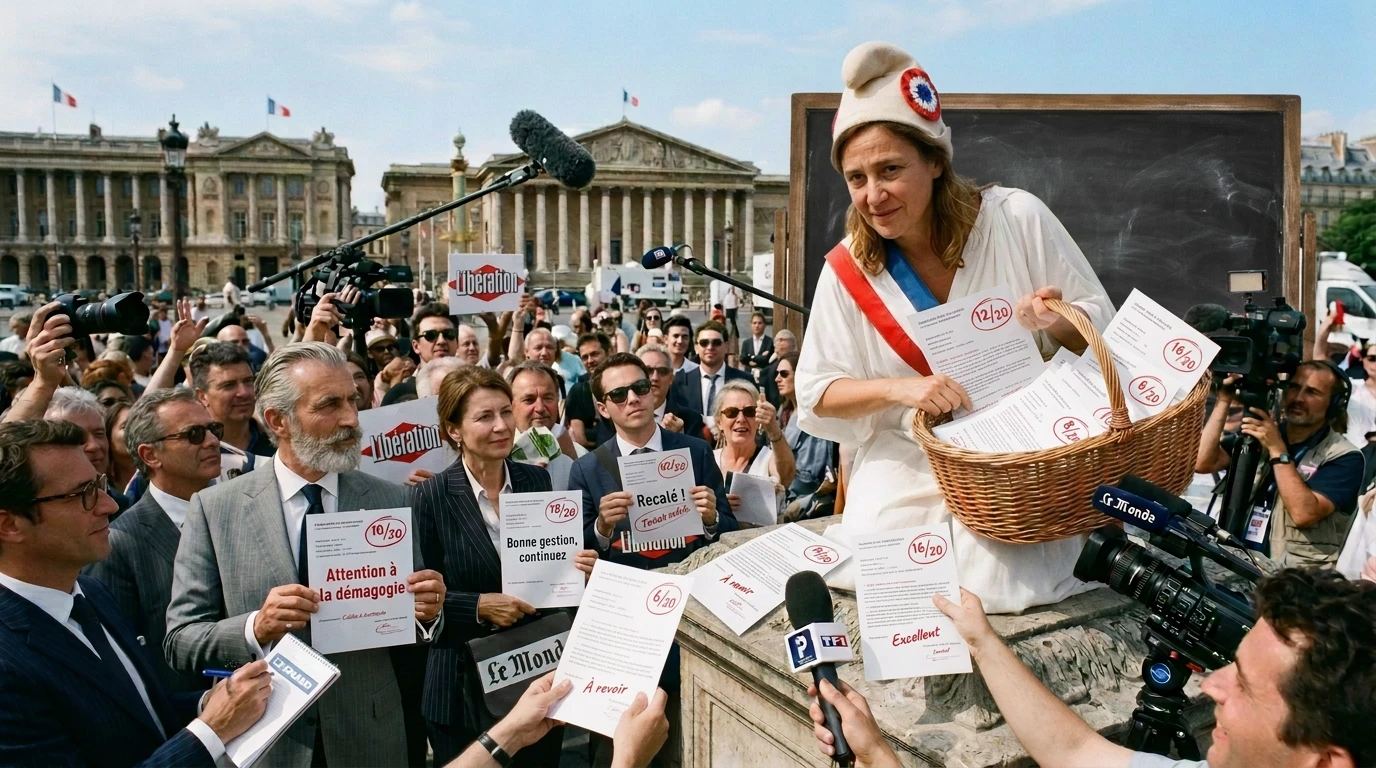 And now Marianne wants to grade the press. You never know — the hand that gives might get bitten.
Six months of work, not one text
What followed fits into a few dates.
The committee’s chairman, Laurent Lafon, ended up saying out loud what the text avoided writing: the risk, in his view, is that “a personality, a current of thought, a political party with substantial financial means” might use social networks “as a weapon”. That is, however, the definition of political action in a democracy.
Ten days after publication, the conservative co-rapporteur Agnès Evren publicly disowned her own report, pointed out that the phrase “internal interference” does not appear in it, and swore she would “never vote for a text aimed at restricting freedom of opinion”. Senator Max Brisson went further: he would vote for “no bill that would entrust an independent body with a form of thought police”.
A bill was to be tabled “at the end of the summer period”.
As of 24 October 2026, three and a half months later, it does not exist. The culture committee still lists “the grey areas of information” among its ongoing fact-finding missions. No text on disinformation appears among the Senate’s recent bills.
Six months of inquiry, 160 pages, 56 recommendations, a unanimous adoption, a disavowal within ten days, and nothing.
Meanwhile, the executive legislated in two weeks
The government did not wait.
On 8 July — the very day the report came out — Prime Minister Sébastien Lecornu announced to the Senate a text on false content during election periods. On 22 July the bill was tabled, carried by the interior minister, Laurent Nuñez.
It triples the penalties: from one year’s imprisonment and a 15,000-euro fine to three years and 45,000 euros, and up to six years if the acts serve “the interests of a foreign power or organisation”. It extends to local elections the fast-track injunction created by the 2018 law. It creates a “public information commission” tasked with flagging false information.
The text is presented as a response to foreign interference, after four campaigns detected by Viginum during the March 2026 municipal elections. But the base offence — producing false content during an election period — does not target foreign actors alone. Foreign origin is merely an aggravating circumstance.
Two weeks for a repressive text. Three and a half months with nothing for reform of the funding. Funny how, when it comes to adding bureaucrats to the controls, things move a great deal faster.
What actually protects
The detour through the United States is instructive, and not for the reason one expects.
The country pays no direct subsidy to its private press, and its First Amendment forbids Congress from legislating on anything that restricts freedom of expression. The safeguard has been tested twice, under two opposed administrations. Under Biden, Missouri v. Biden documented informal pressure on platforms to remove content deemed misleading; a court settlement on 23 March 2026 put an end to it. Under Trump, the chairman of the FCC threatened broadcast licences over editorial content he disliked.
Same mechanism, reversed vocabulary, and in both cases an independent federal judge was able to stop it.
So it is not the virtue of one camp that protects. It is the existence of a lock that no government can get around. France has none, and the reason is not procedural — the Constitution has been revised twenty-three times since 1958.
What the taxpayer is entitled to ask
I am not asking for newspapers to disappear. I read them every day, and I pay for several.
I am asking that three questions be answered before the budget line is renewed a sixteenth time.
What are these 4 billion for, measured by what, and by whom. The Court of Auditors has been saying for ten years that we do not know.
Why do the groups of Bernard Arnault and Xavier Niel top a scheme meant for a fragile press.
And how can a state that funds some of the titles, in the same movement, propose to assess the quality of information.
The citizen who pays asked for neither the subsidy nor the observatory. He was given both.
Personally I do not think it is the state’s role to subsidise the press and the media. Let each citizen pay for the press he prefers — that is his free will.