Weather observations with the Vantage Pro 2 station
I’ve become passionate over the past few years about weather observation. I chose the Vantage Pro 2 from Davis Instruments, known for its reliability. I chose to install it on my flat roof deck for convenience (very easy to access, with no nearby obstacles). I’ve since expanded the setup by adding UV and solar radiation sensors, then an Airlink module (also from Davis Instruments) to measure air quality (PM1, PM2.5 and PM10, plus US AQI and NowCast). All observations are uploaded via a Weatherlink Live module, and more recently via the new Weatherlink console. All the data can be viewed on Davis Instruments’ Weatherlink site.
In 2024, I set up a Raspberry Pi 4 running the Weewx5 application, then upgraded to Weewx 5.1. I reused the old Davis console and its data logger to capture all the weather and air-quality observations locally on the Pi4, letting me be independent of Davis’s cloud. This real-time data is published on my website (Weather menu). The station sends its data roughly every 2.5 seconds. I chose the Belchertown skin for presenting the data, and the weewx/airlink extension to integrate the air-quality data. You can also access it directly via this link or by clicking the image below.
On the hardware side, the Raspberry Pi 4 (4GB RAM) sits in an Argon ONE M.2 case, with a 130GB SATA SSD connected over USB rather than an SD card — more reliable over the long run. It runs in my garage, next to the old console, 40-50m from the ISS on the deck: I’ve never had a data loss on the Raspberry Pi side, unlike the kitchen console, which sometimes struggles through the concrete slab. After 2 years of continuous operation, resource usage stays very modest: around 500MB of RAM out of the 4GB available, 5% CPU at most, and a SQLite database growing by about 160MB a year (15MB at the start, 157MB after one year) — enough headroom for several decades before it fills up. Budget-wise, the Raspberry Pi 4 (model B, 4GB) runs about €54, and the Argon ONE M.2 case about €45 — a modest investment. And for peace of mind on the database side: SQLite can theoretically handle 400,000 to 500,000 HTTP requests a day and grow up to 281TB, so at 160MB a year, there’s nothing to worry about within a lifetime.
On top of the Belchertown skin and the weewx/airlink extension, I also tried the Envoy extension to cross-reference my weather data with my Enphase solar system’s output, without success so far — the database just wouldn’t update, and I haven’t pinned down whether the issue is on my end or with an extension that’s no longer well maintained. Still to investigate.
The installation itself stays fairly simple, though it does need some care: flash Raspberry Pi OS 64-bit onto an SD card, run the system updates, enable VNC and force the boot order to USB, then clone the SD card onto the SSD before booting from it permanently — much more reliable than an SD card long-term. Next comes installing Nginx for the web server, then WeeWX via its official install script, entering the station name, its coordinates and its altitude. The one real snag: the weewx user didn’t have access to the console’s USB serial port (/dev/ttyUSB0) — it had to be added to the system’s dialout group before data collection would start.
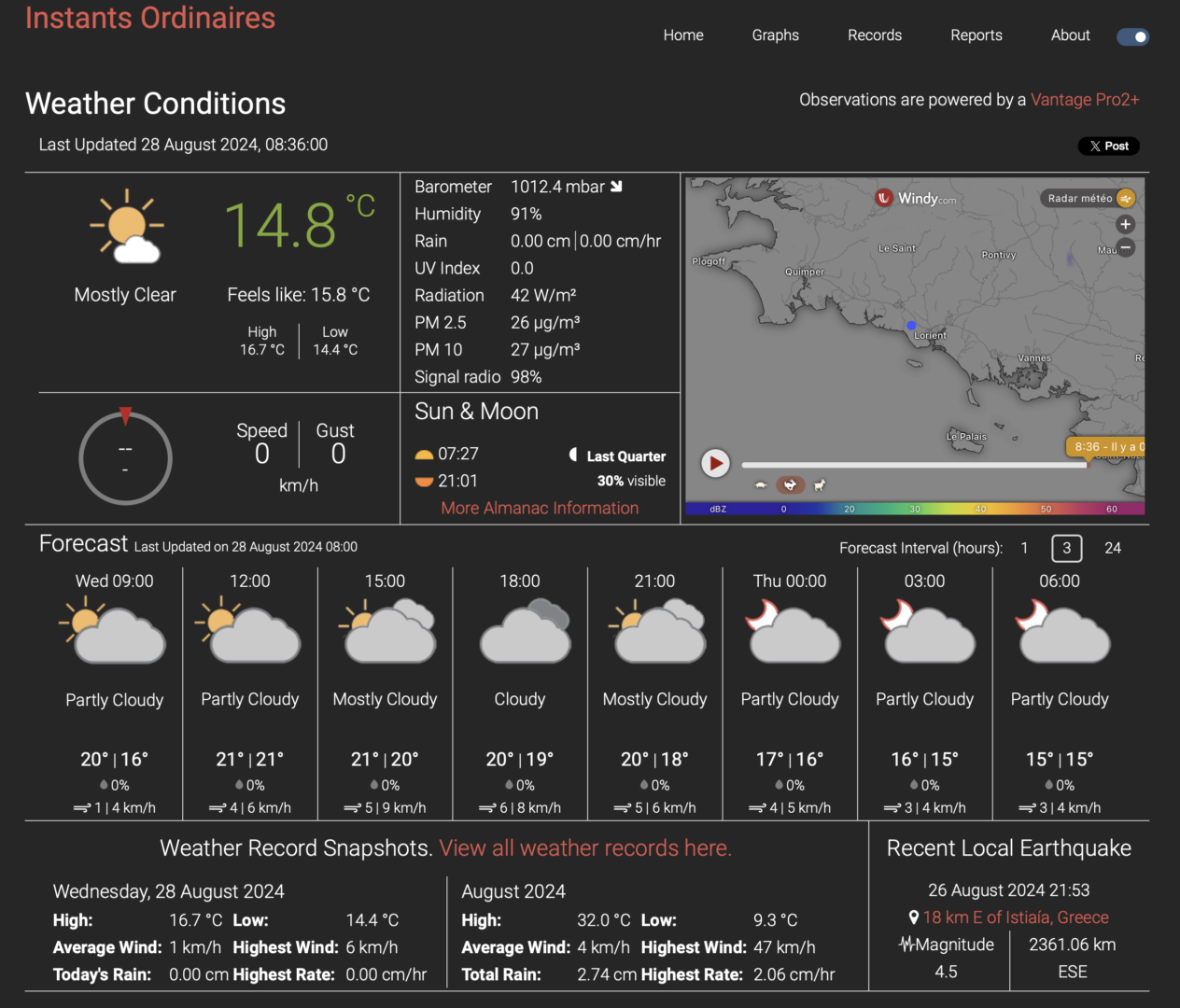
Installing the Belchertown skin, made by Pat O’Brien, is done via the weectl extension install command, pointing directly at the GitHub repo archive (the syntax changed from older Weewx versions, which used wee_extension --install). Once installed, the Weewx service needs restarting for the new report to be generated — it’s added alongside the standard “Seasons” report rather than replacing it, in a belchertown subfolder — and then the Nginx configuration needs updating to point at that subfolder, followed by a web-server restart. The result is genuinely more polished: noticeably bigger graphs, a Windy radar widget positioned automatically from the station’s GPS coordinates, dark mode, an “About” page… Belchertown can also show forecasts via the Aeris weather API, provided you have a PWS Weather account and obtain an API key after a few days of publishing — something I haven’t set up yet. I also plan to look further into the architecture Pat O’Brien uses on his own site: an MQTT broker that syncs data between his Raspberry Pi and his external hosting, which would let me have a genuinely real-time weather page instead of the current static description.
This Weewx5 application also lets me publish Kerroch’s weather observations to well-known weather sites: Wunderground, PWS Weather, Awekas, WoW, and most recently the Météo Bretagne association site (run by Meteo Concept). These websites also publish the data through iOS and Android smartphone apps. It’s all driven from the weewx.conf configuration file: each service has its own section, with a simple Enable = True and the credentials for the account created on that site — Weewx then takes care of sending the data itself. My station also shows up on the Weewx station map (weewx.com), which lists around 1,900 stations worldwide; there aren’t many in Brittany, and rarely a Vantage Pro. Of all these sites, my two favourites remain Wunderground — which assigns a growing confidence level the longer a station publishes without interruption, and I’m now at the maximum level — and PWS Weather, both with a polished, complete presentation. Awekas and the Met Office site (WOW) work fine too, but with an interface I find more confusing.
The village of Kerroch sits by the sea in the town of Ploemeur. So far, the Vantage Pro station has withstood the wear of the salt breeze, storms and gusts of wind.
For a general presentation of the hardware and the full installation story (on video), see Presenting and installing my Vantage Pro 2 weather station.
History:
- April 2022: installation of the Davis Instruments Vantage Pro 2 and the AirLink module for air quality.
- July 2022: added the UV sensor.
- February 2023: added the solar sensor for measuring radiation (W/m2).
- February 2024: live data and graphs published from the Weewx application and the Belchertown skin.
- March 2024: added air-quality data with the weewx/airlink extension.
Clicking the image of Port-Blanc below gives you full-screen access to the “live” data from Weatherlink.com.
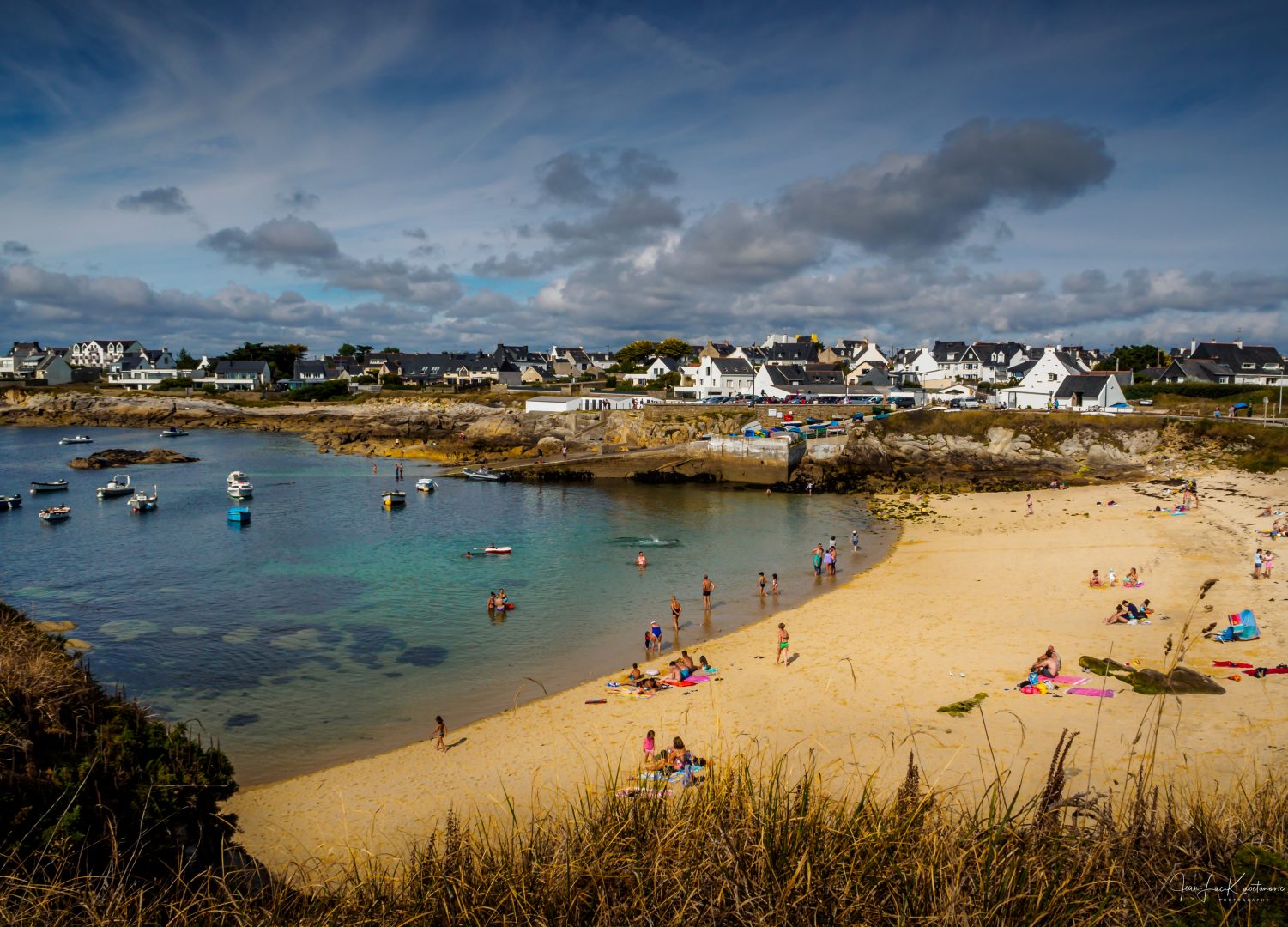
Village of Kerroch - town of Ploemeur - Morbihan. The small harbour and its fine sandy beach.
Monthly readings for the current year, and compressed archives for past years:
// 2022 // 2023 // 2024 // 2025 //
//2024// January, February, March, April, May, June, July, August, September, October, November, December