The Pope in France, a Visit That Does Some Good
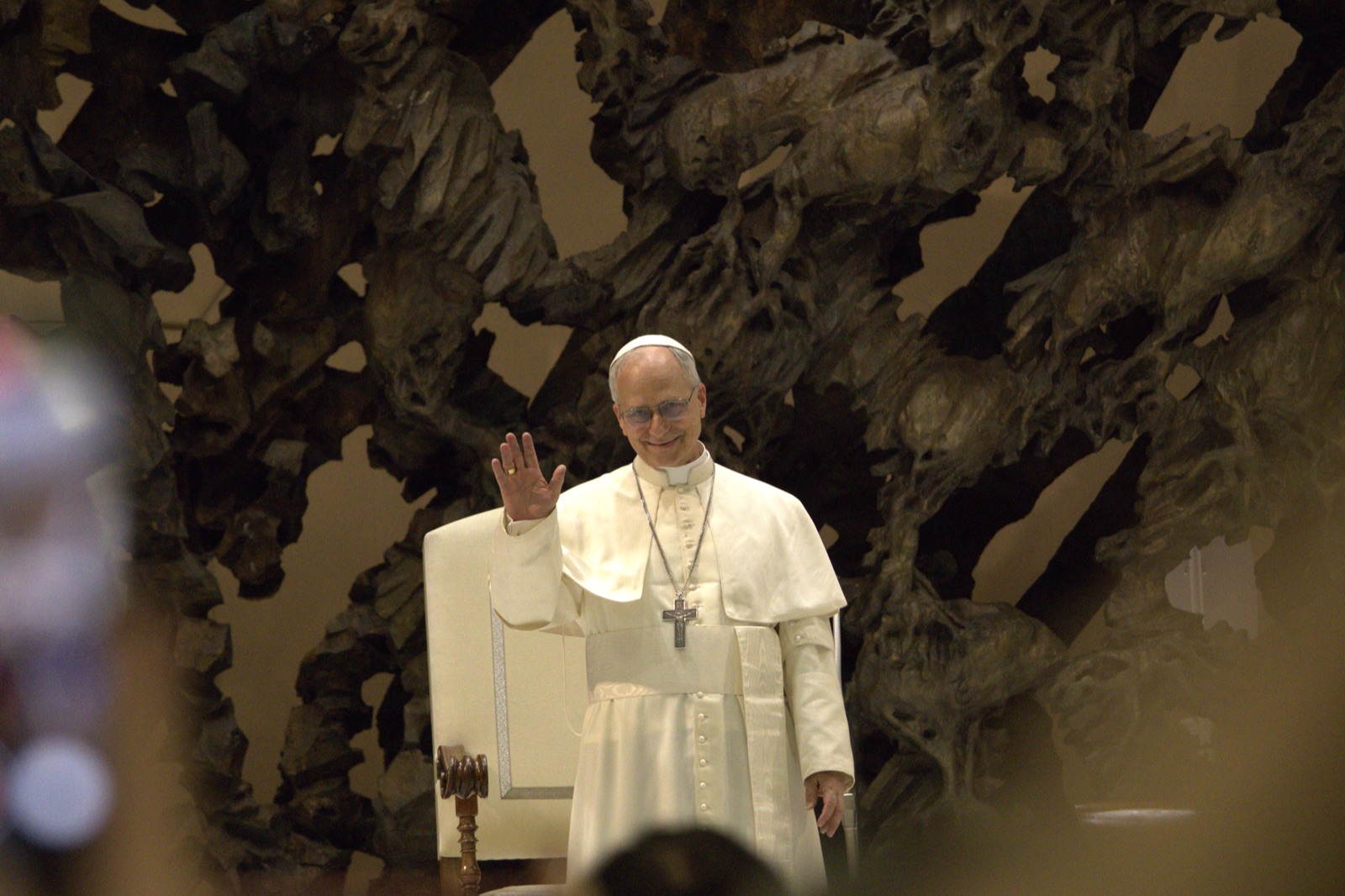
Pope Leo XIV at an audience with the media, 12 May 2025 — photo Edgar Beltrán, The Pillar (CC BY-SA 4.0)
Leo XIV spent four days in France at the end of September 2026, and I followed the fifteen speeches one by one. I am not a believer. But on several points what he said matches exactly what I think, and on one point I disagree with him entirely. Here are the six subjects that stayed with me.
End of life first. I set out my arguments on this at length over the summer, in A law on the end of life: a debate that concerns us all, so I will not repeat them here. At Lourdes, in front of sick people in wheelchairs, the pope said: “It is impossible to regard the giving of death as normal. What is legal is not necessarily moral.” That is exactly it. A parliamentary majority can vote a text through; that does not make the act moral. Legality and morality are two different things, and the two are too often confused in this debate.
There is also what he said to the sick themselves at Lourdes, not only about the law but about dignity. He told them they are not a burden, that no human law should make them lose the certainty of their dignity, that their crutches, their wheelchairs, their hidden tears are not obstacles. I do not share the idea that suffering has a redemptive meaning — that remains a religious conviction I do not take as my own — but the idea that a person’s dignity is not measured by their usefulness or their capacity to produce, that I share entirely.
Abortion next, or rather its writing into the Constitution in March 2024. The 1975 law had already protected that right for almost fifty years, nobody was seriously challenging it, so raising it to constitutional level was above all a symbolic and disproportionate gesture. The Vatican reacted at the time of the vote; the Pontifical Academy for Life said “there can be no right to end a human life”, which is rare for an institution that almost never intervenes in a country’s domestic politics. The law does not, in fact, formally declare that a foetus is not a human being before fourteen weeks; it merely sets a deadline for access without requiring a justification. But the underlying problem remains whole: the science these thresholds rest on keeps moving. The viability threshold in neonatology has receded again recently, with 2025 advances placing it between 23 and 25 weeks against 28 a few decades ago. On foetal pain it is clearer still: the old consensus put the threshold at 24 weeks because a functioning cortex was required, while more recent studies show pain might travel by other routes from 13 weeks, almost at the limit of the French legal deadline. So the question stays open. What will science say in ten years, in fifty.
Rearmament — here I disagree. At Metz the pope warned against the illusion of rearmament, saying that calls to increase military spending are always justified by the danger others represent, the implication being that this is a spiral that ought to be stopped. The trouble is that the danger is real this time. Empires are back, Russia is annexing again, China is building its fleet, nationalism is advancing almost everywhere in Europe. A dictator retreats only before a balance of force, never before dialogue alone; the history of the twentieth century showed it several times. I understand that the vicar of Christ preaches peace, that is his role, but a head of state cannot afford the same position.
Catholic schools. Christian values and republican values are not incompatible. State-contracted Catholic schools overwhelmingly meet their obligations to the Republic: curricula, co-education, secularism in practice in teaching. On results, the gap is real — around 12 points between private and state schools in the rate of obtaining a diploma after seven years of secondary education — but social composition explains most of it: 40.5% of very advantaged pupils in the private sector against 19.5% in the state sector, and the reverse among the disadvantaged, 18.3% against 42.6%. So it is not better teaching, it is different recruitment. One must also be honest about the sector’s limits. The Stanislas affair in 2023-2024 revealed a genuine failure: structural sexism documented by an inspectorate report, a homophobic climate, a judicial investigation opened for incitement to hatred — an isolated case, but not one to be passed over in silence. And while we argue about state and private, the overall level is collapsing. PISA 2025 puts France at its lowest since the survey began in 2000, down 16 points in maths and 18 in reading since 2022 alone, three years. Attacking private schools will not bring that level back up; both sectors are hit by the same decline, and the real problem lies elsewhere.
Artificial intelligence, a subject I know a little through my working life. The pope made it the theme of his first encyclical, Magnifica humanitas, and returned to it at UNESCO: these systems receive the name “intelligence” while we find it harder and harder to recognise the dignity of people judged unproductive, and he says AI can establish correlations between data but answers no question about the meaning of human life. Technically that is correct. A language model finds statistical correlations in data; it has no understanding of meaning, and confusing that with intelligence in the human sense is a category error I was already watching spread before ChatGPT existed. The real risk is not the machine itself, it is that we delegate to it decisions that affect people — hiring, school marking, medical triage — without keeping an identifiable human being responsible behind it. On that precise point the pope is right, and ahead of many others.
Young people, finally. The need for meaning does not disappear because a society becomes more secular; it simply changes shape. The figures bear this out: more than 21,000 adult and adolescent baptisms at Easter 2026 in France, a 28% rise in one year among adults, with the number tripling in ten years. Seeing so many young people gathered and happy at the Stade de France or on the Champs-Élysées — whether or not one shares their faith — is reassuring about this country’s future. Faced with so much joy on those faces, believers young and old together, one almost envies them their faith, and one is glad to have seen that moment shared.