A visa opens onto what, exactly?
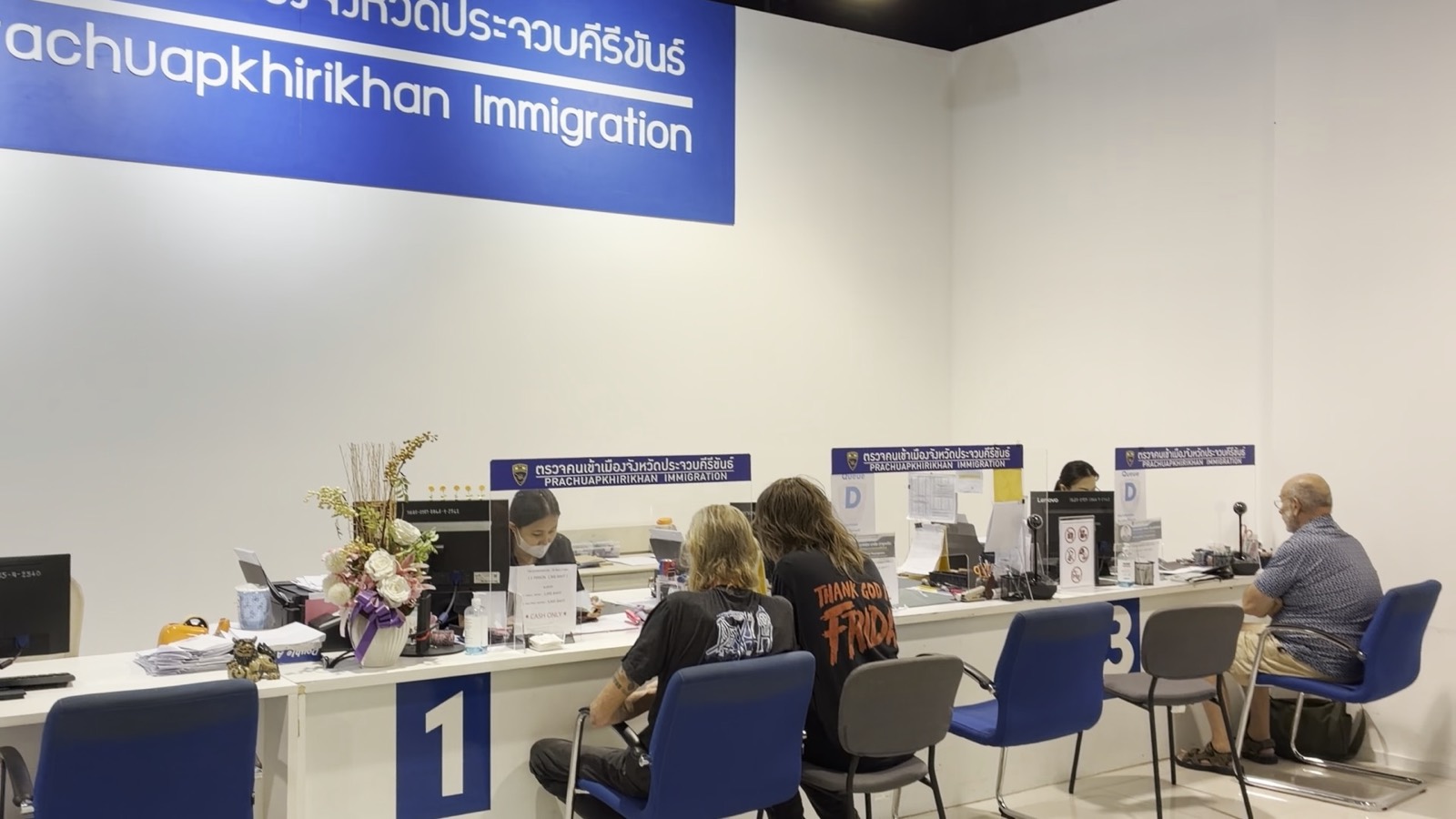
The immigration office in Prachuap Khiri Khan. Counters 1, 2 and 3.
In expat groups, people talk about visas. It is more or less all they talk about. Which form, which office, which agency, how many days of leeway, how much money in which account and for how long. Threads run to three hundred comments, and the three hundredth corrects a comma in the first.
It is procedure. Always procedure.
The question nobody asks is simpler: at the end of all that, what do you get?
Moving
Since May 2026 a French citizen arrives in Thailand with thirty days. It was sixty until then; the cabinet cut the exemption on the grounds that foreigners were working illegally in the country — exactly the reasoning Europe applies to Thai nationals.
To stay, I am on a one-year O-A visa. To renew it you must leave eight hundred thousand baht in a Thai bank account — a little over twenty thousand euros, double that for a couple — seasoned for two to three months before the application, and counted again at every renewal. Or show an equivalent monthly income.
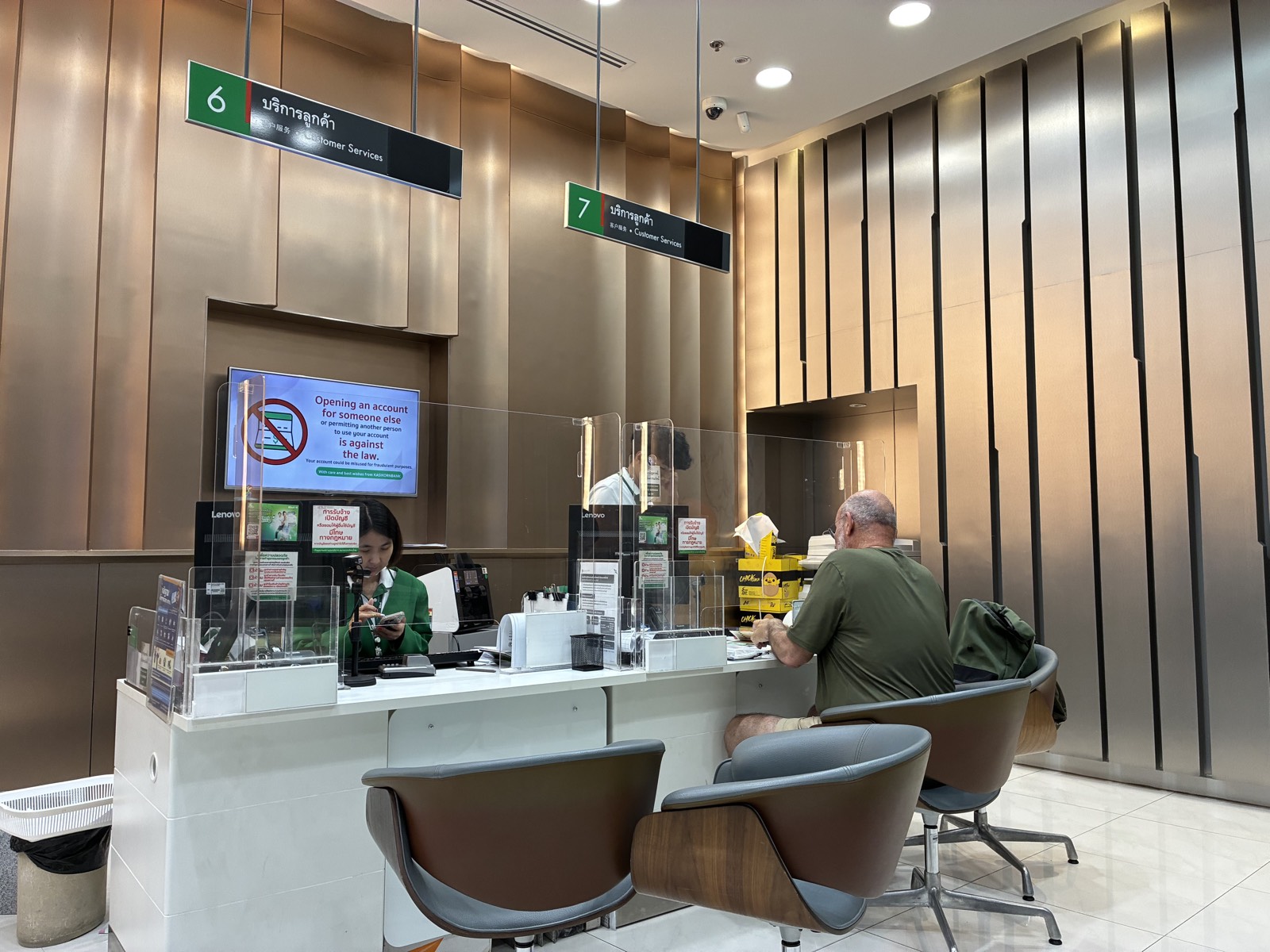
The counter where the eight hundred thousand baht sit.
And every ninety days I go and tell immigration where I live.
There is a second declaration, and I am not even the one who files it. Section 38 of the 1979 Immigration Act requires the owner, head of household or hotel manager who houses me to report my presence to immigration within twenty-four hours. That is the TM30. It has to be filed again at every change of address, and failing to do so is fined — their fine, not mine.
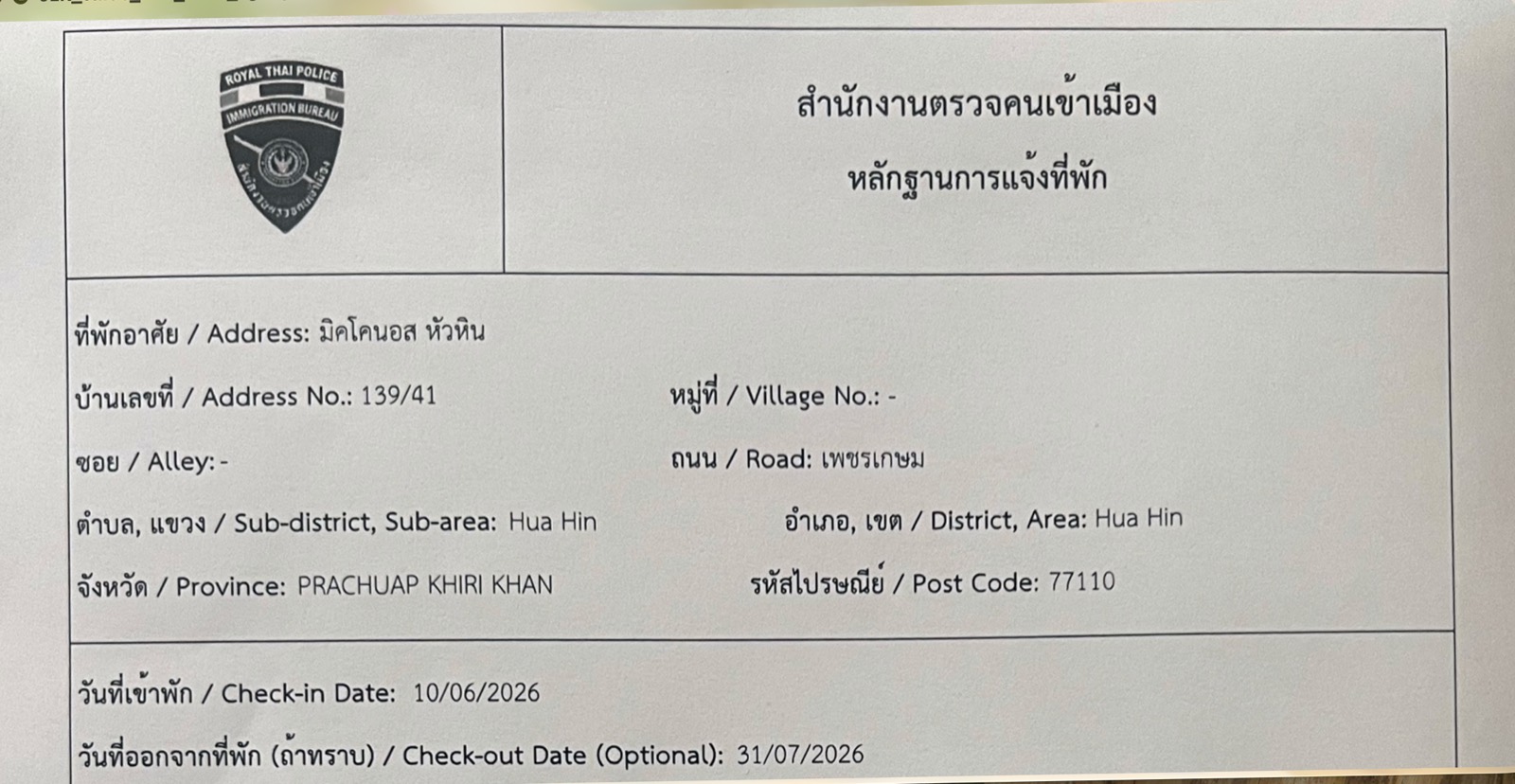
My TM30. I am not the one who fills it in: the person who houses me is.
Freedom of movement, then. With a check-in every three months, and a declaration every time I sleep somewhere else.
None of this is exotic, and none of it is Thai. It is an ordinary instrument of state, and France was using one not long ago.
The law of 16 July 1912 required “nomads” — the statute’s own word — to carry an anthropometric booklet, with fingerprints, front and profile photographs and body measurements, to be stamped in every commune they passed through. The law of 3 January 1969 replaced it with a circulation booklet, to be stamped every three months at a police station. It applied to anyone, French or foreign, without a fixed home or residence for more than six months.
In October 2012 the Constitutional Council struck that booklet down: renewal every three months at a police station was contrary to the freedom to come and go. The rest of the scheme was repealed in January 2017.
These are my two gestures, exactly. The 1912 booklet was stamped in every commune passed through: that is my TM30. The 1969 one was stamped every three months: that is my ninety-day report. A state wants to know where the people it has designated are living. France had designated “nomads”, whatever their nationality. Thailand designates foreigners, and I am one of them.
The category created in 1912 was still there on 6 April 1940, when a decree signed by Albert Lebrun — the Third Republic, before the defeat and before Vichy — banned “nomads” from moving anywhere in metropolitan France and assigned them to fixed residence, on the grounds that they might be spies. Some six thousand five hundred people were interned. The decree was not repealed until May 1946, and the last camp closed on 1 June 1946 — more than a year after the end of the war.
My grandmother, my father and his brother were interned in one of those camps, but that is another story.
Owning
Section 86 of the Land Code bars a foreigner from owning land. The penalty runs to two years in prison.
This is not a dormant clause. Since January 2026 every newly incorporated Thai company has had to prove where its shareholders’ money came from; since April, the same proof is required at every change to a company’s articles. The target is named: nominees, Thai nationals listed as shareholders so that a company can buy the land a foreigner may not hold. Where the arrangement is established, the Land Code orders the land sold, within six months to a year. The campaign started in Phuket, Koh Samui and Koh Phangan; it has reached Krabi, Phang Nga, Bangkok and Chiang Mai.
What stays open: a condominium unit, within a limit of forty-nine per cent of a building’s floor area. A lease of thirty years at most. Ownership of the building, separate from ownership of the ground it stands on.
The ninety-nine-year lease proposal, revived by the finance minister in May 2025, still has not been voted. Nor has the forty-nine per cent quota moved.
Freedom to buy, then. Never an owner, and never more than thirty years.
The road leads nowhere
This is where the expat conversation stops, and where it ought to begin.
Since 2022 there has been a ten-year visa for well-off pensioners. Its own documentation states that it opens no path to citizenship. It is written down, and it is honest.
Permanent residence is capped at one hundred people per nationality per year. The cap is beside the point: about two hundred and fifty are granted a year worldwide, all nationalities together, when the quota would allow one hundred for French citizens alone. So it is not the cap that filters.
It is the categories — investment, employment with a work permit, recognised expertise, Thai family, special cases — and the ranking of applicants by the income tax they pay here. Retirement is not a category, and a retired person pays no such tax. I am not ranked low: I am unrankable.
To get through any of those five doors I would need a work permit, a Thai spouse, or ten million baht — about two hundred and sixty thousand euros — placed in the country.
And Thai citizenship requires ten years of prior permanent residence. Citizenship, and only citizenship, opens the right to own land.
So I could stay here thirty years without coming a day closer. The annual renewal is not a step towards anything. It is the same form as last year.
What about the neighbours
I have talked a lot about Thailand, which is normal, I live here. But do the neighbours do any better? On Facebook you see passport rankings go by, country by country, which do not mean very much, and every nationality exclaims over a rise or a fall in the table. Amusing. What never appears in them is what the passport in question allows you to become.
| Land | Long stay | Permanent residence | Citizenship | |
|---|---|---|---|---|
| France | no condition of nationality, no visa needed | visitor, one year renewable, resources at minimum-wage level | ordinary right after five years, ten-year card renewed as of right | five years, B2 and a civics exam since January 2026 |
| Malaysia | freehold possible, price floor set by each state, eight per cent stamp duty reserved for foreigners | MM2H, property purchase compulsory, €128,000 to €426,000, locked for ten years | Malaysian spouse, recognised expertise, or two million dollars on deposit for five years | ten years out of the previous twelve, granted at discretion |
| Singapore | condominium free but sixty per cent stamp duty, landed property closed | employment or investment | employment, family, or ten million Singapore dollars in a local business, close to seven million euros | two years after permanent residence, renouncing every other nationality |
| Thailand | barred, up to two years in prison; condominium capped at 49%, lease at thirty years | O-A, one year, 800,000 baht locked | five categories, retirement is not one; about 250 granted a year worldwide | ten years of prior permanent residence |
| Vietnam | nobody owns it, Vietnamese included; apartment for fifty years, renewable once | no retirement visa at all | five years, mostly family or investment | five years, Vietnamese language, renunciation |
The pattern is the same everywhere. You bring capital, you marry someone, or you hold a skill the state recognises. Time alone produces nothing. France is the only one of the five where five years of lawful residence is enough to open the next door.
Singapore is the clearest case. First passport in the world in the rankings, and to get it you must either renounce your original nationality or bring close to seven million euros. The ranking applauds first place without ever saying on what terms you get there.
The same journey the other way
I went and looked at what a Thai national finds in France, assuming the asymmetry would run roughly the same. It does not.
French law sets no condition of nationality or residence for acquiring property. House, flat, plot, farmland: a Thai buys on the same terms as a French citizen. He does not even need the visa — the purchase can be made from Bangkok, by notarised power of attorney, without ever setting foot in France.
To live there, he needs a long-stay “visitor” visa: proof of resources at least equal to the minimum wage, about fourteen hundred and fifty euros a month, from wherever they come and with no obligation to move them into France. A commitment not to work. One year, renewable.
After five years of lawful residence he can apply for a ten-year resident card, renewed as of right. Then for citizenship.
France did tighten its own door in January 2026: B2 French is now required instead of B1, along with a civics exam. Both countries are closing — just not in the same place, and not from the same starting point.
So this is not a matter of doors open or shut. Both countries let you in and let you stay. The difference is that at the end of one of the two roads there is a passport and a house.
The wall is not where you think
That leaves the journey in the other direction, the one expat groups never discuss: the Thai who wants to come to France.
I went looking for the Schengen refusal rate expecting a damning number. It is 6.2%, against a global average of 14.6%. Applications filed from Thailand almost all succeed.
So the wall is not at the counter. It is upstream.
In 2024, two hundred and sixty-five thousand applications left Thailand — four inhabitants in every thousand. It takes ninety euros, non-refundable, or eight to ten days of minimum wage, plus the application centre’s fee, plus bank statements, an employment certificate, proof of accommodation, insurance and a dated return ticket. Those for whom that is out of reach do not apply. They appear in no refusal statistic.
That is roughly the file I assemble every year to stay here. The difference is that at the end of mine there is nothing, and at the end of theirs there is a country where you can become an owner, a resident, and then a citizen.
At world scale
The calculation scales up. I took the full matrix of visa requirements, one hundred and ninety-nine passports against one hundred and ninety-nine destinations, and crossed it with income per head.
Of the nineteen thousand seven hundred and one possible pairs of countries, fifty-six per cent are closed in both directions: neither one enters the other freely. Twenty-one per cent are open both ways. The rest are asymmetric — and when a border opens in one direction only, it opens towards the richer country seven times out of ten.
Income explains a little under sixty per cent of the variation between passports. Enough to say that a passport ranking is first of all a wealth ranking. Not enough to say it is only that.
And while I was at it, I redid the ranking itself. Twice: once counting visa-free entry only, once adding visa on arrival and e-visa, the way most published indices do.
| Visa free | Rank | Free + facilitated | Rank | |
|---|---|---|---|---|
| United Arab Emirates | 127 | 2nd | 184 | 1st |
| Spain | 127 | 4th | 184 | 3rd |
| Singapore | 130 | 1st | 181 | 28th |
| France | 127 | 6th | 183 | 9th |
| United Kingdom | 118 | 28th | 179 | 39th |
| Japan | 117 | 33rd | 182 | 22nd |
| Malaysia | 117 | 35th | 180 | 34th |
| Indonesia | 45 | 110th | 114 | 109th |
| Thailand | 40 | 123rd | 115 | 108th |
| Philippines | 36 | 132nd | 107 | 124th |
| Vietnam | 23 | 162nd | 98 | 151st |
| Cambodia | 21 | 167th | 102 | 137th |
| Myanmar | 12 | 187th | 91 | 177th |
Singapore is first in the world, or twenty-eighth, depending on which column you read. Cambodia gains thirty places, India twenty-two, Thailand fifteen. Nothing changed for anyone: same matrix, same day, only the definition of “without a visa” moved.
That is why an article announcing eight places lost says nothing. You would first have to know what was being counted.
What the indices do not see
Being unable to own because of your passport is one economic freedom fewer. Freedom House does ask the question, at G2: are individuals able to exercise the right to own property and establish private businesses without undue interference? The word it uses is individuals.
Thailand scores 2 out of 4. The comment justifying that score talks about undue influence from security forces and organised crime. It says nothing about section 86, nothing about the forty-nine per cent quota, nothing about the thirty-year lease. I checked the 2025 and 2026 editions: absent from both. The institute does have a question about non-citizens, but it covers only basic human rights.
The question says “individuals”. The scoring answers for nationals.
This follows directly from what I noted in Is the world freer today?: the indices measure regimes, and what they measure is real. But a foreigner enters their frame only through a question about his fundamental rights — never through his freedom to move, to own, to renew or to become.
And so
We talk about procedure because procedure is the only thing that moves. The deposit changes, the form gets a new number, the office relocates, the exemption drops from sixty days to thirty. There is always something to comment on.
What does not move, nobody comments on.
Thirty years of annual renewals give exactly what the first one gave: one more year.
Sources: global visa-requirement matrix — passport-index-dataset, CC BY-SA. GDP per capita at purchasing power parity, World Bank. Schengen visa statistics 2024, European Commission. Freedom in the World 2025 and 2026, Freedom House. Author’s own calculations; the script is kept with the article.