Is the world freer today? What the numbers say
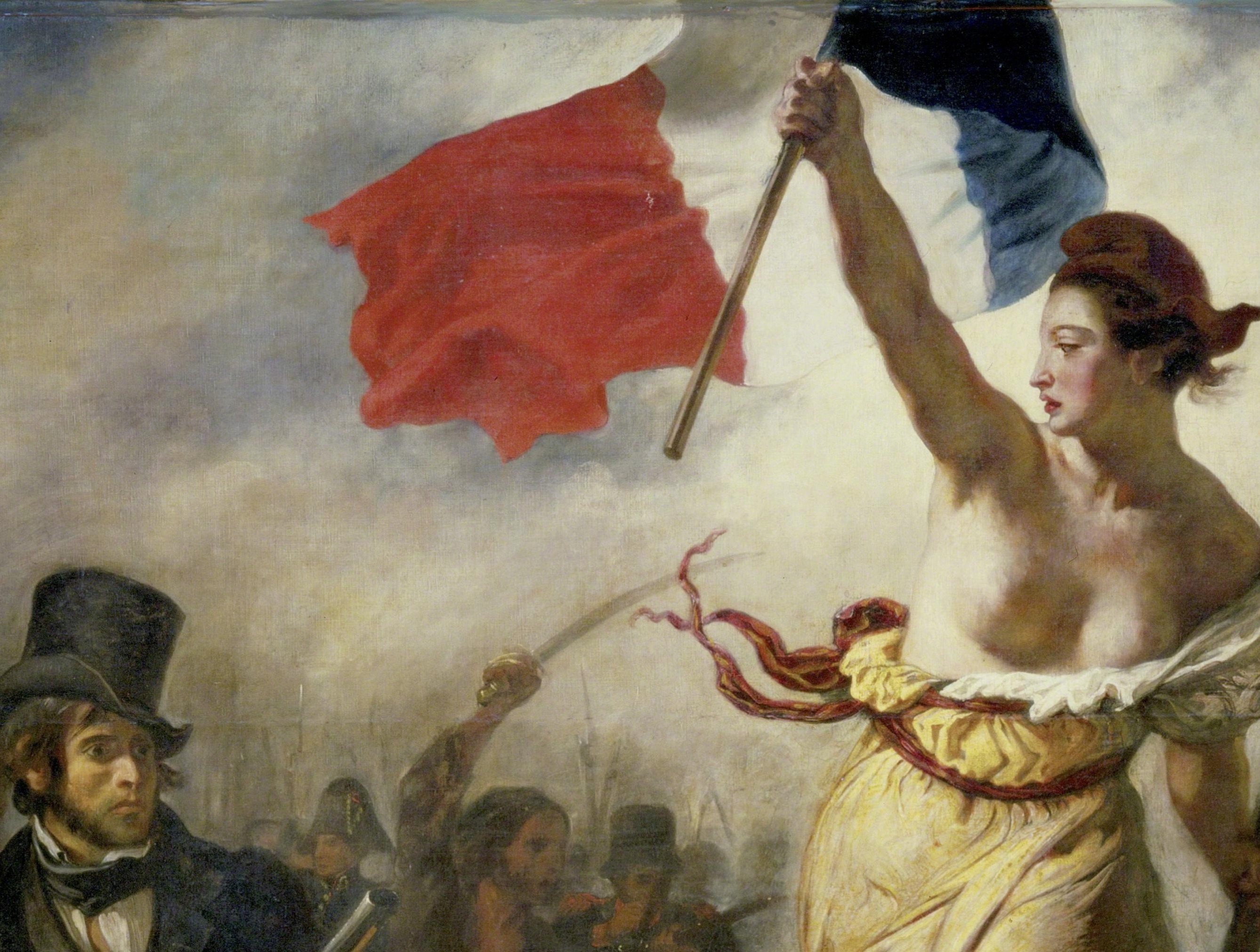 Liberty Leading the People, Eugène Delacroix, 1830 (detail) — Louvre Museum (public domain)
Yesterday we celebrated Bastille Day, and it’s become almost a ritual: we happily watch our parade down the Champs-Élysées, symbol of the national holiday, the pride of being French — but above all the joy of living in freedom. I found myself thinking about how lucky I’ve been to live without war since my birth in 1954. And yet wars haven’t disappeared: Russian boots at our door, the massacre of Jews in Israel, Iran and its proxies, to name only those. So — are we freer today than at the moment I was born?
The world today counts almost twice as many countries classified as “democracies” as in 1973 — and yet we’re living through the 20th consecutive year of decline in global freedom, according to the leading measurement institutes. Both statements are true at once. Understanding why is the point of this article.
I. Three thermometers, three methodologies
Three major indices measure the state of democracy worldwide, each with a different methodology:
- Economist Intelligence Unit (Democracy Index) — 167 countries, scored out of 10, four categories (full democracy, flawed democracy, hybrid regime, authoritarian).
- Freedom House (Freedom in the World) — since 1973, 195 countries + 13 territories, scored out of 100, three statuses (Free, Partly Free, Not Free).
- V-Dem (Varieties of Democracy, University of Gothenburg) — the most granular approach, four categories (liberal democracy, electoral democracy, electoral autocracy, closed autocracy).
2025-2026 comparison
| Index | Strict authoritarian regime | + grey zone/hybrid | Total non-democratic |
|---|---|---|---|
| EIU 2024 | 60 countries (36%) | +36 countries (hybrid) | 96 countries |
| Freedom House 2026 | 67 countries (Not Free) | +52 countries (Partly Free) | 119 countries |
| V-Dem 2026 | 35 countries (closed autocracy) | +57 countries (electoral autocracy) | 92 countries |
The three institutes agree on the trend (decline over ~20 years) but diverge on the exact count, because they aren’t measuring quite the same thing.
II. Fifty years of history, in numbers
Here is the full series, built from Freedom House’s own publications:
| Year | Free | Partly Free | Not Free | Total assessed |
|---|---|---|---|---|
| 1975 | 40 | 53 | 65 | 158 |
| 1985 | 56 | 56 | 55 | 167 |
| 1995 | 76 | 62 | 53 | 191 |
| 2005 | 89 | 58 | 45 | 192 |
| 2015 | 89 | 55 | 51 | 195 |
| 2025 | 89 | 52 | 67 | 208 |
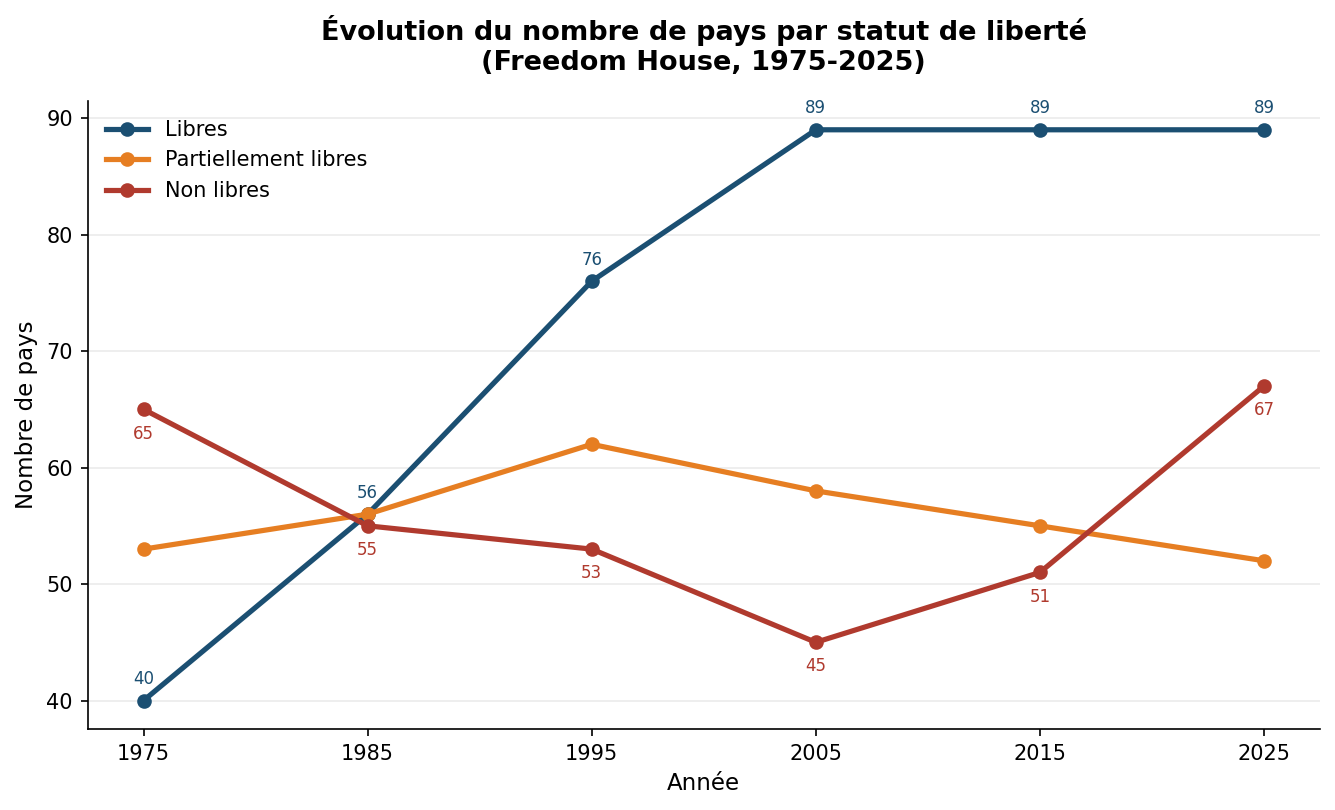 Number of countries by status, 1975-2025 (Freedom House)
Three phases stand out clearly:
- 1975-2005: a continuous rise in “Free” countries (40→89), a symmetrical decline in “Not Free” ones (65→45) — the “third wave” of democratisation (Huntington) and the collapse of the Soviet bloc.
- 2005-2015: a plateau. The number of “Free” countries freezes at 89, while “Not Free” ones are already climbing again (45→51).
- 2015-2025: the “Not Free” category clearly breaks away (51→67), while “Free” stays frozen at 89. All the recent growth in the number of countries assessed has gone to authoritarianism, not to democracy.
The real paradox: number of countries vs. world population
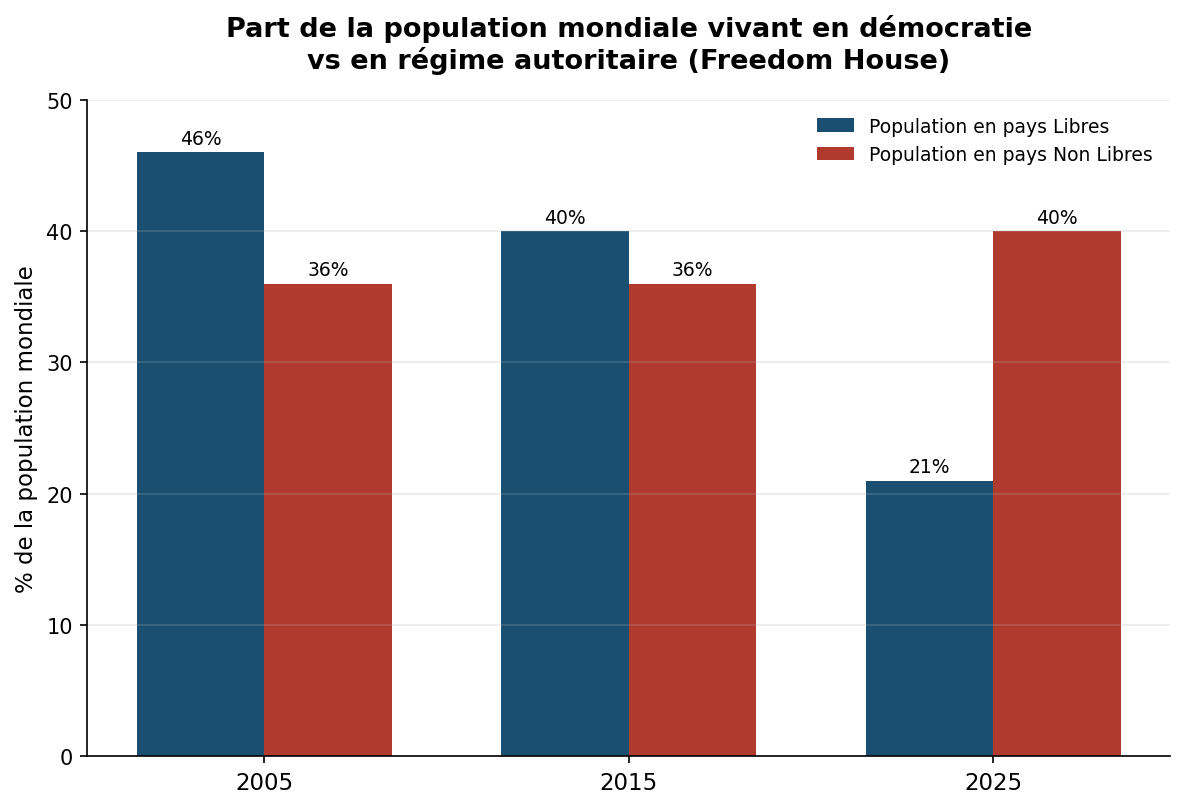 Share of world population in Free vs. Not Free countries, 2005/2015/2025 (Freedom House)
| Year | % of population in “Free” countries | % of population in “Not Free” countries |
|---|---|---|
| 2005 | 46% | 36% |
| 2015 | 40% | 36% |
| 2025 | 21% | 40% |
The share of the world’s population living in a “Free” democracy has been cut by more than half in twenty years (46%→21%), even as the number of “Free” countries has stayed stable. The growth in the number of democratic countries since 1973 (44→89) came through micro-states and small countries — not through the demographic giants (China, India, Russia, Pakistan, Indonesia, Nigeria).
A measured note of hope: of the 87 countries classified “Free” in 2005, more than 85% stayed that way throughout these two decades of decline. Established democracy remains “sticky” — the decline mostly hits fragile or recent democracies, not a generalised collapse of mature ones.
III. Methodological aside: decolonisation and Soviet collapse, two waves, two fates
The total number of countries assessed has nearly tripled since 1975 (158→208), largely because of late-stage decolonisation and the breakup of the USSR/Yugoslavia. But these two waves of state creation had radically different democratic trajectories.
African decolonisation (1957-1975): a democratic window quickly shut
| Country | Independence | Authoritarian turn | What happened |
|---|---|---|---|
| Ghana | 1957 | 1966 | Nkrumah drifts toward one-party rule, military coup in 1966 |
| Guinea | 1958 | almost immediate | Sékou Touré installs one-party rule right from independence |
| Togo | 1960 | 1963 | Assassination of President Olympio, the continent’s first post-colonial coup |
| DR Congo | 1960 | 1965 | Congo Crisis, assassination of Lumumba (1961), Mobutu’s coup (1965) |
| Nigeria | 1960 | 1966 | First military coup, Biafra war (1967-1970) |
| Congo-Brazzaville | 1960 | 1968 | Youlou overthrown (1963), military coup installs a Marxist regime (1968-1992) |
| Uganda | 1962 | 1966-1971 | Obote suspends the constitution, Idi Amin’s coup (1971) |
| Mali | 1960 | 1968 | Modibo Keïta overthrown by a military coup |
| Equatorial Guinea | 1968 | immediate | The country’s only free election; totalitarian dictatorship under Macías Nguema right after |
At least 24 coups took place in Africa between 1960 and 1970 alone; some hundred successful coups have occurred across 35 African countries since 1952. Notable exceptions: Botswana (independence 1966) built a stable multiparty democracy from the outset; Nyerere’s Tanzania avoided coups through strong leadership, despite one-party rule.
The Soviet collapse (1989-1991): a sharper fork in the road
| Trajectory | Countries | Outcome |
|---|---|---|
| Durable democratic consolidation | Estonia, Latvia, Lithuania, Poland, Czechia, Slovakia, Hungary | All “Free” today, EU/NATO integration — see the current-events box below on Hungary and its April 2026 electoral turnover |
| Authoritarian recycling with no democratic window | Turkmenistan, Uzbekistan, Tajikistan, Kazakhstan | Communist elites reconverted into autocrats right from independence (scores 1-23/100) |
| Democratisation weakened by conflict | Georgia, Moldova, Ukraine | Real but weakened by territorial conflicts with Russia |
| Democratisation then closure | Russia | Opening under Yeltsin, closure under Putin since 2000 (score 12/100 today) |
Conclusion of this aside: the end of a dictatorship or an empire does produce an immediate spike in new democracies — true for both waves. But the durability of that gain depends on local structural conditions: decolonisation largely receded for lack of external institutional anchoring (Cold War, bloc rivalry), while the ex-Soviet bloc split between consolidated trajectories (anchored to the EU/NATO) and authoritarian-recycling trajectories (Central Asia, isolated from that anchor).
Current-events box: the Hungarian case, a real-time empirical test
Freedom House had classified Hungary as “Partly Free” since 2019 (media capture, capture of the judiciary, electoral redistricting under Orbán). That diagnosis rested on the idea that an incumbent power can rig the electoral game to the point of making alternation nearly impossible.
On 12 April 2026, that diagnosis was put directly to the test: Péter Magyar’s Tisza party crushed Fidesz in a landslide (141 seats out of 199, a two-thirds majority), with the highest turnout since the 1990 democratic transition. Orbán conceded defeat without contest that same evening. Despite 16 years in power and documented electoral redistricting, the system stayed open enough to produce a massive, peaceful alternation — a result that will weigh on next year’s Freedom House classification, and that illustrates well the limits of frozen classifications when faced with genuinely dynamic trajectories.
IV. The return of the nation-state: one phrase, two opposite logics
IV.1 — The democratic revolt (“taking back control”)
A thesis put forward by David Goodhart (The Road to Somewhere, 2017 — the “Somewheres”/“Anywheres” divide) and, earlier, by Christopher Lasch (The Revolt of the Elites, 1995). The central argument: the growing delegation of public decision-making to unelected bodies (European Commission, ECB, WTO) has hollowed out national suffrage of its substance — the return to nationalism would be an attempt to repatriate sovereignty to the level where the vote still has a real effect.
Empirical limit: populist governments are four times more likely to damage democratic institutions than non-populist ones, and more than half of them have amended or rewritten their constitution, most often to weaken checks and balances. It’s the leap from “taking back control” to attacking the checks and balances themselves that worries the institutes.
IV.2 — The imperial instrumentalisation of sovereignty (the Russian case)
A documented trajectory: 2000-2008 (electoral erosion) → 2008 (Georgia war) → 2014 (annexation of Crimea) → 2022 (full invasion of Ukraine). The mechanism identified by political scientists Gunitsky and Casey: personalist authoritarianism deprives the leader of reliable information (no dissenting voices even within the elite), which explains Putin’s miscalculations about Ukrainian resistance — a pattern inspired, according to Freedom House, by Aliyev’s successful precedent in Azerbaijan at Armenia’s expense (the 2023 reconquest of Nagorno-Karabakh).
The final paradox: Russia deploys anti-Western sovereigntist rhetoric to justify its denial of another state’s sovereignty — a direct counterpoint to the “democratic revolt” reading developed above.
V. The diversionary war theory
Principle: a leader under domestic threat starts or escalates an external conflict to rally the population around the flag.
Confirming cases:
- Iran — anti-Israeli/anti-American rhetoric as a cement of legitimacy since 1979; 2025 strikes coinciding with internal economic and social difficulties.
- China — the Senkaku/Diaoyu dispute with Japan, dormant then punctuated by spikes coinciding with negative domestic events (2010 anti-Japanese fervour, the 2012 Bo Xilai affair).
- Syria (pre-2011) — thirty years of state discourse focused on Israel as a fabricated threat to weld the domestic front together.
- Azerbaijan — successful use of military aggression against Armenia to reinforce Aliyev’s power.
- Russia — the seizure of Crimea (2014) simultaneously boosted national pride and support for Putin, with an established causal link between the two.
Conclusion of this section: diversionary theory is debated in international relations — authoritarian consolidation creates the conditions favourable to the mechanism, without any guaranteed automaticity (cases like Argentina over the Falklands in 1982 or Turkey over Cyprus in 1974 add nuance to this reading).
VI. The economic price of political closure
North Korea
Military spending estimated at 20 to 40% of GDP (against ~2% global average). Consequence: the famine of the 1990s (“Arduous March,” 240,000 to 3 million deaths), 60% of the population today below the absolute poverty line, while the regime maintains the world’s 4th-largest army by headcount. The “Songun” doctrine (military first) is a structural choice, not a one-off accident.
Venezuela
GDP contraction of roughly 80% between 2013 and 2025 — the largest modern economic contraction for a country outside war, exceeding the American Great Depression (-29%). Causal mechanism: the capture of institutions (electoral authority, army, media) by Chávez and then Maduro removed the checks and balances that, elsewhere, would have stopped disastrous policies (expropriations, price controls, uncontrolled money printing). The territorial dispute over Guyana’s Essequibo region has been described as a “diversionary engagement,” though a risky one for a regime already weakened by annual inflation above 90%.
The common thread
Without checks and balances (an independent judiciary, a free press, real opposition), nothing stops the trajectory of a disastrous economic policy. In a democracy, electoral alternation or judicial challenge limits this risk over time. Political closure therefore doesn’t only have a moral cost (loss of freedoms) — it has a measurable, disproportionate economic cost. This is probably the strongest empirical argument against the “authoritarian efficiency” thesis.
VII. What no index measures
I asked a question at the start of this article and never answered it for myself. The three institutes measure regimes. There is a freedom measured differently — by the stamp in a passport, by the permit slip folded into a pocket — and it appears in none of the three rankings.
It has been cut to almost nothing twice in my lifetime, in France, with no coup and no single party. Once by economics, once by public health.
1983, by economics
In 1954, a French citizen who wanted to leave needed a visa almost everywhere. And a currency booklet: a livret in which the bank recorded every purchase of foreign currency, stamped at the counter and again by customs on the way out, with a page for handing back whatever you had not spent.
On 24 March 1983 the Delors austerity plan tightened it — two thousand francs of foreign currency per adult per year, one thousand francs in French notes per trip. About seven hundred euros in today’s money for the year, three hundred and fifty more per trip. It was the measure that drew the loudest protest of the whole plan, and the travel agencies, stripped of their customers overnight, were the first to say so.
In July a decree created the file that went with it. It was called Archange. Its job: to manage the issue and closure of the booklets, produce statistics, and detect anomalies — meaning, in the text’s own words, cases where more than one booklet had been issued to the same holder. It recorded title, surname, given name, date and place of birth, and home address.
That turn of the screw was not only about empty coffers. Mitterrand was hesitating at the time over leaving the European Monetary System — Chevènement pushing him towards the door, Delors holding him back. Tightening exchange controls was the price of staying in. France stayed, and it was out of that anchoring that Schengen and the euro came.
The booklet lasted a year. Delors scrapped it in 1984 because it was strangling tourism. Exchange controls themselves went in 1989. The decree behind Archange was not repealed until 1 May 2026 — forty-two years after the thing it managed had ceased to exist.
Throughout all of it, France stayed classified “Free”. Same category before, during and after.
2020, by public health
Lockdown on 17 March, a permit slip to be filled in before going out for bread, one hour and one kilometre to walk in. Borders closed, checks reinstated inside Schengen. I have written elsewhere about what that period produced in the way of surveillance and of sorting people into categories.
What concerns me here is only movement. In November 2021, to enter Thailand through the Phuket Sandbox, I needed a Thailand Pass, PCR tests, compulsory insurance, an approved hotel and a transfer booked in advance. On arrival, the room until the results came back, meals left outside the door, staff forbidden to come in. We had been told fifteen days, then seven; it was three.
A complete file, assembled over weeks, for the right to cross a border.
France stayed classified “Free”. Thailand did not change category either.
What the two episodes have in common
Neither was a border policy. One was aimed at the balance of payments, the other at a virus. Freedom of movement was collateral in both cases — and that may be why no index recorded it.
Archange recorded the name, date and place of birth, and home address of French citizens buying foreign currency. Forty years later, the lockdown permit slip asked for your address, the time you left and your reason for leaving. Neither one shows up in any index.
And both times it lifted. The booklet lasted a year, the entry protocol eighteen months. That is what separates these episodes from what happens elsewhere, permanently, to people without the right passport — but that is another subject, and I have taken it up separately: A visa opens onto what, exactly?.
VIII. Conclusion
Is the world freer? The honest answer is threefold. Structurally, yes — more countries have democratic institutions today than 50 years ago, and established democracies show remarkable resilience (“stickiness”). Cyclically, no — 20 years of continuous decline, and the world population living in democracy cut in half since 2005. And badly measured — twice in my lifetime, in a country classified “Free” throughout, freedom of movement was cut to almost nothing without a single score moving.
None of the three cancels the others. Depending on which one you pick, you can prove more or less whatever you like.
The Hungarian case, resolved in the middle of writing this article by a spectacular electoral turnover, is a reminder of something essential: these classifications are snapshots, not final verdicts. Democracy, even weakened, sometimes retains reserves of rebound that the indices struggle to anticipate.
Main sources: Freedom House (Freedom in the World, 1994-2026 editions), Economist Intelligence Unit (Democracy Index), V-Dem Institute (Democracy Report 2025-2026), Our World in Data. For part VII: European Commission visa statistics, the global visa-requirement matrix (passport-index-dataset, CC-BY-SA), World Bank GDP per capita at purchasing power parity — author’s own calculations.