CNRS: a reckoning with mass surveillance
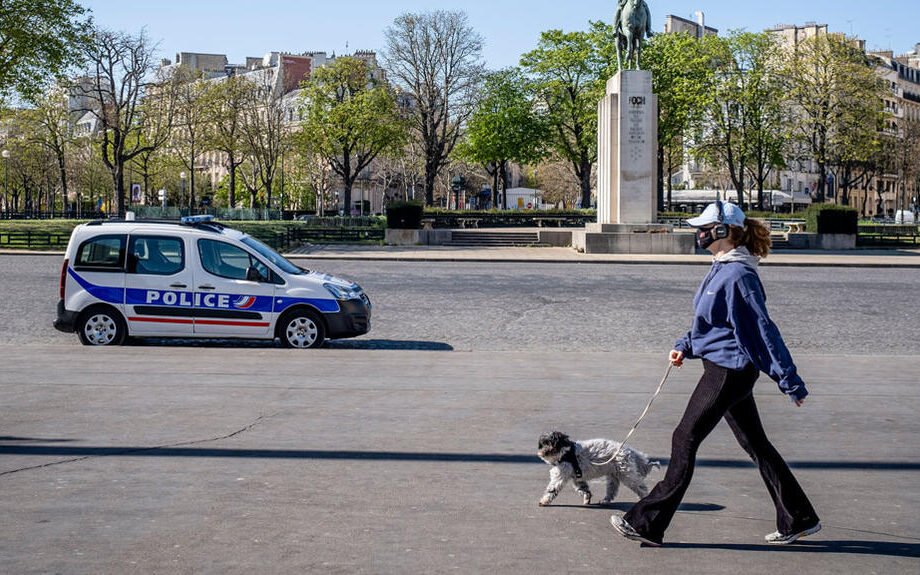 A near-deserted Paris street during lockdown, under the eye of a police car.
At last, an article from the CNRS that dares to look this period in the face — not from a public-health angle, but from a regulatory and policing one. And the figures it gives are staggering: 21 million checks in two months for a population of 67 million. In the Lot département, more checks than adult inhabitants. Public space emptied to the point where women alone were afraid to step outside into what had become, in the researcher’s own words, a “strange” outdoors.
What Nicolas Mariot — historian and sociologist, co-author of L’Attestation (Anamosa, 2023) — says precisely struck me: France did not adopt a harsher policy because the health risk was higher here than elsewhere, but because our authorities were used to managing populations through constraint rather than trust — and were coming out of the Yellow Vests crisis with a fear of a population deemed undisciplined. Unlike China, where restrictions at least tracked people’s actual health status, France imposed uniform confinement, blind to individual risk. It’s this lack of differentiation that strikes me as the real scandal — more than the word “dictatorship,” which I’d be tempted to reach for in the heat of the moment.
I lived this disproportion firsthand. Stopped twice: on the coastal path 150 metres from my house, because the prefect of Morbihan had ruled it “dangerous to health” to walk alone outdoors; and on the deserted beach at Fort-Bloqué, where I was alone for kilometres around, watching birds. Water sports banned even when you’re alone on the ocean. None of these prohibitions answered a real risk of contamination — they answered a logic of visible enforcement and punitive uniformity, exactly what the study documents at national scale.
The other point the article sheds light on, and one worth quoting precisely because it’s more unsettling than a simple moral observation: even at this level of control, never more than 50% of the population actually complied with the barrier measures. Fear of the virus alone, then, does not explain the mass obedience. What explains it, according to the researcher, is also a horizontal discipline: everyone’s concern that their neighbour not get away with the slightest privilege. That, I believe, is the key to the explosion of denunciations I witnessed myself on prefecture Facebook pages — not simply malicious informing, but a social mechanism of collective self-surveillance, as old as the crises of national unity (the researcher, a specialist of WWI, points this out himself).
What I take from this, as a citizen who lived through these absurd checks: no political official has ever had to answer for this regulatory and policing dimension of crisis management. Some were even redeployed, promoted. And research itself — aside from this belated 2024 work — stayed remarkably silent on the subject for four years, as the author himself notes, surprised that no French or European team had looked into it before him.
(On the 2021 ostracism of the unvaccinated, a distinct subject this article doesn’t address, I’ll come back to it separately — the two sequences of the crisis each deserve their own reckoning rather than being blended together.)
Source: Covid-19 : bilan d’une surveillance massive, interview with Nicolas Mariot, CNRS Le Journal, 10 April 2024.