The unvaccinated: what the state stopped me from endorsing, even having made the opposite choice
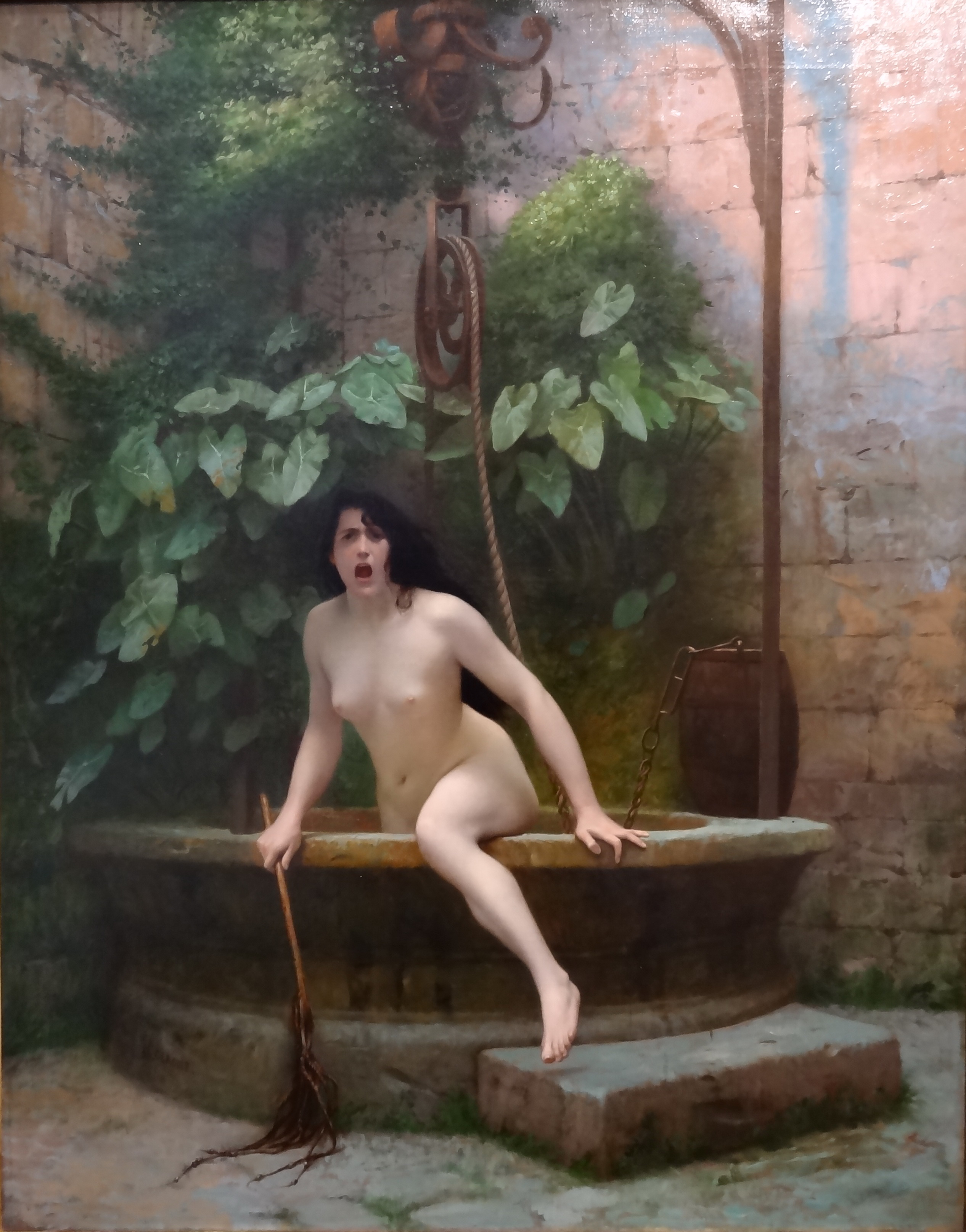 Truth Coming Out of Her Well Armed with Her Whip to Chastise Mankind, Jean-Léon Gérôme (1896) — Musée Anne-de-Beaujeu, Moulins.
I want to be clear on one point before anything else, because otherwise it will be thrown back at me as an easy accusation: I got vaccinated against Covid-19 in May and June 2021. Two doses, in the first months the vaccine became available to my age bracket. At the time, I thought it was an experimental product — mRNA technology had never been deployed at this scale, we lacked hindsight, and I knew it. I did it anyway. By choice. Because I weighed the risk, weighed the benefit, and decided, myself, for myself.
That is exactly why I don’t accept what followed. The principle that led me to accept that injection is the same one that forbids me from accepting that it be imposed on anyone else against their will: freedom over one’s own body isn’t something you negotiate à la carte, depending on whether the decision you make yourself is convenient for the collective. Either consent is a principle, or it’s just a formality withdrawn the moment it becomes inconvenient.
What France concretely put in place
On 4 January 2022, Emmanuel Macron told readers of Le Parisien: “the unvaccinated, I really want to piss them off [les emmerder].” He “fully” stood by these words three days later, at a press conference. The phrase wasn’t an isolated slip — it accurately described a policy already under way: a health pass since July 2021, then a vaccine pass from 24 January 2022, which removed the negative-test option and made vaccination de facto mandatory for access to restaurants, cinemas, theatres, gyms and long-distance trains1.
The Constitutional Council validated the scheme on 21 January 2022, in the name of a “balanced reconciliation” between health protection and individual freedoms. But the Ligue des droits de l’Homme, the Syndicat des avocats de France, Solidaires and the CGT brought before that same body an argument that remains, I think, the best summary of what was at stake: this text amounted to legalising discrimination based on health status, by handing unauthorised individuals — waiters, receptionists, ticket inspectors — a policing power over other people’s social lives2. France’s Defender of Rights, as early as 20 July 2021, was already warning about the risk of stigmatising unvaccinated children within their own schools3.
The double lie of the advertising campaigns
What perhaps shocked me most during this period wasn’t the legal constraint itself, but the way emotion was mobilised to make it acceptable. Vaccination of teenagers — opened on 15 June 2021 to those 12 and older — was officially presented on two registers: the individual benefit for the teenager, and the collective benefit of “protecting your loved ones” and reducing viral spread4. Santé publique France’s ads showed children jumping unmasked into their grandmother’s arms, with the tagline: “To see each other again tomorrow, let’s get vaccinated.”
The process amounts, in my view, to a double lie.
First lie: children were made to carry, through emotional pressure broadcast at prime time, the moral responsibility for their grandparents’ health — even as the National Consultative Ethics Committee itself, in its opinion of 8 June 2021, pointed out that minors were “little affected by severe forms” of the disease, and squarely raised the question of free and informed consent from children subjected, in practice, to considerable social and family pressure for a benefit that wasn’t their own5.
Second lie, more serious still: at the very moment families were being made to feel guilty with this argument, science was already starting to contradict it. A month before the CCNE opinion opening the way to vaccination of 5-11-year-olds on 16 December 20216, Günter Kampf documented in The Lancet that vaccinated people transmitted the virus at significant levels7. The causal link sold to families — vaccinate your child, save your grandfather — rested on a premise already undermined by the data available at the very moment it was being hammered home in prime time.
What science itself eventually said
Here is what strikes me as the most damning, in hindsight: the health argument meant to justify sidelining the unvaccinated collapsed under the weight of the very science invoked to defend it.
As early as November 2021, Günter Kampf published a piece in The Lancet with an unambiguous title: “Stigmatizing the unvaccinated is not justified”7. His argument: vaccinated people continued to transmit the virus significantly — viral loads comparable to those of the unvaccinated were measured in several clusters in the United States and Germany. Talk of a “pandemic of the unvaccinated,” as several Western leaders put it at the time, wasn’t just morally questionable: it was scientifically inaccurate. The virus made no such distinction; only policy did.
What sociology later measured
A study published in Nature in 2022, covering 15,233 people across 21 countries, documented something even more troubling: vaccinated people expressed discriminatory attitudes toward the unvaccinated as strong, or even stronger, than those usually directed at immigrants or people struggling with addiction — two of the classic targets of social prejudice8. The mechanism identified by the researchers is the “free rider” effect: the unvaccinated person perceived as benefiting from the collective effort without contributing to it. And the detail that stops me is this: this hostility was more pronounced in countries with high social trust and a strong culture of cooperation. In other words, it isn’t despite French civic-mindedness that ostracism was so intense here — it’s partly because of it: the same spring that pushes us to trust institutions pushes us to collectively punish those who step away from them.
A more recent study, run by Inserm on the EpiCov cohort (63,377 adults, published in 2026), offers an angle that’s almost the reverse of what we were sold at the time: it’s often discrimination already experienced — within the healthcare system, within public services — that predicts vaccine refusal, more than the other way around. Distrust of institutions preceded, for some of the unvaccinated, distrust of the vaccine. What was treated as a problem of ignorance was, for some of them, a logical consequence of an already damaged relationship with the state9.
What I take from this
I have no regrets about choosing to get vaccinated. But I recognise the difference between accepting a risk for oneself and imposing it on others in the name of a calculation that, we now know, was itself scientifically questionable. You can be right on substance — and I do think vaccination was broadly useful — and wrong on method. Coercion, social exclusion organised by law, stigmatisation encouraged from the very top of the state, guilt placed on children on the basis of an argument already on shaky ground: none of it proved necessary, and part of it didn’t even prove accurate.
Freedom isn’t measured by what we do when we agree with the majority’s decision. It’s measured by what we’re willing to defend for those who don’t.
(On the checks and the lockdown, a separate strand of this same period, see CNRS: a reckoning with mass surveillance.)
-
“The unvaccinated, I really want to piss them off,” Emmanuel Macron, interview with Le Parisien, 4 January 2022. See also the dedicated Wikipedia page for the full timeline of reactions. ↩︎
-
Decision no. 2022-835 DC of 21 January 2022, Conseil constitutionnel; submissions from the LDH, the SAF, Solidaires and the CGT filed on this occasion. ↩︎
-
Défenseur des droits, opinion no. 21-11 of 20 July 2021 on the bill relating to management of the health crisis. ↩︎
-
Santé publique France “Tous vaccinés, tous protégés” campaign, 2021; vaccination opened to 12-17-year-olds on 15 June 2021. ↩︎
-
CCNE, “Ethical issues relating to Covid-19 vaccination of children and adolescents,” opinion of 8 June 2021. ↩︎
-
CCNE and COSV, favourable opinion on vaccinating 5-11-year-olds subject to it being voluntary and non-coercive, 16 December 2021. ↩︎
-
Günter Kampf, “COVID-19: stigmatizing the unvaccinated is not justified”, The Lancet, 20 November 2021. ↩︎ ↩︎
-
Alexander Bor, Frederik Jørgensen, Michael Bang Petersen, “Discriminatory attitudes against unvaccinated people during the pandemic”, Nature, 2022. ↩︎
-
Study on the EpiCov cohort (Inserm/Drees/Santé publique France/Insee), 63,377 respondents, published in Frontiers in Public Health, 2026. ↩︎